
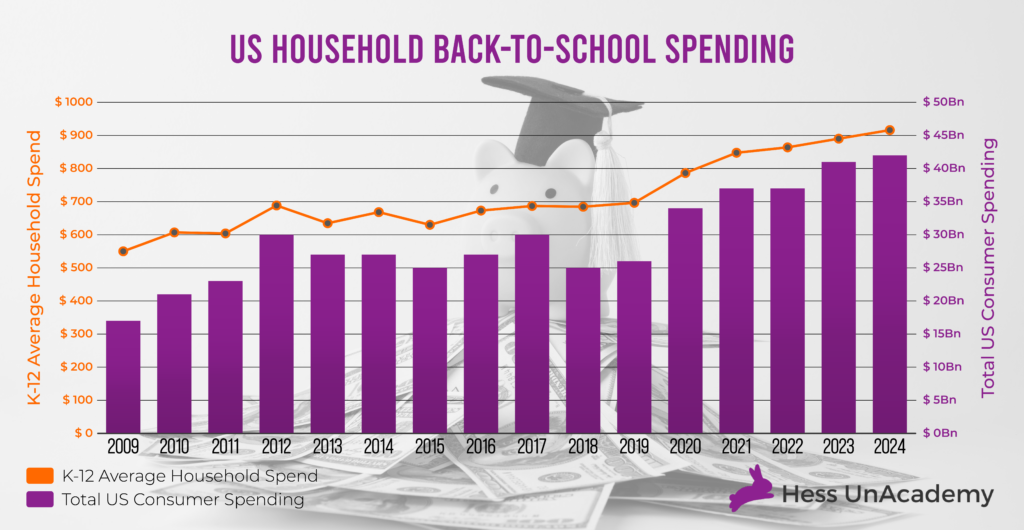
As summer break comes to a close, many families are already dealing with the financial fallout from summer camp fees and travel expenses — not to mention the ever-increasing cost of groceries, eating out, and well, everything — but now comes another dreaded expense: back-to-school shopping, which is expected to reach historic highs this year.
Our analysis shows that US families with K-12 students will spend an average of $918 on school supplies, clothing, and other related expenses. This is $28 more than last year’s $890 spend, and a new record high.


In total, US families are expected to spend about $42 billion as their elementary-to-high-school-aged kids return to school for the 2024-25 academic year.
To put it in perspective, just 15 years ago, the average family spent $549 on back-to-school shopping. If the costs had kept pace with inflation, families today would spend about $804 this year, but as our numbers show, that’s not the case. The shopping expense for the average family has gone up by over 67% since 2009, significantly outpacing inflation.
So, what gives?
While inflation certainly accounts for a big part of the increased cost of spending, the fact is that back-to-school shopping has gotten a lot more complicated than it used to be.

What was once a pretty straightforward process of buying new clothes and classroom supplies has now become a more elaborate and costly affair that includes high-tech gadgets (tablets, laptops, etc.) for students and a variety of products needed by teachers for their classrooms (teachers are already spending upwards of $800 of their own money on classroom supplies).
These extra items, frequently requested by underfunded schools, add additional financial burdens on families. It has become usual for teachers to request that parents help supply basic necessities such as extra pens and pencils, paper towels, cleaning products, and other essentials.
The expenses have become so substantial that a recent study by Intuit Credit Karma discovered that nearly half of all parents are having to temporarily pause essential household purchases, like groceries and bills, to afford the cost of school supplies.
Interestingly, Capital One reports that homeschooling parents tend to spend about 15% less on back-to-school shopping compared to other households. This is likely due to the different needs and environments of homeschooling, which may require fewer traditional school supplies and less frequent updates to tech gadgets.
Regardless, nearly all families are feeling the pinch of rising costs. In fact, two-thirds of back-to-school shoppers say that they’ve seen an increase in prices across the board for back-to-class items. This surge is hitting budgets hard, prompting families to seek out sales, use coupons, and prioritize needs over wants more than in previous years.


As families prepare for another school year, the rising costs of back-to-school shopping pose a considerable financial challenge. With spending reaching historic highs, what was once a routine seasonal expense has now become a substantial financial burden for American families.
- Love Languages in Learning: How Children Receive Encouragement Differently - February 2, 2026
- Valentine’s Day Ideas for Homeschoolers - January 25, 2026
- Parent Self-Care & Homeschooling: Why It Matters and 5 Simple Strategies - January 12, 2026
