



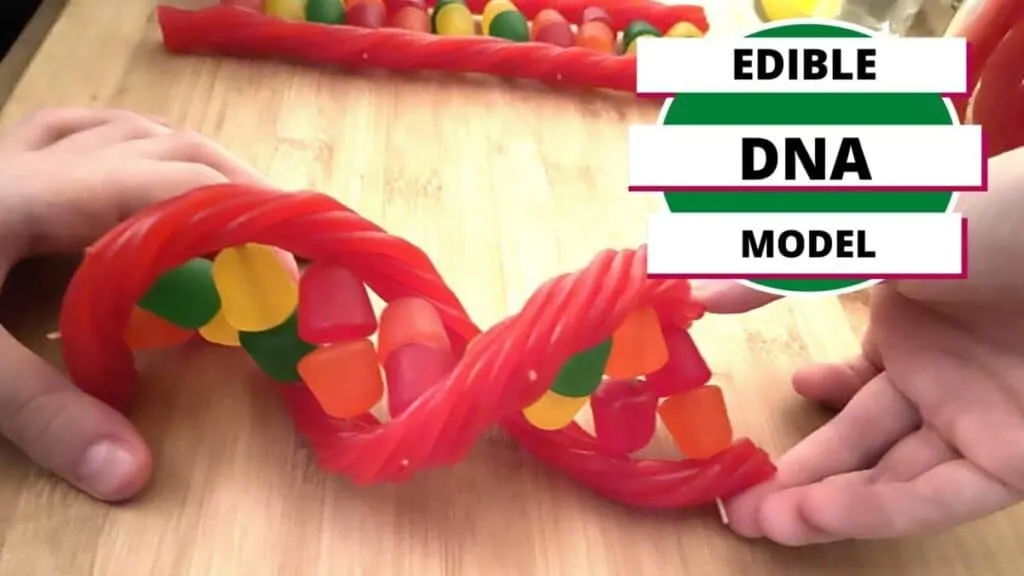
With a handful of different candies and a sprinkle of imagination, your little scientists will create their very own DNA models. It’s an edible, hands-on experience that will have their minds buzzing with excitement and curiosity.
Looking for an easy 3D DNA model project idea? Well, if your kids like hands-on activities that involve food, they are going to love this edible candy DNA model.


Homeschool parents and teachers, gather ’round as we embark on a scrumptious journey through the wonders of DNA – with a mouthwatering twist!
Imagine unraveling the mysteries of life’s building blocks not with test tubes and lab coats, but with colorful candies that are as delightful to the eyes as they are to the taste buds. Get ready to transform your kitchen table into a scientific playground where learning becomes an absolute treat.
You can use this edible science experiment to teach your kids about DNA, the double helix, and basic genetics. Take what you’ve learned and apply it to a science project (including a science fair project) or a fun STEM activity.
It’s a unique opportunity to understand the blueprint of life in a way that’s engaging and memorable. From budding biologists to inquisitive minds, everyone will have a blast crafting their candy DNA models while exploring the marvels of genetics.


STEM activities of all kinds are good to include in your lessons because they are so educational, versatile, and just downright fun! Hands-on activities are good for bringing some fun into your day, plus they are especially beneficial to kids who are kinesthetic learners. Actually, many learning styles can benefit from STEM activities like this because so many elements of learning are included.
Easy Navigation
The Science Behind the 3D Candy DNA Model
DNA [Deoxyribonucleic Acid] is the genetic blueprint of a life-form and it has the ability to encode and pass on the information on how to grow and maintain that life-form. In simpler form, DNA stores the recipe for the life or an organism.
This project is a fun alternative to the standard lesson about the structure of Deoxyribonucleic Acid. Having your kids create this model is not just a more child-friendly, easy-going way to teach this lesson, but it also helps them to truly appreciate the double-helix structure of DNA and the base pairs A-T and G-C within it!


This edible DNA model is assembled initially as a flat, 2-D diagram of DNA, then your children can twist the completed project to learn more about the double-helix shape in a 3-D version!
FUN FACT: Human DNA is 99.9% identical in each person you see, meet, or are involved with. Each human has a unique DNA sequence that makes all of us VERY different! How cool is THAT?!


Put down your textbooks and pick up the candy for this fun & educational STEM activity!


More About DNA and Genetics
DNA [Deoxyribonucleic Acid] is made up of certain molecules called “nucleotides”. Each of these nucleotides contains a PHOSPHATE GROUP, which contains a sugar group and a nitrogen base.

The Four Types of Nitrogen Bases are as Follows:
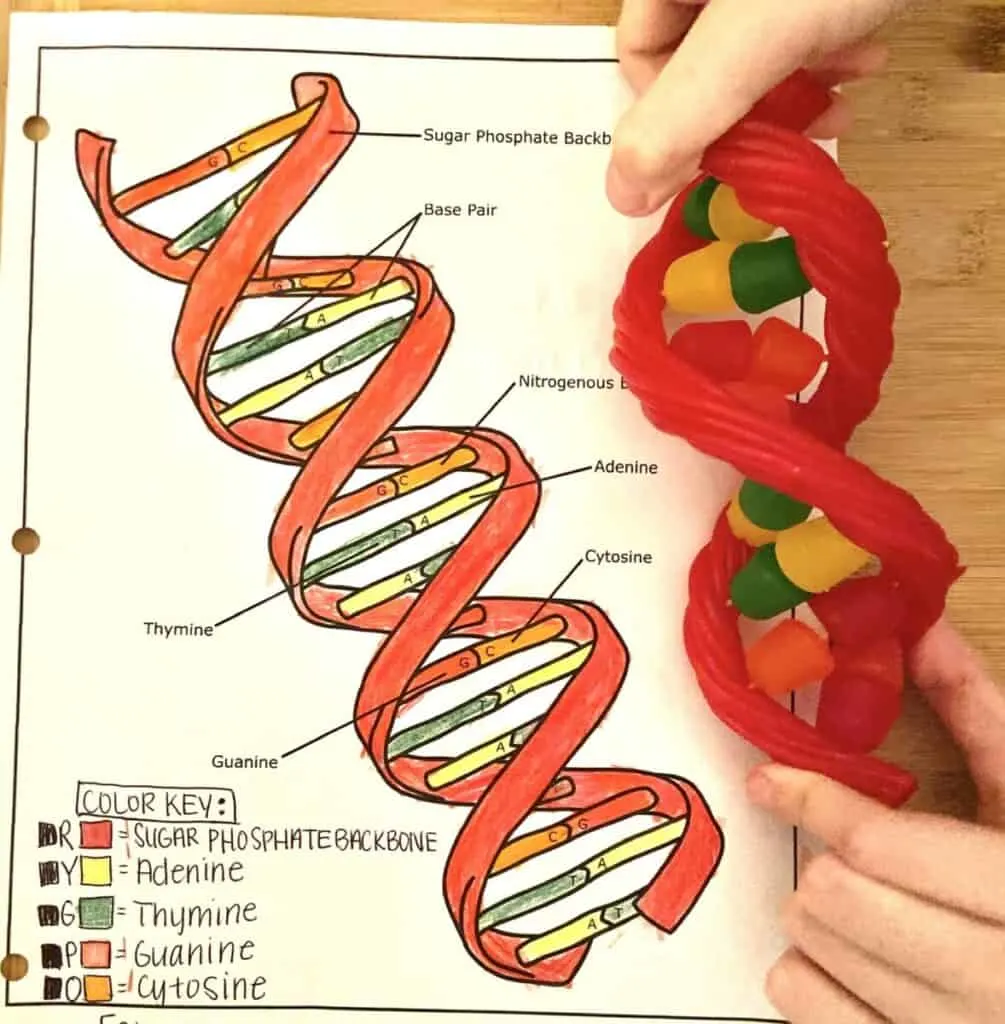
[A] = ADENINE [We used YELLOW Dots here.]
[T] = THYMINE [We used GREEN Dots here.]
[G] = GUANINE [We used ORANGE Dots here.]
[C] = CYTOSINE [We used RED Dots here.]
The order in which these bases are in determines the DNA’s genetic code, or instructions. Each string of amazing DNA carries these instructions called “genes”. Genes tell a cell how to make certain proteins that are used by the cell to grow and survive. These genes are also passed down from generation to generation.


Have you ever wondered why you might get told something like, “You look so much like your _______?” Why and how does this happen exactly? GENES are the answer!
There are Certain Base Rules:
ADENINE [A] & THYMINE [T] are always paired together.
GUANINE [G] & CYTOSINE [C] are always paired together.
This can easily be taught to your kids by assigning each one of them a certain colored candy and making sure to remind them of this fact before the start of the construction phase. The wooden toothpicks in this activity are used to show the binding forces!
Getting Started on this Fun DNA Project Idea
For this project, you might consider downloading the free DNA double helix worksheet.


Total time needed for this project is approximately 20-40 minutes.
- PARENT PREP TIME: 5-10 mins. [This depends on how particular you are about setting things up for your kids to separate their candy nucleotides and assemble their double-helix models themselves.]
- CHILD PREP TIME: 5-10 mins. [I had my oldest color a DNA double-helix worksheet, with matching colors of the candy that would be used to create his edible DNA Model beforehand. He and my toddler separated the colored candies into the four jars together.]
- TIME FOR DOING THE PROJECT: 10-20 mins. [Normally, I would lean towards the 10 minute assembly time, but with my kids “needing” to snack and swing the Twizzlers around “like a helicopter” or the random quick, yet floppy, “sword fights” that kept occurring, our assembly took about 20 minutes. Haha!]
- PARENT SUPERVISION: This truly depends on the individual ages and skill-set levels of your children, but here are my recommendations:
If you have younger, toddler-aged children, you might want to just hang out next to them for the duration of the project. If there’s a way to do something weird or dangerous with the toothpicks, they will find it. Trust me on this one. Safety first, guys!
If you have children that are in the early-elementary or late-elementary/middle school age ranges, they should really be able to do this on their own after some initial explaining and setup.
I would suggest that you have a little bowl of “excess snacking candies” that they can visit with while assembling their DNA models [I think it makes it more fun and they will be able to focus on the learning aspect of the project instead of sloppily putting it together quickly in hopes that that means they get to take it apart and eat it sooner.]
If they are in the middle-school and high-school age ranges, you can pretty much just give them the assignment, the supplies, and go fold that huge pile of laundry on your bed while they are constructing their edible DNA models. Once they’ve finished, you can have them show you their science projects and then go into some deeper questions and activities on the topic to show understanding before they can take it apart and eat it.
Skill-Set Notes for This Make-A-Model-Of-DNA Activity
- 2-4 AGED TODDLER: Great for Color-Sorting, Fine-Motor Skills, as well as Teamwork & Sharing [if there are siblings completing the project with them]
- EARLY-ELEMENTARY: While the actual concepts of DNA are considered to be fairly complex, you can still teach children in this range the basic nucleotide base pairings and discover the unique double-helix shape together. This is also an opportunity to start talking about the basic ideas of genetics.
- LATE-ELEMENTARY/MIDDLE SCHOOL AGED: Having an activity, like the DNA coloring worksheet I mentioned using earlier, along with some videos and activities on DNA & genetics earlier in the day before doing the project really helped to solidify the learning part before the fun of the candy was introduced for my oldest.
- ADVANCED/LATE MIDDLE SCHOOL/HIGH SCHOOL AGED: Just ask them to say “Deoxyribonucleic Acid” five times fast, give them a pop-spelling-quiz on it, throw the candy and other supplies at them, along with the basic instructions, then run away screaming, “Have Fun! Show me when you’re finished!” 😂
I’m joking, unless you want to. But for the most part, they really don’t need the assistance as much. I would, however, suggest having some questions and further exploration activities handy to go along with the lesson for these guys.
Candy DNA 3D Model Project Ingredients


- TWIZZLERS CANDY [Or some other type of long rope or licorice type candy]
- SOFT CANDY THAT COMES IN 4 COLORS [You need a candy that has at least 6-10 pieces each – we used DOTS but gum drops or something similar would work nicely. Colored marshmallows are also a good option.]
- WOODEN TOOTHPICKS
- 4 DIFFERENT CUPS OR BOWLS FOR SEPARATING THE SOFT CANDY [We used glass jars, and I even put the Twizzlers in one and had one for some “extras for snacking purposes”, but any bowls or cups would work here.]
A SOLID-COLORED SHEET OF PAPER OR CUTTING BOARD [This isn’t necessary, but I think it keeps things less distracting for the already excited kids. Haha!]
Project Instructions – Separating and Sorting


- You’ll want to separate your 4 colors of the soft candy into different cups or bowls. [My toddler was pretty pleased with himself after helping his brother with his project. 🥰 They both, of course, really enjoyed the random opportunity for the sweet treats, as that’s not usually a regular occurrence in our household. Haha!]
- Assign each of the colors a specific nucleotide. [If you chose to have your kids color the DNA model coloring sheet first, you could try to have these in corresponding colors to keep the consistency.]
Project Instructions – Constructing Your Base Pairs


- First, it is important to make sure that you remember which nucleotides are to be paired together and then put the two colored candy cups or bowls with their buddy before starting this step.
- Then choose the order for your base pairs and lay them out onto your workspace in the order you chose.
- Bring on the toothpicks! Start putting your soft candies on the toothpicks in sets of two, one on each end.
- Continue doing this until you’ve used all of the nucleotides you set up in your sequence pairs.
Project Instruction – Assembling Your 2D DNA Model


- Once you have the number of desired base pairs for your DNA model constructed, you may want to lay them out in the order you’re going to be attaching them to your “backbone pieces”.
- My oldest decided to make TWO separate models and laid them out in order on the cutting board with a Twizzler on either side.
- Then he started attaching the pairs to the backbone by shoving the exposed ends of the toothpicks into the Twizzler pieces until everything he laid out was used [While he did choose to attach both sides of the backbone with each pair before attaching the next one, I do wonder if it might be easier to do all attaching on one side first, and then add the other side?].
Project Instructions – Turning Your Edible DNA Model into a 3D Double Helix


- Now for the coolest part! Once you have your 2D model [or models] completed, compare them with your colored DNA model [if you chose to do this part].
- Then grab both ends of your model and slightly twist them in opposite directions to create YOUR VERY OWN DNA DOUBLE-HELIX!
- You can choose to talk more on this topic if you choose, or even do go over some of the questions and ways to take this lesson a step further below, or you can then place a napkin and a container down on the cutting board and let the kids go to town on disassembling their projects!

STEM Resources Delivered to Your Inbox Every Month

If you liked this edible STEM activity, you are going to love the STEM Made Easy Digital Subscription. Each month, you’ll receive 5 fully-planned STEM project guides along with worksheets and instructions for how to make them fun and engaging for kids ages 3-19. Check it out now!
- Love Languages in Learning: How Children Receive Encouragement Differently - February 2, 2026
- Valentine’s Day Ideas for Homeschoolers - January 25, 2026
- Parent Self-Care & Homeschooling: Why It Matters and 5 Simple Strategies - January 12, 2026
Judy Eason
Saturday 9th of April 2022
I'm trying to print out the article and instructions for the DNA project but it doesn't seem to work. Help!!
Charlene Hess
Wednesday 13th of April 2022
Click on the button to sign up for the free chapter sample and the printable instructions will be emailed to you :-)