


This article may contain affiliate links. Please see our disclosure policy for more details.


Try these Pine Cone Science activities with your kids, the perfect activities for winter fun!


Pine trees are a very common sight in North America and they’re beautiful to look at. This time of year especially, parents everywhere are looking for pine tree science activities for their kids that will engage them in seasonal learning adventures.
Have you ever wondered what the inside of a pine tree looks like? The answer is that it’s impossible to see unless you cut one open or use a microscope, but there is still some science we can do with pine trees on your own!
In this post, I’ll show you how to enjoy your own pine tree science activity with your kids – my kids love these activities! You can teach kids about the life cycle of a pine tree while also introducing them to the inner workings of a pine cone.
Easy Navigation
Pine Cone Science Experiments and Science Activities
First, let’s take a look at a few science experiments and science activities that involve pine cones and pine trees. Add these activities to your homeschool pine tree lesson plans and enjoy some hands-on learning with your kids. They are ideal for preschool/PreK, kindergarten, and younger elementary ages, but older kids might enjoy these projects as well.


And if you like these STEM activities, be sure to check out our other collections of STEM and STEAM activities for kids.
Pine Cone Science – Why Pine Cones Open and Close
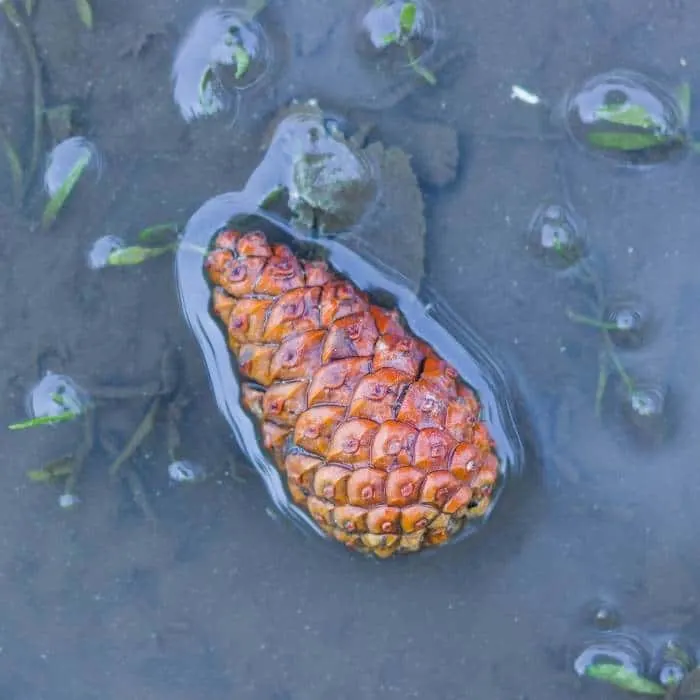
Did you know that pine cones open and close? In this pine cone science experiment, children will learn why pine cones open and close. All you need is a couple of pine cones, a couple of containers, and some water.
First, gather your pine cones. Try to gather three of the same type and similar size and shape.
Next, stick each of the pine cones in a container.
Finally, add cold water to one container and hot water to another. Leave the third container with nothing but air and the pine cone. Be sure to label each jar.


Observe what happens to your pine cones. You should see changes almost immediately! Make sure to write down your observations and then discuss why these changes occurred.

A Short Background on Gymnosperms
For older kids, take this discussion even further and talk about gymnosperms.

Gymnosperms are plants that have seeds that are almost completely unprotected. Rather than being protected by pods or fruits, gymnosperm plants have seeds that are exposed and merely carried until they are ready to be released. This is, in fact, one of the main differences between coniferous trees and deciduous trees (besides their type of leaves).
For more information on gymnosperms, check out education.com.
More pine cone science experiments and activities include measuring pine cones, seeing how long it takes to burn a pine cone, studying pine cones under a microscope, and making a pine cone mobile.
You could also enjoy some fun pine cone arts and crafts projects and make your own Christmas and holiday decorations! I’ll include some fun ideas at the bottom of this article.
Do you have any pine cone science experiments or activities that are not mentioned in this article? Please share them in the comments section below. We’d love to hear all of your ideas!


Many of the same rules that apply when doing science experiments with kids also apply when doing science activities with teens and adults. Whatever experiments you choose to conduct, be sure to follow the scientific process. Identify your problem or question, make your hypothesis, keep track of your materials and procedures, and record all of your data and conclusions.
For extra help, download my free scientific method worksheets here.
Learning About Pine Trees
Do you know what makes a pine tree so green and full of life? It’s the needles on top that help keep them cool all year round.
Why do pine trees have needles? To protect themselves from the sun! In this science activity, kids will get to learn how a pine tree’s needle helps it stay cool while also helping the tree to retain as much water as possible in cold and dry areas and seasons.
Pine Tree Life Cycle
What is the life cycle of a pine tree? How do pine trees grow?
The life cycle of a pine tree is very interesting and, as it turns out, very useful. The life cycle of a pine tree consists of several different stages:
Seed Germination – Pine trees start as seeds. When these seeds are planted, they will begin to germinate and eventually grow into seedlings. Seedling development continues as the seedling grows into a young tree.
Growth – Once the younger tree has grown to about 4-8 feet tall, it will begin to develop cones on its branches. The older trees will keep their cones longer, which allows them to produce more pine nuts for consumption by animals and people.
Maturity – After between 10 and 20 years, a pine tree reaches maturity. A mature tree can produce up to 300 cones in a year!
Dormancy – Once the cone production has slowed down and there are no more seeds to be produced, the cones will begin to dry out and eventually drop from the tree branches. This marks the end of the life cycle for that particular pine tree.
Parts of a Pine Tree
What are the different parts of a pine tree?
Pine trees have one main stem called the trunks. All of the branches, needles, and leaves come from this stem. The trunk is made up of different layers which include:
- Bark – provides protection for the wood under it
- Trunk – contains the wood and water
- Roots – help the tree take up water and nutrients from the ground
- Needles – help to protect pine trees from cold weather by reducing evaporation of water from their leaves. Needles are long, thin structures that consist of a midrib, a flattened stalk, and an array of branches from which other thin structures called leaflets
- Sprouts – new branches that grow when the whole tree is not very old.
- Pine Tree Cones – Cones are made up of scales that protect pine tree seeds.
- Seeds – small structures used for reproduction
- Branches – structures that grow from the trunk where the needles come out of,
Parts of a Pine Cone
What are pine cones? How do they work? Pine cones are made up of scales that protect pine tree seeds. The cone will open when it is mature and ready for reproduction, which allows the pine cones to spread their seeds around nearby areas.
The pine cone looks very different when it is open vs when it is closed. When the pine cone is open, you will be able to catch a glimpse of the seed and also the pine cone scales.
How Do We Use Pine Trees
How do we use pine trees? What are some of the uses for pine needles? Are there any other parts of a pine tree that we can use? These questions can be answered by learning more about the many uses of pine trees.
Pine needles are used to make tea, which provide a soothing and relaxing effect. The bark is also an important ingredient in some types of herbal remedies for coughs, colds, aches & pains.
Oftentimes, people use pine needles as bedding or insulation, especially people who are into homesteading or living naturally off the land.
The wood of the trunk is often used to make furniture like chairs and tables. The wood can also be used to make other household items such as crates and tool handles. If you raise small animals such as chicks or hamsters, you might have used pine shavings as a clean and sanitary bedding option.
Pine resin is a sticky liquid that comes from pine trees. It forms on the bark of the tree and hardens when it mixes with air and sunlight, and this substance is often used in chewing gum and adhesives like glue, postage stamps, and the adhesive on envelopes. Some people even use it to make varnish for paintings or cars.
Finally, people decorate for holidays such as Christmas with pine trees and branches.
Free Printable Pine Tree Investigation Activity Packet
Would you like an easy way to teach your kiddos about pine trees and pine cones? Why not try a free printable pine tree investigation activity packet?
This learning resource is the perfect addition to any of your pine cone or pine tree lesson plans. It would also be a great supplement for a winter nature study or a lesson on coniferous vs deciduous trees.
Inside this packet, you will find 6 pages worth of fun and engaging activities for your kids. Have them complete the pine tree life cycle page. Or encourage them to label the parts of a pine tree and of a pine cone.


Enjoy some more guided hands on experiments with your own pine cones using this packet. And finally, practice comparisons and measurements with a simple yet fun activity. At the very end, your kids will have a page that allows them to decorate their own paper Christmas tree. They’re going to love it!
Just imaging all that your kids will learn with one simple packet that you got to enjoy for free!
What are you waiting for? Grab your free Pine Tree Investigation Science and Learning Activity Packet now!
Why Are Pine Trees Used As Christmas Trees?
Have you ever wondered why pine trees are used for Christmas decorations, or if the real reason is different from the legend?
We all know that a pine tree smelled nice and has pretty needles, but did you know there was more to the story of how they became part of our celebrations?
Several thousands of years ago, Pagans used branches to decorate their homes around the winter solstice because these evergreen branches were bright and beautiful and reminded them of the promise of upcoming spring.
Over time, Pagans, Romans, and even more modern day Northern Europeans (by modern I mean 1000 or so years ago) brought fir trees into their homes to decorate for the new year and the upcoming new life, or even to just brighten up the home when all other plants were in hibernation mode.
More recently, Christians began using evergreen trees to decorate because the everliving, evergreen trees represented their everlasting life with God. Actually, this Christian tradition is credited to the Germans. Over time, people began decorating these trees with sparkling lights and natural resources (fruits, nuts, etc) until they evolved to become the holiday symbol they are today.
Read even more about the history of Christmas trees at history.com.
More Fun Pine Cone Crafts and Activities
Do you want to take your pine cone and pine tree lessons even further? Why not enjoy some pine cone crafts and art projects?
All around the world, children are enjoying making crafts with pine cones. This list includes projects where kids can paint, glue items to pine cones, create designs with markers or crayons, and more!
The great thing about arts and crafts projects such as these is they develop fine motor skills as well as problem solving skills in young learners, and they encourage kids to pay attention to detail. They increase creativity, they produce a sense of accomplishment, and they’re just plain fun!
And if you like these activities, check out our other collection of STEAM activities that involve arts and crafts.
Glitter Pine Cones
For this simple art project, your kids will need a pine cone, some glue, some paint, and some glitter.
This project can get really messy so keep that in mind when picking your location!
First, grab your pine cone. Paint it to your heart’s desire.
Next, add some glue (white Elmer’s glue works great) to the edges of your pine cone scales.
Finally, while the glue is still wet, roll your pine cone in glitter.
Leave it somewhere to dry and voila! A beautiful, sparkly decoration just for you!
Paper Plate Pine Cones
This is a fun craft where you and your kids can decorate paper plate pine cones together.
All you need are some glue, markers, and construction paper!
First, cut out a paper plate so that it makes a cone shape.
Next, have your kids decorate their pine cones however they’d like! Let them use markers or crayons to draw on the scales. They can also glue pieces of construction paper onto the plate in whatever design they’d like.
If you want, let them add some glitter when they’re done to make their pine cones shine.
Pine Cone Bird Feeders
This is a brilliant project that lets your kids feed their favorite birds while decorating them at the same time!
All you need are some pine cones, peanut butter, birdseed, and ribbon!
First, have your kid spread peanut butter on their pine cone. You’ll want to get a thick layer of peanut butter on there so the seed sticks.
Then have them roll their pine cone in birdseed. When they’re done, thread some ribbon through your pine cone and hang it outside!


Snowman Ornaments
This is an easy craft that lets your kids turn their pine cones into pretty snowmen to hang on the Christmas tree.
You’ll need a pine cone, some white paint, some googly eyes, felt, glue, and ribbon for this one!
First, have your kids paint their pine cone white.
Next, let your kids glue the googly eyes onto the pine cone.
Then they can cut out circles of felt (the size of the snowman’s mouth) and squares (for his buttons). Help them glue the pieces on in whatever way they want.
Finally, they can tie a pretty ribbon onto their snowman’s neck to give him a scarf!
These are just some of the fun pine cone crafts and art projects that kids enjoy every day all around the world. How do you like to use pine cones in your home? Let us know with a comment down below!
- Free Printable Valentine Multiplication Worksheets - June 4, 2025
- Free Printable Martin Luther King, Jr. Word Scramble - June 4, 2025
- Digital Math Curriculum | Pros, Cons, and Options - June 4, 2025