


If you like using awesome unit studies with your kids, you are going to love this fall unit study and free photosynthesis lesson plan for elementary kids.
As the days grow shorter and the weather begins to cool, many parents start to wonder how they can help their children learn about the changing of the leaves.


While some may think that this is a topic best left for science class, it can be a fun and interesting unit study for elementary-aged students when done correctly.


A Fall Leaves Unit Study is a great way to explore this topic in-depth. This article will provide you with all of the information you need to get started.
This article may contain affiliate links. Please see our disclosure policy for more details.
Easy Navigation
Why Do Leaves Change Colors?
As the weather gets chilly and the days get shorter, the leaves of deciduous trees begin to change color. While this may seem like a sudden and dramatic transformation, the process of leaf color change is actually a gradual one that begins in the summer.


While the exact shades may vary depending on the species, the overall effect is often a beautiful display of reds, oranges, and yellows. But why do leaves change color in the fall?


One of the reasons has to do with photosynthesis, the process that helps plants to create food from sunlight. During the spring and summer months, there is plenty of sunlight available for photosynthesis to occur. However, in the fall, the amount of sunlight begins to decrease. As a result, leaves produce less chlorophyll, which gives them their green color.
With less chlorophyll present, other pigments in the leaves are able to shine through, resulting in the vibrant fall colors that we enjoy each year.
What Is Photosynthesis?
Photosynthesis is a process that helps plants to convert sunlight into energy. In order to photosynthesize, leaves need two pigment molecules: chlorophyll and carotenes.
Chlorophyll is responsible for the green color of leaves, while carotenes produce yellow, orange, and red hues.


During the summer, chlorophyll is produced in large quantities as leaves use sunlight to create food for the tree. However, as autumn approaches and daylight hours grow shorter, photosynthesis slows down. As a result, chlorophyll production decreases and the green color of leaves begins to fade.
At the same time, carotene pigments become more visible as they are no longer masked by chlorophyll. The result is a beautiful display of yellow, orange, and red leaves that signal the arrival of autumn.

Children’s Books About Photosynthesis
Keep the learning going with these fun children’s books about photosynthesis! Add them to your fall unit study or your photosynthesis lesson plan adventures.



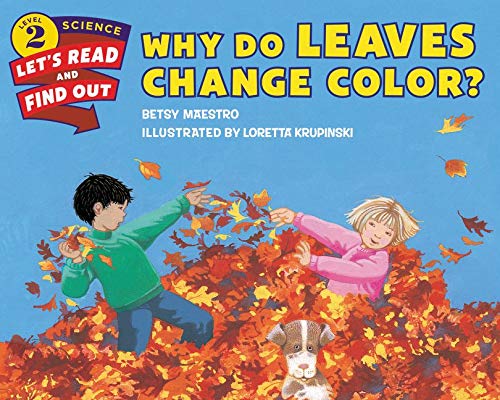
Tell me – what books would you add to this list?
Free Printable Leaf Cutouts
If you’re enjoying a photosynthesis unit study or lesson with your students, you’re going to want some leaf cutouts!




I created a few leaf cutouts for you to print out and use to enhance your studies. Just download, print, cut, and enjoy!
Click here to access the free printable leaf cutouts!
What Colors Do Leaves Change To?
Most leaves will change to a red, orange, or yellow color. While the exact shade may vary depending on the type of tree as well as the nutrients in the soil, these are the most common colors that you will see in the fall.
Some trees, such as maples and oaks, produce leaves with multiple colors. These leaves may have yellow, orange, and red hues all on one leaf.
The color of a leaf can also vary from one year to the next. For example, a leaf may be mostly yellow one year and then be mainly red the next.
This is due to a number of factors, including the amount of sunlight and moisture that the tree receives as well as the soil nutrients that are available.
When Do Leaves Change Colors?
The leaves usually start to change colors in September or October. The exact timing will depend on the type of tree as well as the location.
For example, trees in southern regions will often start to change color earlier than those in northern regions.

The changing of the leaves typically peaks in October and then starts to decline in November.
By December, most of the leaves will have fallen from the trees and the leaves that are still remaining will be brown.
What Causes Leaves to Fall Off Trees?
Once the leaves have changed color, they will eventually fall off the tree. This is caused by a process known as abscission, which is the natural separation of leaves from the tree.
As winter approaches, trees will begin to prepare for the colder months ahead. One way they do this is by producing a layer of cells at the base of each leaf stalk.


This layer of cells will gradually break down, causing the leaf to fall off. The process of abscission helps trees to conserve energy and resources as they enter into winter dormancy.
What Happens to Leaves After They Fall?
Once the leaves have fallen from the trees, they will begin to decompose. This is a natural process that helps to recycle nutrients back into the soil.
As the leaves decompose, they will be broken down into smaller and smaller pieces. Eventually, they will become part of the topsoil, where they will help to provide nutrients for new plants and trees.
Why Do Some Leaves Change Color Faster Than Others?
You may have noticed that some leaves change color faster than others. This is because the rate of color change is determined by a number of factors, including the type of tree, the amount of sunlight, and the temperature.


For example, leaves that are exposed to more sunlight will typically change color faster than those that are in shadier areas. Temperature can also affect the rate of color change.
Leaves that are exposed to cooler temperatures will often change color faster than those in warmer climates.
More Resources For Learning In the Fall
Are you looking for more fall learning resources? In addition to this color-changing fall unit study, we’ve got plenty of other ideas for you to explore!
- Corn Maze Unit Study
- Scarecrow Unit Study
- Brilliant Leaf Science Experiments
- Fall Math Activities for Preschoolers
Free Printable Photosynthesis Lesson Plan
Want to take a copy of the Photosynthesis Lesson Plan with you? I’ve got a 23-page unit study and lesson plan for you to use with your students!
You’ll get an easy-to-follow lesson plan (also seen below), information on photosynthesis and why leaves change colors (also seen above) and some brightly-colored visual aids to help with your learning adventures.
This lesson plan is ideal for homeschool and traditional schooled elementary students.
Click here to access your free printable Photosynthesis Lesson Plan and Unit Study!
Or keep reading to view the online version.
Conclusion
After completing this lesson plan, students should have a better understanding of the process of photosynthesis and why leaves change color in the fall. This knowledge can help students appreciate the natural world around them and understand how amazing trees are.
- Free Printable Valentine Multiplication Worksheets - June 4, 2025
- Free Printable Martin Luther King, Jr. Word Scramble - June 4, 2025
- Digital Math Curriculum | Pros, Cons, and Options - June 4, 2025