


These STEAM lesson plans can be used and adapted for any STEM activity. Just find a fun STEM project or challenge (such as this edible DNA model for example), print off these free STEAM lesson plans, and go through the prompts with your kids!
Never stress about having to come up with engaging and stimulating questions again! Now you can enjoy the STEAM activity of your choice and we’ll do the hard part for you.


So what are you waiting for? Get ready for a learning adventure your kiddos will never forget!
This article may contain affiliate links. Please see our disclosure policy for more details.
Easy Navigation
What Is STEAM?
STEAM stands for Science, Technology, Engineering, Art, and Math. It’s an educational approach that incorporates all five subjects into one learning experience.
Next time a student asks you, “What is a good STEM project?“, you’ll know exactly what to tell them!

The idea behind STEAM is that these five disciplines are interconnected in the real world and should be taught together in the classroom. This approach is designed to promote creativity, problem-solving skills, and critical thinking.
Why Teach STEAM?
There are many benefits to incorporating STEAM, via STEAM activities and lesson plans into your classroom curriculum. One of the most important is that it prepares students for the real world. In today’s society, it’s not enough to be good at one thing. Employers are looking for well-rounded individuals who are able to think critically and solve problems.


Another benefit of teaching STEAM is that it engages all types of learners. Some students are visual learners who prefer to learn through art and design. Others are hands-on learners who need to build or create something in order to understand it. And still others are auditory learners who benefit from hearing explanations and discussions.
A STEM education and STEAM lesson plans provide a way for all types of learners to engage with the material and learn in a way that’s best for them.
How to Teach STEAM
There are many different ways to incorporate STEAM into your classroom. One approach is to design projects that require students to use all five disciplines. For example, a project on designing a new park could incorporate science (studying the local ecosystem), technology (researching sustainable building materials), engineering (designing the layout of the park), art (creating a scale model or mural), and math (calculating the area of the park).


Another approach is to use an interdisciplinary approach in which students rotate through different stations, each with a different focus. For example, one station could be focused on science, another on technology, another on engineering, and so on. This allows students to delve deeper into each subject while still getting exposure to all of them. This can be done over the course of one day or a few days, depending your available time and learning space.
No matter what approach you take, the important thing is to make sure that each STEAM lesson is engaging and stimulating for your students.

What Is A STEAM Lesson Plan?
A STEAM lesson plan is a set of questions and activities that can be used to guide a learning experience in the different subjects of STEAM: science, technology, engineering, art, and math.


These STEAM learning lesson plans are designed to promote creativity, problem-solving skills, and critical thinking. They can be used with any STEM project or challenge, and are perfect for use in the classroom or at home via Google classroom or as part of your homeschooling adventures.
Free STEAM Lesson Plans | Adaptable For Any Project
We’ve created a set of free STEAM lesson plans that can be used for any STEM activity. Just find a fun STEM project or challenge, print off these free STEAM lesson plans, and go through the prompts with your kids!
These free STEAM lesson plans are adaptable for any project! No matter what STEM activity you’re enjoying today, from seasonal Halloween or July STEM activities to age-specific STEM challenges, include these lesson plans for a top-notch experience that’s easy too!
These lesson plans can be used for any age, from Kindergarten to grade school to high school.


Follow along with the online version below.
Or click here to access the free printable STEAM lesson plans.
Objectives
– To understand the basic concepts of STEAM and how they apply to today’s STEM project.
– To be able to identify examples of STEAM in their everyday lives
– To be able to identify how today’s STEM project can be applied in the real world.
– To learn about and appreciate different careers in the STEAM field today’s project can prepare them for.
– To be able to utilize and improve critical thinking and creative problem-solving skills.


Materials
– computer or tablet/phone
– internet access
– the STEAM activity of your choice
– scientific method worksheets (below)
– pencils
– notebook for each student
– whiteboard or easel
– markers or chalk
Scientific Method Worksheets – Free Download
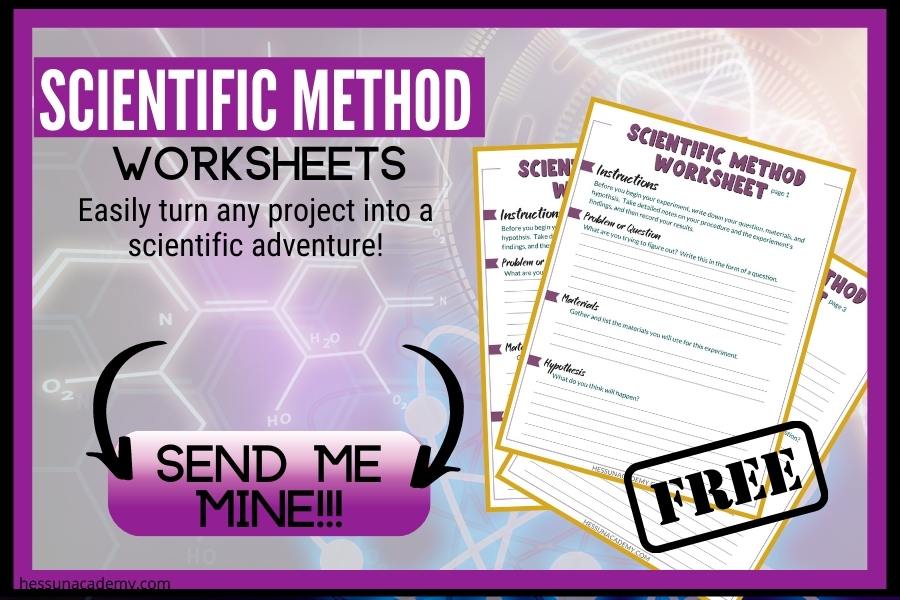
Before you move on, we’ve got some free scientific method worksheets for you to download and enjoy. These printable worksheets are useful for any science experiment, science project, STEM challenge, or STEM projects your students might be engaging in.
Turn every science project and STEAM activity into a thought-provoking STEM challenge. Plus give left brain and right brain kiddos alike a chance to utilize their strengths and improve their weaknesses. Get yours now!
Procedure
- Introduce the students to the concepts of STEAM and how they relate to today’s STEM project.
- Have the students identify examples of STEAM in their everyday lives.
- Follow the instructions for today’s STEM project or activity.
- If time allows, have the students complete the scientific method worksheet to document their process.
- Have the students identify which subjects from STEAM today’s project touched on. (science, technology, engineering, art, math)
- Have the students brainstorm various applications today’s STEM project could have in the real world. For example: A child builds a very tall structure out of colorful foam blocks. The child could explain that an engineer might design buildings or bridges using a similar engineering design process. The child could also explain how an artist might use color to create mood or feeling in their work. A mathematician might be interested in the shapes used in the child’s structure or in the patterns created by the colors.
- Discuss how today’s STEM project can help students prepare for future careers in STEM.
- Have the students brainstorm careers that would utilize the skills used today. For example: If students worked on coding for a robotics project, they could discuss careers such as computer programming, game design, app development, or computer science. Encourage kids to use their imagination and come up with answers that might not be obvious.
- If you included the scientific method worksheets in your project, discuss the results with the students.
- Wrap up the lesson by discussing what they learned through today’s experiment, entertaining STEAM projects and ideas, and answering any questions the students may have.
- If you decide to grade students, give grades based on participation and effort rather than correct or incorrect answers. (Since STEAM projects, lessons, and resources are typically open-ended, this is the best approach.)


Assessment
This lesson plan assesses students on their understanding of STEAM concepts and how they apply to today’s STEM activity. Students will be asked to identify examples of STEAM in their everyday lives, follow instructions for a STEM project, and identify the different subjects and disciplines from STEAM that were touched on by the project. Critical thinking and problem-solving skills will also be assessed and writing skills will be utilized.
Differentiated Instruction
Some students may need more guidance from homeschool parents or educators than others when it comes to identifying examples of STEAM in their lives. You may want to have a short ideas brainstorming session with the whole group to get them thinking or give them a list of possible examples to choose from.
If your STEM project involves a lot of hands-on work, you may want to provide some students with worksheets to help them document their process.
Some students may be interested in careers in STEM that weren’t mentioned in the lesson. Encourage them to do further research on their own and discuss what they find with the group.
Guided Practice
– How can STEAM help students in other subjects?
– What projects can students do to explore different aspects of STEAM?
– What careers can students pursue with a STEAM education?
– Have students research and write about a career in STEAM that interests them.
– Have students choose a project from another subject and find ways to integrate STEAM concepts.
– Have students create their own STEM project and document the process using the scientific method
– Do you know somebody who has a career in the STEAM fields you discussed today? See if you can take a field trip and observe them in action!


Reflection
– What was your favorite part of the project?
– What did you learn from this project?
– How could you improve your work on this project?
– What would you do differently next time?
– Would you like to try a similar project again? Why or why not?
Enrichment Activity:
1. Choose one of the STEAM concepts from today’s lesson and research it further.
2. Using a notebook or a piece of paper, write a report on your findings, including examples of how the concept is used in the real world.
3. Finally, present your findings to the group.
- Free Printable Valentine Multiplication Worksheets - June 4, 2025
- Free Printable Martin Luther King, Jr. Word Scramble - June 4, 2025
- Digital Math Curriculum | Pros, Cons, and Options - June 4, 2025