


Easy Navigation
Writing Short Stories In Our Homeschool
Do your kids spend their time making up stories?
Our kids are extremely creative and love coming up with new and exciting storylines in their free time/playtime. It’s so much fun to sit and listen to their antics while I’m feeding the baby or sorting laundry.


They’ll spend hours acting out these stories that they’ve created in their heads. Ben is always saying they should document these funny stories so people can read them someday!
Well, that day is today.


Short Story Writing In Our Homeschool
Before our homeschooling style bloomed into what it is today, we spent a lot of time trying to do traditional lessons with the kids.
One of the lessons my kids found least interesting was language arts. In fact, these kids find traditional language arts studies downright BORING.

They have zero interest in sitting still long enough to read or even listen to and a story or poem. It would take some creativity on my part to think of ways to get them to pay attention to a language arts lesson.
I’m not going to lie, even when we tried to follow a traditional homeschool schedule, language arts was not something we studied daily.
In fact, homeschool language arts lessons tended to pop up for a few weeks and then disappear again for a month or so before they’d reappear again.
(It’s not a wonder we stopped with the traditional curriculum based schooling, huh? Even I couldn’t handle it!)
But the fact of the matter is, whether you follow a more traditional homeschooling style or not, there are components of language arts that everybody needs to know. Such as reading and writing coherently.


And so I asked myself
How Can We Make Language Arts Interesting and FUN?
Let’s have some fun with language arts!

The kids are getting older. Although I’m not super concerned about following a public school’s curriculum, I do want to raise cultured children.
I want to raise children who are capable of making intelligent choices as they continue to grow and mature. And there are so many life lessons to be learned when you engage in short story writing.
It sounds a little overwhelming, but the kids are excited about it. It’ll be a fun adventure for sure!


Free Story Mapping Printable
If you want to get started on storytelling, creative writing is a great place to start. This free creative story mapping printable makes it easy to map out the entirety of your story.


Just go through the pages and fill them out. Before you know it, you’ll have a nearly complete story that just needs a little bit of fill in the blank!


Grab your free Creative Writing Story Mapping Printable now!
Brainstorming Our Short Stories
When writing short stories, the first thing you want to do is brainstorm.
What is your story about? What happens in your story? Where is the general setting? Is it fiction or nonfiction? Is it realistic or fantastical? Dangerous adventure? Mystery? Short and sweet?
Get your creative juices flowing here!
We did our brainstorming as a family so that the kids could bounce ideas off of each other.
We talked about what they wanted their main characters to look like.
Did their story take place in a world of talking animals? Was it about aliens on another planet? What did the aliens look like? Could the characters do magic or were they regular humans?
The setting of the story was also very key in deciding what the overall story would be about.
After all – if your story takes place on another planet in a galaxy far far away, then you have all the creative liberties in the world to come up with an incredible-looking alien!
But if your story takes place in a simple small town here on earth, your characters will be more ‘normal.’ Or will they?
The kids discussed the back story of their characters. The backstory is VERY important for any well-written story.
Ask any writer, and they will tell you that they spend HOURS coming up with a great backstory for their character – and most of the time, that backstory never really makes it into the book. But because the author knows where the character comes from, he is better able to follow the character through his journey.
So we talked about backstory and history. How did their characters come to be in their current state? (i.e. – why can the animals talk, and how did they come to be in their world?)
And so on

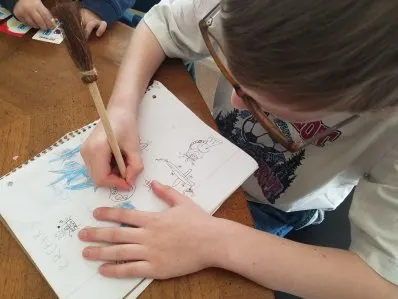
We will continue in this unit over the next couple of weeks, delving into the how-to’s of character development, the importance of setting and plot.
Spelling and sentence structure will be studied as we move on to editing. I’m not super crazy about grammar or anything. Things like adverbs and pronouns always went right over my head.
But the ability to form a complete sentence and speak like an intelligent human being will help the kids go a lot farther than if they sound like they’ve never read a book in their lives.
Art will, of course, be focused upon during the illustration section. Digital art is coming to be a very important part of the way our world works, but hand-drawn art is not necessarily an archaic form just yet.
Some of our kids have decided they want to draw their pictures, and some have decided they want to learn how to make 3D digital art for their books. All these choices are fine by me!
It will be a fun adventure, and one that the kids are very excited about. By the end, we should have a couple of well-written children’s stories, and a couple of more-cultured children. Should be fun!

Related Posts:
Storytelling How-Tos for Beginners
Writing Short Stories In Our Homeschool
- Free Printable Valentine Multiplication Worksheets - June 4, 2025
- Free Printable Martin Luther King, Jr. Word Scramble - June 4, 2025
- Digital Math Curriculum | Pros, Cons, and Options - June 4, 2025