


This article may contain affiliate links. Please see our disclosure policy for more details.

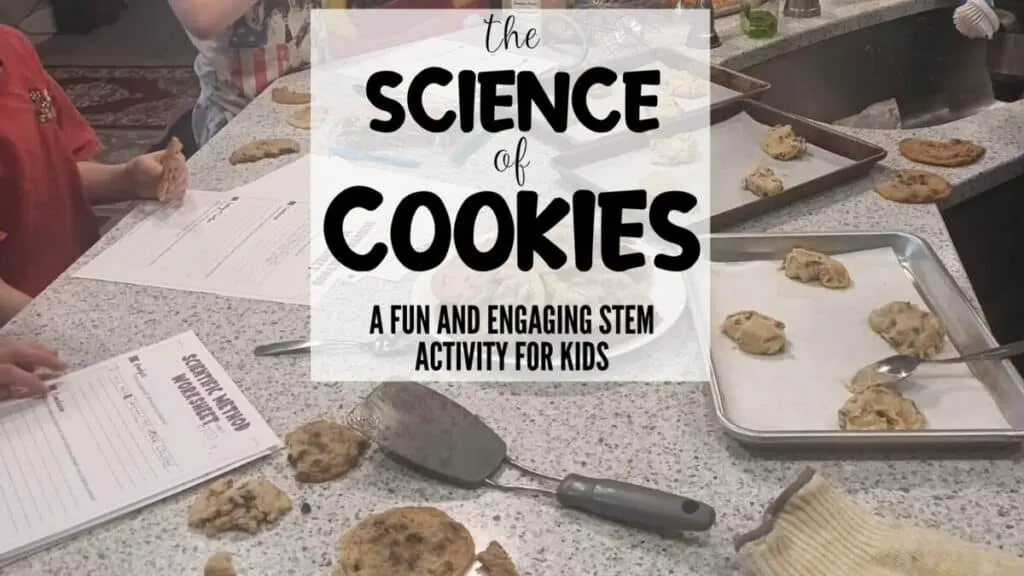
One of the best parts about homeschooling is the flexibility to enjoy hands-on STEM activities anytime you like. This science of cookies science experiment is a fantastic STEM activity that your kids are absolutely going to love!


It makes a bit of a mess and it takes several hours, but trust me, your kids will remember this day and the lessons they learned for a very long time. Mine sure did, and it’s one of their favorites for sure!
Easy Navigation
About the Science of Cookies Science Experiment
The purpose of this STEM activity, besides having a ton of fun and eating delicious cookies, is to help your students learn about different ingredients and how they change and interact with an overall cookie recipe.
Students will use basic cookie recipe ingredients to test and experiment. How does each ingredient affect the cookies in flavor, texture, etc.? Does amount or even consistency of the ingredients affect the cookies?
Students will be able to make multiple versions of the same recipe and learn the science and chemistry behind each ingredient. Then they will get to enjoy the fruits of their labors.


Love this project idea? You can even use it as a full-on cookie science fair project! And it’s a great Christmas STEM activity!
Tools Needed for This Activity


- A cookie recipe. We used the chocolate chip cookie recipe from the bag of chocolate chips but any basic cookie recipe will do.
- Ingredients found on recipe along with any ingredients you plan on experimenting with. In our case, this was flour, white sugar, brown sugar, baking soda, baking powder, softened butter, melted butter, salt, vanilla, eggs, and chocolate chips.
- Kitchen with oven
- Mixing bowl, spoon, measuring cups, measuring spoons, baking sheet, etc
- Observant eyes
- Paper and pen for writing observations and altering recipes
- Scientific Method Worksheets (below)
Scientific Method Worksheets – Free Download
Before you move on, we’ve got some free scientific method worksheets for you to download and enjoy. These printable worksheets are useful for any science experiment, science project, STEM challenge, or STEM projects your students might be engaging in.
Turn every science project and STEAM activity into a thought-provoking STEM challenge. Plus give left brain and right brain kiddos alike a chance to utilize their strengths and improve their weaknesses. Get yours now!
Initial Prep and Set-Up
- Pick a chocolate chip cookie recipe you want to experiment with. We used the one on the back of the chocolate chip package.
- Pick a few ingredients you want to experiment with, based on the age of your child. Youngest children can test 1 maybe 2 recipes, oldest students should be able to test 4 or more. Some examples of things to experiment with include but are not limited to:
- Baking powder vs baking soda
- Consistency of butter
- Ratio of brown sugar to white sugar
- Temperature of eggs
- Creaming sugars and butters vs just mixing all ingredients together at once
- Using salted butter vs unsalted butter
- Using other fats instead of butter (oils, etc)
- Measuring methods – sifting, ‘liquid’ measuring cups, ‘dry’ measuring cups, weighing ingredients, etc
- Other add-ins (M&Ms, flavored chips, oatmeal, nuts, etc)
- Different types of flours (potato, wheat, half and half, rice, gluten-free, etc)
- Egg whites vs egg yolks

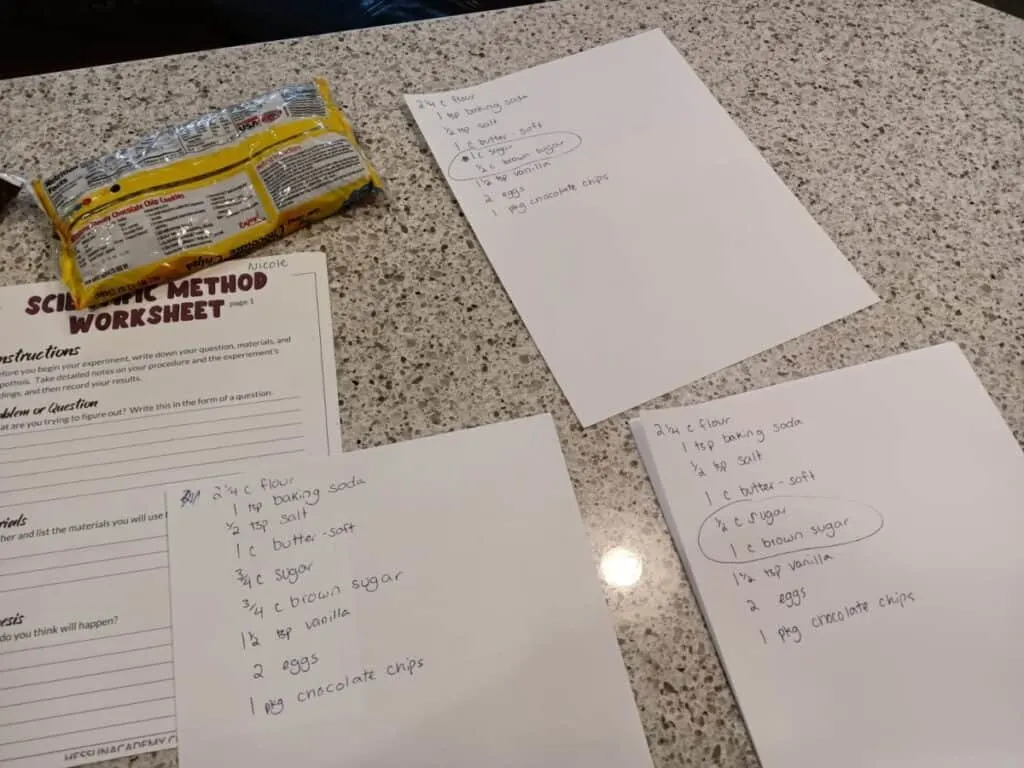
IMPORTANT – be sure whatever changes you make, you only change one thing at a time and you ALWAYS have a ‘control’ recipe. Otherwise your scientific method will be ruined and you will not be able to determine what affected what.
- Write altered recipes down and label them
- Gather needed ingredients for each recipe
- Write down your hypothesis as to what you think will happen with each recipe.
Making Your Cookies
- One recipe at a time, mix and bake your cookies. For easier cleanup, we suggest using parchment paper on your cookie sheet.
- Observe cookie doughs side-by-side and make note of differences in flavor, color, texture, etc.
- Observe finished cookies side-by-side and make note of differences in flavor, color, texture, baking time, etc.
- Write down your observations and conclusions
Finishing Up the Project
- Discuss the science behind each included ingredient. What do you think made each dough and cookie behave the way it did?
- Write down your conclusions.
Follow up Questions
- Which recipe did you like best? Which was the worst?
- What happened to make each cookie behave the way it did?
- If you could create your own ideal recipe, or the perfect chocolate chip cookie, what would you include?


The Science Behind This Experiment
While art is a huge part of cooking, baking involves a lot of science. Your kids will become better at baking when they understand the science behind how each ingredient works in relation to the rest of the recipe.


For example –
Baking Soda
Baking Soda – Baking soda is also known as bicarbonate of soda or sodium bicarbonate. Baking soda is a base. This is why when you mix it with vinegar, the result is a bubbling explosion.

When a recipe (cookies, cakes, etc) calls for a base such as baking soda, there is typically going to be an acid of some kind involved. In the case of cookies, the acid is the brown sugar.
The baking soda reacts with the acid and creates carbon dioxide which makes the item rise. This is why cookies with baking soda are fluffier and chewier than cookies without. However, you must be careful not to use too much baking soda as if you have more baking soda than you have acid, the result will be a bitter flavor.
Baking Power
Baking Powder – Baking powder is actually a combination of baking soda and cream of tartar (which is an acid). When baking powder gets wet, it begins its activation process which means if you let a dough sit wet for too long it will no longer rise upon baking.
Baking powder already contains an acid and a base so it is typically used in a recipe that does not have another acid. When it is used in a recipe with other acidic ingredients, it tends to result in flat and browned cookies rather than fluffy.
The ratio of acids to bases in your recipe will determine if you want to use baking powder, baking soda, or both.


Softened Butter
Softened butter – Butter is used in baking partly to add moisture but also to add texture. When the butter in the recipe is heated, it releases steam that helps in the leavening or rising process.
This is why pastries require cold butter – they will release the most amount of steam and thus end up being the flakiest thanks to little pockets of air. Softened butter is popular in cookies because it holds its shape and allows the butter to add air to the sugars during the ‘creaming’ process which results in fluffier cookies.
If your butter is too warm, it will not be able to hold enough air and your cookies will be flat.


Melted Butter
Melted butter – melted butter will provide moisture and flavor without adding extra air pockets. It is perfect for cakes, muffins, etc.
Brown Sugar vs White Sugar
Brown sugar vs white sugar- Brown sugar is acidic which makes it work well with baking soda recipes. White sugar is a neutral ingredient that, while adding sweetness, will not overpower a recipe flavor-wise.
Brown sugar contains more moisture than white sugar resulting in moister cookies. However, it cannot hold air pockets as easily as white sugar so if you use too much brown sugar, your cookies, though chewy, will spread out more.
The overall texture and spread-a-bility of your recipe will not be determined by sugar alone but also by other ingredients and how they work together. But in the case of chocolate chip cookies, more brown sugar = chewier cookies and more white sugar = fluffier cookies.
The science goes on and on, depending on the ingredients you choose to use. Using books and the internet, feel free to research your own ingredients even more.
Tips and Tricks
Follow these tips to ensure you have the best experience possible.
- ALWAYS make sure you have a base or control recipe so you have something to compare each recipe to.
- To protect the integrity of the experiment, only change one thing at a time in each recipe
- If using softened butter, get your butter out at least an hour beforehand to protect the integrity of the experiment.
Follow Up Questions
During or at the end of your project, ask your kids the following questions. Engage in discussions that will help the lessons really sink in.
- Which recipe did you like best? Which was the worst?
- What happened to make each cookie behave the way it did?
- If you could create your own ideal recipe, what would you include?
Ideas for Taking the Learning Further
Follow these ideas for taking the learning even further. Take the project from an afternoon to an entire week-long adventure!
- Have your kids describe their ideal cookie. What does the perfect cookie consist of? What would they need to change about their recipe in order to achieve the perfect cookie?
- Middle school and high school students can create and write down their own ideal cookie recipe and then make the cookies. Did their cookies turn out the way they intended them to?
- Using the science learned in this activity, encourage older students to experiment with or even create their own recipes of other kinds. Cakes, muffins, etc. You’ll have your own inventive chefs on your hands in no time!
Free STEM Project Guide Download

Want a free sample STEM project guide? Sign up to have one sent to you so you can see exactly what to expect from the STEM Made Easy Digital Subscription. Just click the button below!
Or read more about the other STEM Made Easy Digital Subscription here. Each month includes 5 STEM project guides along with instructions for how to make them fun and engaging for kids ages 3-19.
More STEM Posts You Might Like
If you like this STEM activity, check out these other articles:
- Edible Science Experiments
- STEAM Activities for Middle School Students
- STEM Activities for Elementary School Students
- Free Printable Valentine Multiplication Worksheets - June 4, 2025
- Free Printable Martin Luther King, Jr. Word Scramble - June 4, 2025
- Digital Math Curriculum | Pros, Cons, and Options - June 4, 2025
Steff
Monday 30th of September 2024
This is such a fun idea! Thank you for sharing. Our 13yo Daughter loves to bake and loves all things science. We are looking forward to doing this project.