



Are you looking for an activity that will showcases the layers of the ocean for kids? We’ve put together a free ocean zones in a jar STEM activity that’s educational, fun, and easy to get started!
Immerse your homeschool or classroom environment in the ocean’s wonders with this engaging and educational activity.


Whether dedicating an entire week to an ocean-themed curriculum or just looking to incorporate fascination with the sea into your regular lessons, this hands-on STEM activity is a fantastic way to teach the layers of the ocean to kids.
It provides children with a vivid visualization of the vast and mysterious ocean and shows a look into its fascinating layers and how ocean zones are formed.
Understanding these concepts is enriching and crucial for appreciating the significance of our oceans in the context of our planet’s health and well-being.
In this article, we’ll explore this engaging ocean zones in a jar activity and talk a bit about why it’s essential for children to delve into the depths of ocean knowledge.


Easy Navigation
Free Ocean Zones in a Jar Printable Project Guide
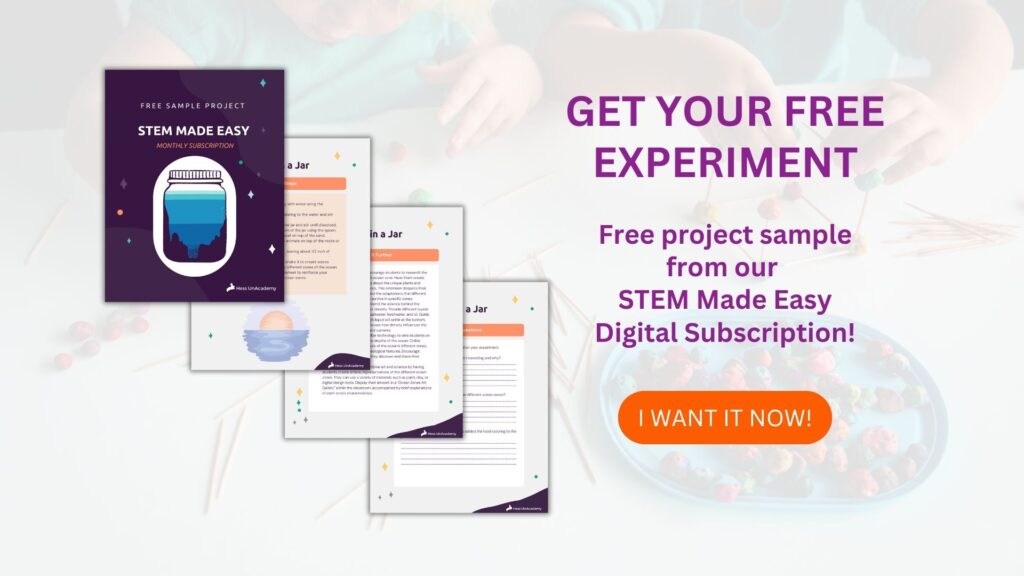
If you’d prefer to get a printable guide for this project that includes helpful visuals, just click here and you can get the project pack delivered straight to your inbox right now!
Ocean Zones in a Jar Project Materials
To demonstrate ocean zones, you’ll need a few different materials readily available in your kitchen and around the house.
- Rubbing alcohol (1/2 cup)
- Cooking oil (1/2 cup)
- Water (1/2 cup)
- Dish soap (1/2 cup)
- Corn syrup (1/2 cup)
- Food coloring in shades of green, blue, and red to represent various ocean depths.
- Large clear jar
- Funnel
With these easily accessible materials, you can craft an engaging visual aid to help learners comprehend the layered complexity of ocean zones.
How to Create the Ocean Zones in a Jar
Place a large clear jar on a table to assemble your ocean zone model.


Blend drops of blue and red food coloring in a bowl with corn syrup until it achieves a deep black hue. Carefully use a funnel to pour this mixture into the jar, forming the Trench Zone.
Combine red and blue food coloring with dish soap in another clean bowl to create a rich purple shade. Use the funnel to introduce this purple dish soap layer into the jar, signifying the Abyss Zone.

In a separate bowl, add green food coloring to water until it becomes a dark green hue, then use the funnel to add this layer to the jar, representing the Midnight Zone.
Mix blue food coloring into cooking oil in another bowl, giving it a deep blue tint. Introduce the blue cooking oil layer with the funnel into the jar, symbolizing the Twilight Zone.
In a different bowl, add just a single drop of blue food coloring to the rubbing alcohol, turning it into a light blue shade. Carefully pour this light blue layer into the jar, minimizing mixing with the other layers, representing the Sunlight Zone.
Finally, be sure to label each zone for clarity and take the time to observe the distinct layers created within the jar. This will vividly illustrate the ocean’s different zones and their unique characteristics.
After building your ocean model, encourage kids to draw and color the distinct layers, reinforcing their understanding of the ocean’s structure.


Additionally, dive into the fascinating world of marine biology by explaining the types of organisms that thrive at each level, from the vibrant Sunlight Zone, where photosynthetic organisms harness sunlight, to the mysterious Abyss Zone, inhabited by unique and often bioluminescent species adapted to extreme conditions.
Exploring the diverse life forms in these zones enriches children’s comprehension of ocean ecosystems.
This multifaceted approach enhances their scientific knowledge and fosters a deeper appreciation for the complex and fragile marine environments vital to our planet.
Adapting the Project to Match Different Depths of Student Understanding
As you plan this activity that highlights the layers of the ocean for kids, there are some tweaks you can make to adjust this project to whatever age group you’re working with.
Preschool (ages 3-5)
At this stage, children can actively engage in the activity with some assistance from a parent or guardian. They can participate in pouring and keenly observe the formation of layers, enhancing their sensory skills.
Introduce the concept of the ocean, emphasizing its vastness and the idea that it’s a large body of saltwater.
Also, highlight their habitats by introducing a few simple and colorful ocean animals like fish, dolphins, and turtles.
Check out our preschool STEM activities guide for more project ideas for this age group.
Early Elementary (ages 6-8)
As students enter early elementary school, they become more hands-on. They can actively contribute by mixing liquids, carefully pouring them into the jar with a funnel, and even labeling each zone for clear identification.
Teach about the world’s oceans, emphasizing the names of the major oceans (e.g., Pacific, Atlantic) and their locations on a world map or globe.
Simplify the ocean’s layers, explaining the surface, twilight, and deeper zones in easy-to-understand terms.
Check out our elementary school STEAM activities guide for more ideas for kids this age.
Upper Elementary/Middle School (ages 9-12)
In this age group, students are ready to grasp more comprehensive concepts like density and layer formation. They exhibit increased independence and can manage the experiment steps with minimal guidance, showcasing their growing scientific abilities.
Dive deeper into ocean zones, explaining each one’s characteristics, inhabitants, and unique features, including the Midnight and Abyss Zones.
At this age you can also introduce the concept of ocean currents, discussing how they affect climate and marine life.
Check out our middle school STEM activities guide for more ideas for kids this age.
High School (ages 13-18)
High school students, with their advanced knowledge, can successfully conduct the experiment and delve into the scientific intricacies behind the layering of liquids. Encouraging them to explore deeper scientific explanations can further enhance their understanding and analytical skills.
Provide more in-depth knowledge about oceanography, including studying the ocean’s physical, chemical, geological, and biological aspects.
This age also allows kids to explore the intricate relationships within marine ecosystems, discussing food chains, symbiotic relationships, and the importance of biodiversity.
Take it one step further and discuss ocean-related environmental issues such as ocean pollution, overfishing, and coral reef conservation, fostering a sense of responsibility toward ocean stewardship.
Check out our high school STEM activities guide for more ideas for kids this age.
What are the Zones of the Ocean?
The Sunlight Zone is the topmost layer of the ocean and extends from the surface down to about 200 meters. In this zone, sunlight penetrates, allowing for photosynthesis to occur. It is home to a rich diversity of marine life, including plankton, fish, and large predators like sharks and dolphins. This zone is where most of the ocean’s primary productivity occurs, making it vital to the marine food web.
The Twilight Zone begins at around 200 meters and extends to about 1,000 meters below the surface. Here, sunlight becomes increasingly scarce, resulting in a dimly lit environment. Organisms in this zone are adapted to low light conditions and include bioluminescent creatures that create their own light. Predators like squid and lanternfish are common inhabitants of the Twilight Zone.
The Midnight Zone stretches from about 1,000 to 4,000 meters deep. It is almost entirely dark in this zone, and the pressure is intense. The life forms found here have unique adaptations, such as the ability to withstand extreme pressure and minimal light. Animals like giant squids and deep-sea fish are well-suited to this challenging environment.
The Abyss Zone begins at around 4,000 meters and extends to about 6,000 meters. It is one of the least explored areas of the ocean. Despite extreme cold and pressure, life exists here, including various species of sea cucumbers, brittle stars, and other invertebrates. Adaptations in these creatures allow them to thrive in this forbidding environment.
The Trench Zone is the deepest part of the ocean, typically starting at around 6,000 meters and reaching the deepest oceanic trenches. This zone is characterized by immense pressure and complete darkness. Unique organisms like deep-sea amphipods and extremophiles that can withstand extreme conditions call this zone home. It represents one of the most extreme and mysterious environments on Earth.
Why is Learning About the Ocean Important?
Learning about the ocean is crucial for homeschool students because it opens a window into understanding the Earth’s interconnected systems.
It also introduces the ocean’s vital role in our planet’s health. It provides insights into climate regulation, weather patterns, and biodiversity.
Ocean education instills environmental stewardship by highlighting the significance of preserving and conserving this vast and fragile ecosystem. This empowers students to become informed global citizens who can contribute to protecting our oceans, ensuring a sustainable future for generations to come.
Get STEM Project Guides Delivered to Your Inbox!
If you found this DIY STEM activity to be fun and exciting, dive deeper with the STEM Made Easy Digital Subscription. Every month, you’ll gain access to five meticulously planned STEM project guides. These guides come complete with worksheets, supplemental resources, and detailed step-by-step instructions, designed to make learning educational and entertaining, catering to learners of all ages.
More STEM Guides
- Educational Board Games Collection
- Homeschool STEM Curriculum
- Valentine’s STEM Activities
- The Best Online STEM Classes for Kids
- STEAM Art Project Ideas
- Edible Science Experiments
- STEAM-Based Homeschooling
- How to Teach Telling Time to Kids: 17 Fun Activities - June 4, 2025
- How to Make an Amazing Homeschool Morning Basket (Complete Guide) - June 4, 2025
- Free DIY Anemometer STEM Activity for Kids - June 4, 2025