


This article may contain affiliate links. Please see our disclosure policy for more details.

This is the perfect chore system and has been working wonders in my family for years. The free chore point system for kids is the best way to get them to want to work.


Here at Hess UnAcademy, we not only homeschool, we also teach kids life skills with a free chore point system.
Teaching kids life skills such as cleaning, cooking, laundry, gardening, and so on, are important for ensuring kids are able to stand on their own two feet when they finally grow up and move away.
Unfortunately, it can sometimes be overwhelming to try and teach kids all these skills.
The good news is, there is plenty of good advice to be gleaned from friends, family, and online experts.


Easy Navigation
Teach Life Skills For Kids with a {FREE} Chore Point System For Kids
Today I am going to share with you something big.
This trick is something our family has been implementing for around 8 years now with amazing success.
I have never shared this secret before, but today is the day. Today I share with you the secret to our household success: the reason behind 7 kids who are (almost) always happy and willing to help with the chores. The secret behind our lack of screen time fights.
Your challenge, should you choose to accept it, is to get your entire household running smoothly and efficiently, with minimal effort from you.
This one house rule will change your lives. And today, I’m going to share with you the secret.


Funnily enough, this secret is really no big secret. I merely took a success principle that many successful adults build their lives upon, and simplified it so that my own children could understand it. So even though this may seem like a great big secret or an incredible life hack, it’s really just a principle for success that is taught in hundreds of success books already.
And today, not only am I going to share this success principle with you, I am going to teach you how to share this principle with your own family so that you too can get your children started now on this pathway to success.



Is Giving Kids Anything They Want Bad?
What is the ONE house rule for kids that has changed my life?
You can do anything you want – but you have to EARN it.
You read that right. I say yes to just about everything my kids ask. BUT they have to EARN it first.
DISCLAIMER: (Now we are a religious family with a very strong moral base. The kids know right from wrong according to our religious beliefs and they know that going against these core, moral beliefs is unacceptable. When I say I let the kids do anything, I mean things like screen time, treats, toys, etc. Things like that.)
Now you might be thinking something along the lines of,


Oh boy. She lets her kids do ANYTHING? I bet she’s got some spoiled rotten little brats.
or
That’s a great way to raise entitled kids who don’t know how to accept disappointment.
Well, you would be WRONG. I am not raising entitled brats who don’t know how to deal with disappointment. Instead, I am raising problem-solvers who are willing to work for the things they really want in life.
So how does this work? Let me tell you!
The secret all comes down to our DIY chore system.
The Perfect Chore System to Teach Kids Life Skills and Reward Good Behavior
I started this chore system when my oldest was 4.
This little kid was a screen time junkie and I hated telling him no every time he asked to play on a screen. I felt like such a mean mom, always telling him no all the time. Plus, saying no to the same request over and over kind of gets redundant.
On the other hand, I couldn’t very well say yes all the time either! I didn’t want a kid who never played outside and never had the opportunity to use his imagination because he was always in front of a screen.
Plus, for some reason, my kids get cranky when they have too much screen time. I don’t know if that’s the case for other kid, but it’s definitely true in my house. Whenever the kids get cranky and snippety, it means they’ve had an overdose of screens.
So I decided to solve both problems at the same time. I became a yes-mom and put a nice limit on the amount of screen time in our house at the same time!
How?
By making my kids EARN their screen time.
Chores to Earn Screen Time and Other Treats
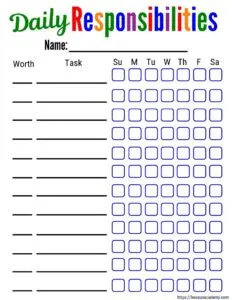
I decided to create a chore chart point system in our family. I made a list of (age-appropriate) chores my kids could complete, and assigned a point value to each chore.
I also made a list of ‘rewards’ the kids could buy with their points. The idea was that the kids would do chores to earn screen time or small pieces of candy, things like that.
Now my kids were young at this point. My oldest was 4, remember? I needed a simple point system for chores that would be easy for little kids to understand.
So I bought some of these foam hearts off of Amazon. These became our family currency.
I told the kids that they could watch movies whenever they wanted. You should have seen my son’s face light up: he was so excited! All they had to do was pay me 4 hearts, and I would let them watch a movie.
My son asked how he could get hearts to pay me (good question, kid!) and I showed him the list of chores. I told him he could do any of the chores on this list to earn some hearts.
Let me tell you, my house was so clean that week! My kids (my son especially) ran around doing everything on that list so that they could earn all the hearts they could. They wanted A LOT of hearts so that they could watch A LOT of movies.
Every time they completed a chore, I gave them a heart. We kept these hearts in a little plastic baggie with the kid’s name written in sharpie.
This was a very simple reward system for the kids to understand and for me to keep track of. And you wouldn’t believe the number of problems this system solved! Now that the kids had to work for their screen time, they were amazingly less ornery. Without even meaning to, I was encouraging good behavior in my kids.
They still got as much TV time as they’d had before, only now it was accompanied by some great work ethic, which decreased the crankiness caused by too much screentime. Win-win!

Side Note On This
This also solved the problem of the kids asking for toys or candy at the store. Now instead of saying no all the time, I tell them they can buy anything they want – after they earn the hearts to pay for it.
An Evolving Chore Chart Point System
As the kids grew (and multiplied!) we outgrew the heart system. This was due to a number of reasons.
First of all, I got tired of finding little sticker foam hearts all over the place. We’d always find them stuck to the bottom of our shoes, or I’d find them in the washer. The hearts were easy to keep track of with just one or two interested kids, but as we got up to 4 and 5 kids using hearts, they just tended to get everywhere.
Additionally, I started noticing some discrepancies in the amount of hearts my kids had.
I’d like to say my kids are perfectly honest and would never dream of lying or stealing for the sake of personal gain.
But the reality is every child needs to test the honesty waters at some point in time. And having our family currency in the way we had it allowed some of the kids too many opportunities to snatch hearts from a sibling’s bag, or from my own stockpile.
Add to the fact that some of my kids are particularly bad at keeping track of their things and were always losing their heart bag (he’s 3 – what can I say?) It became obvious that it was time for our system to evolve.
So we moved onto a digital family currency.
A Digital Chore Chart and a Kids Chore App
I spent weeks searching for and researching chore apps that would be able to do what I wanted them to do.
I still wanted the kids to be able to receive and keep a running total of the points they had earned.
And I wanted them to be able to use these points to pay for rewards and prizes easily.
I needed a chore app that would assign different chores a different point value.
And I needed a chore app that would allow me to manage everything from one device – even though I was trying to work with (at this point) 4 or 5 kids.
You would not believe the number of different apps I downloaded. I’d test them all! Some I’d uninstall after just a few minutes. Some I tried out for a few weeks.
One excellent app to feature is S’moresUp. It offers a unique, engaging approach to chore management, making it easier for families to stay organized and for kids to develop responsibility. Here’s a detailed overview:
What S’moresUp Offers
S’moresUp is more than just a chore management app—it’s a comprehensive family organizer. Parents can assign chores to individual family members or create group tasks for the whole household. The app uses a rewards system to keep kids motivated, where they earn “S’mores” points for completing tasks. These points can be redeemed for rewards set by parents, like extra screen time, a fun outing, or a small allowance.
The app also includes a shared family calendar, allowing everyone to stay informed about schedules and important events. Its robust reporting feature lets parents monitor chore completion rates, helping them see who’s excelling and where reminders might be needed. For families with multiple kids, S’moresUp provides an easy way to manage everyone’s responsibilities without confusion.
Why S’moresUp Is a Great App
S’moresUp stands out for its intuitive interface and gamified approach to chores. Kids love the point system, which turns mundane tasks into opportunities to earn rewards. Parents appreciate the app’s flexibility, as it can be customized to fit their family’s needs. It’s not just about managing chores; it’s about building a team-oriented household where everyone contributes.
The app also fosters good habits by teaching children accountability and time management. It’s a perfect tool for busy parents who want to instill a sense of responsibility while staying on top of household tasks.
How to Download S’moresUp
S’moresUp is available for both iPhones and Android devices.
- For iPhone Users: Visit the Apple App Store and search for “S’moresUp.” Click “Get” to download and install the app. Once installed, you can create an account and start setting up your family profile.
- For Android Users: Head to the Google Play Store and search for “S’moresUp.” Tap “Install” to download the app. After installation, follow the prompts to set up your household and assign chores.
The Law of Sowing and Reaping
Our family currency system (or points-based chore chart) is rooted in a powerful principle: the Law of Sowing and Reaping. This timeless concept teaches that you get out of life what you put into it—if you plant seeds and nurture them, you’ll eventually reap the rewards.
In essence, if you plant a pea seed, you’ll grow a pea plant, which, with care and effort, leads to a harvest. This principle is simple but profound and perfectly reflected in how the S’moresUp app operates. Kids learn that by completing chores (sowing), they earn points or rewards (reaping). This process shows them that effort leads to tangible outcomes, teaching responsibility in a practical, everyday way.
Unfortunately, today’s world often blurs this principle. Many children grow up disconnected from the effort behind the “harvests” they enjoy, like toys, treats, or privileges. Without learning the value of work, they risk entering adulthood expecting rewards without effort—a mindset that leads to frustration and failure.
S’moresUp helps bridge that gap by giving children a framework to connect effort with reward. The app instills the understanding that everything meaningful—be it a strong family, financial stability, or personal success—requires planting the right seeds and tending to them with hard work and dedication.
The app goes beyond responsibility, offering lessons in negotiation, financial literacy, and even basic economics. Kids quickly learn to manage their points wisely, trade chores with siblings, or pay each other to complete tasks they’d rather skip. It’s fascinating to see how quickly they embrace the system once they realize that consistent effort leads to the things they want.
S’moresUp isn’t just a chore app; it’s a life skills tool. By teaching kids the Law of Sowing and Reaping in a fun and engaging way, it sets them up to understand that success—in any area of life—requires effort, patience, and intentionality.
Before we get into the frequently asked questions of this highly successful chore point system, I wanted to let you know that we have finally evolved into yet another system.
Our older kids are entering middle school now and it’s time we teach them true financial literacy. I just finished writing a detailed post about our new financial literacy education that you’re welcome to read. Or you can continue on with the chore point system.
Depending on your kids’ ages, either system will bring your family great success, I’m sure.
Frequently Asked Questions
In preparation for this post, I had a good friend Amy (from Real Talk With Amy) discuss this family currency system with me. I gave her all the details I could think of, and she picked my brain.
I wanted to make sure all a new user’s questions would be answered right up front, and that this system was very clearly explained so everybody could implement it right away.
So here is the extent of our conversation (conversation has been edited for clarity)
How do you get kids to help around the house?
AMY: Speaking of kids, how on earth do you get yours to be helpful and cooperate? I feel like I can’t get anything done unless my husband takes them out or they are asleep.
CHARLENE: We have a currency system. The kids are not allowed free treats, tv time, screen time, video games, etc at all – they have to buy it. They can earn (points, stickers, marbles, etc) by doing chores. Then they spend those on treats, screen time, or cash.
How do kids earn points?
AMY: How do they earn points?
CHARLENE: I pay them to do jobs around the house. Each job is assigned a point value. If I really need a job done, I will pay the kids extra (a bonus) to get it done quickly.
What if the kids still won’t work?
AMY: Does this always work? What if the kids still don’t want to do their jobs?
CHARLENE: Just like in the real world, the kids don’t have to do any job they really don’t want to do. Just like I could hire a maid or a cook to do my work for me, the kids can hire me (or a sibling) to do their jobs for them. If the kids are still unwilling to work, I will either do the job myself and charge them points, or assign a sibling and deduct points from the first kid to pay the second.
What happens if the kids’ points go into the negative?
AMY: What happens if the kids’ points go into the negative?
CHARLENE: If a child is in the negative, they are ‘soft grounded’ until they are out of debt.
This means they not only have no points of their own to spend on anything, but they also cannot piggy-back on siblings’ purchases (such as movies or computer games) until they are out of debt.
If a sibling buys a movie, the indebted child must leave the room.
Can the kids share screentime?
AMY: What happens if the TV is in a common area and one kid is watching, but the other kids didn’t spend their currency on that? How do you keep track without your head spinning with who is redeeming what reward?
CHARLENE: The kids are allowed to watch each others’ screen time, but they get no say in what is being watched – that is for the person who paid to choose.
Additionally, the kids are allowed to pool their points and buy a movie together, thus splitting the cost. This means they have to agree on the chosen movie.
Any child that isn’t in debt is allowed to watch the other kids’ show. Children in debt must leave the room.
Do the kids ever get free screentime??
AMY: Do you guys do things like family movie nights where they don’t have to spend points to join in? Or is ALL screentime earned?
CHARLENE: Family screentime is free. School screentime is free. And ‘Mommy is desperate for you to stop talking’ screentime is free. Unless they’re in debt, of course.
If a child is in debt and we decided to do a family movie night, the child has to stay in his/her room. Sometimes we include popcorn or something to make debt extra painful. (needless to say, they’re not in debt very often)
School screentime they usually get to do, but no fun stuff rewards after.
Watching Points Accumulate
AMY: So are the kids able to see their own currency build up or be spent since it’s on the app? How do they know what they can spend/owe you?
CHARLENE: The app makes it hard to see points accumulate. I mean, you can log in and see what’s there, but the kids can’t just pick up their baggie and see what they have anytime they want. I’d need to log in and tell them what they’ve got.
It’s one downfall to the app vs something concrete, like the foam hearts system we used to have.
What Are Points and Hearts Worth?
AMY: What if you have a child who wants to earn cash? How do you determine how much cash a point is worth?
CHARLENE: We figure one point is worth one penny. This simplifies the conversion process.
When we were using the heart system, each heart was worth a quarter (again, to simplify things)- only 4 hearts needed to watch an hour of screen time instead of 100)
I also only let them buy cash in increments of $5.00 so 500 points.
This keeps me from giving them pennies and quarters all the time and encourages them to learn how to save. (this also gives me time to prepare my wallet since I rarely carry cash!)
What About Little Kids?
AMY: What age do you start this with them? Your little ones that don’t quite get it yet – how do they fit into the equation?
CHARLENE: I pay the little ones once they start asking for points like everybody else – usually around 3. They don’t understand the concept of earning vs spending until about 4 or 5. So I just pay them a little every time they do something helpful or they see a sibling working and want to help them.
This gets them excited about working and earning, even though they don’t fully grasp the entire concept yet.
Individual stuff has to be purchased about the time they turn 5. Before that, they get to participate in everything for free. They’ll start to buy things naturally, just by watching their siblings ask. You’ll know when they understand. That’s when it transfers over.
Won’t The Little Ones Have a HUGE Stockpile?
AMY: Ahh…so do they just accumulate until that point?
CHARLENE: Sometimes I do a dump so the 3-year-old doesn’t have 5000 points. I try to keep the little ones around 500 or so until they really start understanding what’s going on.
What are some available prizes?
AMY: What prizes do you include in your family?
CHARLENE: I include things like a feature-length movie, one TV episode, a piece of candy, a trip to Grandma’s house, time on the tablet, a computer game, a family popcorn party or pizza party, a Lego set, cash…the options are limitless!
How does school screentime work?
AMY: How does school screentime work? Do they have to pay for that?
CHARLENE: If we are watching a school movie ‘for school’ then they get to be included without paying. If it’s an educational show the kids just want to watch for fun, I usually offer that to them for purchase at a discount.
How do you assign chores?
AMY: How do you assign chores? Is there a preset list?
CHARLENE: We tend to rotate systems. Keeps things fresh and interesting!
Sometimes we assign kids certain jobs and when that job needs doing, I know who to ask. We would rotate this list of assigned chores monthly so everybody would get a turn to learn how to do all the available jobs.
Other times I just have a list of available jobs and if I see one needs doing, I assign a random kid to do it.
Anytime a kid volunteers to do a job, they get paid double the usual amount of points. This encourages them to get used to looking around and noticing what needs to be done.
What happens if the kids still grumble?
AMY: What happens if the kids still grumble? Do they lose payment for grumbling?
CHARLENE: That depends on my mood and how irritating the kids have been that day. (#truthbomb)
Minimal grumbling earns me telling them off.
Major grumbling earns a dock in pay.
If grumbling continues after that, I assign a different kid to do the job and the first kid has to pay the second kid from their stockpile.
If they can’t afford to pay, the kid goes into debt and stays in debt until they have bumped their balance back up to zero.
What are the prizes worth?
AMY: What are the different prizes worth?
CHARLENE: An example of our prizes and their worth includes:
- Piece of candy – $.50 so 50 points or 2 hearts.
- 1 TV episode – $1.00 so 100 points or 4 hearts.
- Feature-length movie – $1.50 so 150 points or 6 hearts.
- Livingroom sleepovers – $10.00 so 1000 points or 40 hearts
- Pizza parties – $25.00 so 2500 points or 100 hearts
The kids are allowed to combine their points for big things they want to earn together
What do you pay for chores?
AMY: What do you pay for chores?
CHARLENE: Remember this system is flexible and can be set up however you need. But our chore list looks something like this:
- Get the little brother dressed – $1.00 so 100 points or 4 hearts
- Do the dishes – $1.00 so 100 points or 4 hearts.
- Take out the garbage – $.25 so 25 points or 1 heart
- Cleaning out the car – $5.00 so 500 points or 20 hearts
And so on.
Chore System For Kids and Our Family
I have found this system to be really great in our family.
We sometimes refer to this system as our family currency system because this is the currency by which our family runs.
I love all the life skills and life lessons my kids are learning from this one simple system. I also love how smoothly our household runs now that we’ve implemented this.
I hope this answered all of your questions! If you have any more questions, or if something is still unclear, please comment below and I will get back to you ASAP. I love answering comments from my readers!
Related Posts:
- Teaching Kids to Show Each Other Love
- Teaching Kids to be Patient
- Teaching Kids to be Grateful
- The Secret to Teaching Kids Financial Literacy
- Teach Kids Crochet
And hey, I’ve teamed up with a WHOLE BUNCH of other bloggers to bring you an epic list of boredom busters and educational activities. Feel free to browse this list if you’re in a bind! There are some great resources here.


Teach Life Skills For Kids with a {FREE} Chore Chart Point System For Kids


- Best Summer Reading Programs for Homeschool Kids in 2025 - June 4, 2025
- Free Printable Mad Libs For Kids | The Ultimate Collection - June 4, 2025
- Educational Thanksgiving Point Activities and Events - June 4, 2025
Clayton Edgley
Wednesday 11th of October 2023
Thank you so much for this my ol lady and I have been trying so many different things and it's just not fair to the kids. WE just have not had the time after doing everything to do anything so I know this will be the bail out the we need and on our behalf i thank you and your family for this so much thank you!
Hess UnAcademy Team
Thursday 12th of October 2023
Hope it works out for you!
Jen
Friday 30th of July 2021
I couldn't see the video tutorial link?
Charlene Hess
Friday 30th of July 2021
The video will begin playing automatically. It is sitting just under the heading Our Home Chore System App Walk-Through Tutorial in this article.
Michelle Gionfriddo
Friday 23rd of July 2021
How do you think this work for teenagers? I have 2 unmotivated foster teen boys. They do work a little but one wants to burn through his money. (I don’t let him) this same teen doesn’t want to go outside and just wants to play video games or watch tv. I NEED to motivate him!!
Charlene Hess
Friday 23rd of July 2021
I don't see why this wouldn't work for teenagers. As long as you make the prizes something they actually want to earn (time with their video games or TV for example) this system should work even for teens. My teenager won't work for TV or movie time anymore but he certainly will work to earn time on his Minecraft. I make him earn 200 points for 2 hours of Minecraft and then each chore is worth 10 or 20 points and I pay him extra for having a good attitude and not spazzing out on his siblings. I also throw in some negative reinforcement sometimes and tell them if all of their list isn't done by X:o'clock then they can spend the rest of the day in their rooms with no screens or books.
Rebecca
Friday 18th of June 2021
Do you require that all schoolwork and personal chores are complete before they can begin earning? I’m thinking that they would have to keep their room clean and make their beds as a requirement to earn for other work, but how do you handle that?
Charlene Hess
Friday 18th of June 2021
There are a few ways to handle that. You could make those daily requirements not pay them any points but still be required before they are allowed to spend their points. Or you could make them do those things before they're allowed to start earning points from other chores and school activities. When we were using physical payment methods such as the foam hearts, it was easier to have the kids do the basic required chores before I'd start paying out for other things. When we swapped to digital, it was easier to put them in their list as free or only worth 1 point and then there was just no spending until the entire list was done. Some kids require more motivation and I have had to implement rules such as if the whole list isn't done by X O'Clock then that child is grounded to their room for the rest of the day. That way they are motivated to get things done even if they don't want to do the 'free' chores. It really depends on what motivates each particular child, but those are things that have worked for us.
Samantha S
Sunday 21st of March 2021
This app is amazing! Thank you for the detailed write up and for the riveting video tutorial ;) I've been praying for wisdom on how to get things under control over here and am so thankful for this. I think my kids will dig it. Thank you again!
Samantha S
Tuesday 23rd of March 2021
@Charlene Hess, do you know how to deduct points aside from deleting the task from rewards? I'd like to use that as a consequence but can't seem to figure it out. Thanks!
Charlene Hess
Monday 22nd of March 2021
You're so welcome! I hope it makes a difference in your home.