


Homeschooling is the fastest-growing form of education in the US right now, with the number of homeschooled kids increasing by over 60% from 2020 to 2022 with no signs of slowing down even after the pandemic-driven spike.
The reasons for the increase in homeschooling’s popularity? Many parents say they love the flexibility it provides and feel it allows them to provide a better, more effective educational experience for their kids.


But what exactly does this flexibility look like for homeschooling families?
We surveyed over 500 homeschooling families to get a look at the daily routines and academic outcomes that characterize this rapidly-growing educational model.
Our findings reveal that the average homeschool day and overall academic calendar is not only significantly shorter than that of public schools, but also yields better academic results, challenging traditional assumptions about classroom time and educational success.
Easy Navigation
Key Findings
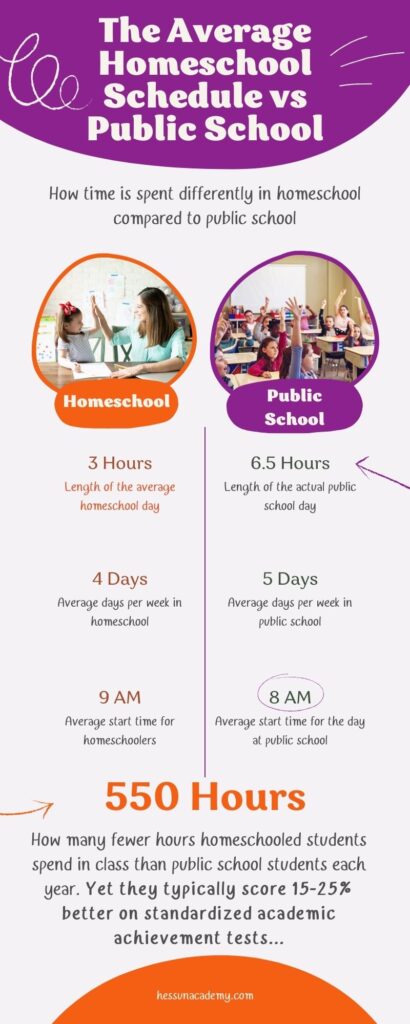
The average homeschooling day is just 3 hours long

Unlike traditional school settings that often require long hours in the classroom, homeschooling families manage to condense their educational activities into just 3 hours per day on average.


That’s less than half as long as the average US school day, which includes around 6.5 hours of daily classroom time.
This efficiency is largely due to a focused, distraction-free environment where teaching is highly personalized for the individual student.
As a result, students can cover material more quickly and retain information better.
The average homeschooled student has a 4-day week
Homeschooling families often opt for a 4-day academic week, offering a balance that many find optimal for deep learning and personal well-being.
This approach is not only beneficial for homeschooled students but has also caught the attention of public school districts in recent years. Many districts have debated shifting to a 4-day week (with some already testing it), prompted by studies suggesting such a schedule can improve student morale, lower operational costs, and reduced teacher burnout.


For homeschoolers, the reduced days allow for regular, extended periods of downtime, crucial for assimilating information and fostering creativity. These breaks give children the opportunity to pursue interests outside the academic curriculum, which could improve motivation and reduce burnout—benefits that public school systems hope to replicate.
Homeschooled students tend to get more sleep than their public school peers
Numerous studies have highlighted the benefits of later school start times, with the CDC recommending that schools begin no earlier than 8:30 am to align with adolescents’ natural sleep cycles. Despite these recommendations, the majority of public schools start earlier, often due to logistical and budgetary constraints, leaving many students struggling with insufficient sleep.

In contrast, homeschooled students typically enjoy more flexible schedules that allow families to start the school day later, with a 9 am average start time according to our survey data. Our data indicates that this flexibility is paying off, as homeschooled students get more sleep than their peers in traditional schools.
Adequate sleep is crucial for children and teenagers, affecting everything from brain development to daily functioning. It’s linked to improved concentration, memory retention, and mood stability—factors that are directly connected to learning efficiency and academic performance. Parents report that with more control over their schedules, they can ensure their children go to bed and wake up in a way that suits their individual needs, rather than conforming to the demands of a predetermined school timetable.
This approach not only supports optimal health and well-being but may also contribute to the higher academic outcomes observed among homeschooled students. The ability of homeschooling to adapt to natural sleep patterns is an often overlooked advantage that could inform future discussions on public school start times and overall student health.
Homeschooled students spend at least 550 fewer hours in class annually than public school students while achieving better academic results
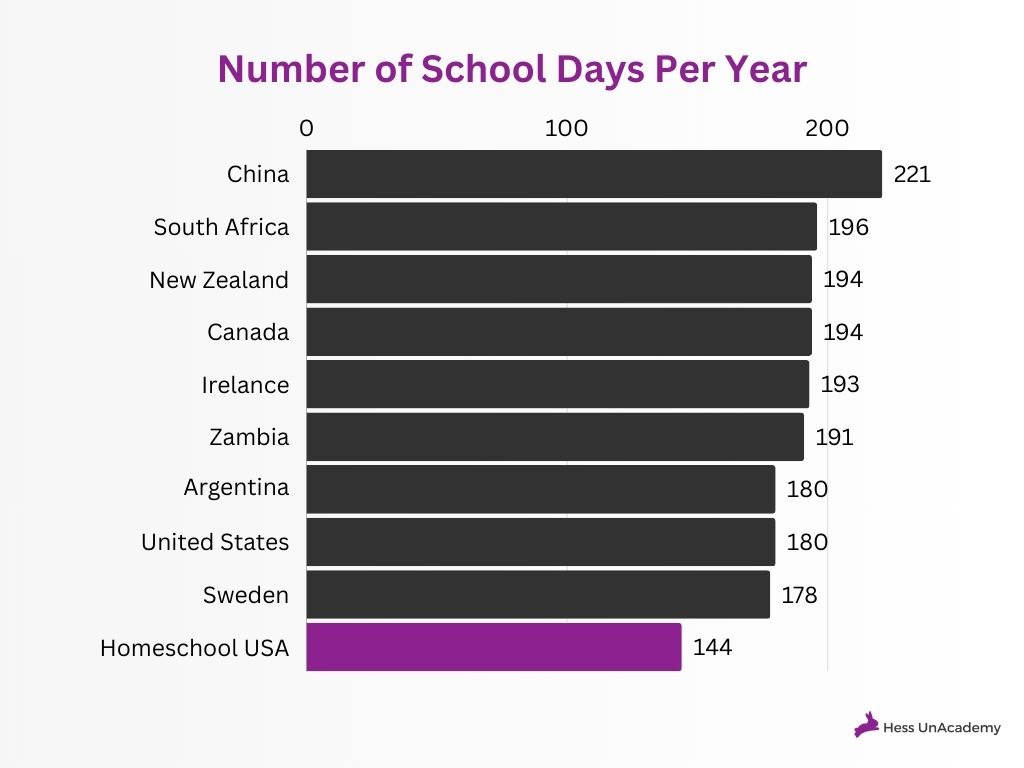
It might seem counterintuitive, but despite spending significantly fewer hours in formal instruction each year, homeschooled students often achieve better academic results than their public school counterparts.
Despite having about 30 fewer days of class time per school year (about 144 days compared to 180 for public school students), multiple studies show that homeschooled children typically score 15 to 25 percentile points above public-school students on standardized academic achievement tests. In fact, 78% of peer-reviewed studies on academic achievement show homeschool students perform statistically significantly better than students in traditional schools.


This finding challenges the typical ideas about the quantity of instructional time required for effective education.
By using tailored teaching methods and catering directly to the individual’s learning pace and style, homeschoolers are often able to get better results in less time.
The Significance of These Findings
As more families choose homeschooling, they’re finding not only improved academic results but also a lifestyle that aligns more closely with their values and the needs of their children. This movement away from traditional schooling might not only signify a shift in educational preference but also a broader cultural shift towards more personalized and flexible learning environments.
Share this Image On Your Site
- Love Languages in Learning: How Children Receive Encouragement Differently - February 2, 2026
- Valentine’s Day Ideas for Homeschoolers - January 25, 2026
- Parent Self-Care & Homeschooling: Why It Matters and 5 Simple Strategies - January 12, 2026