


This article may contain affiliate links. Please see our disclosure policy for more details.

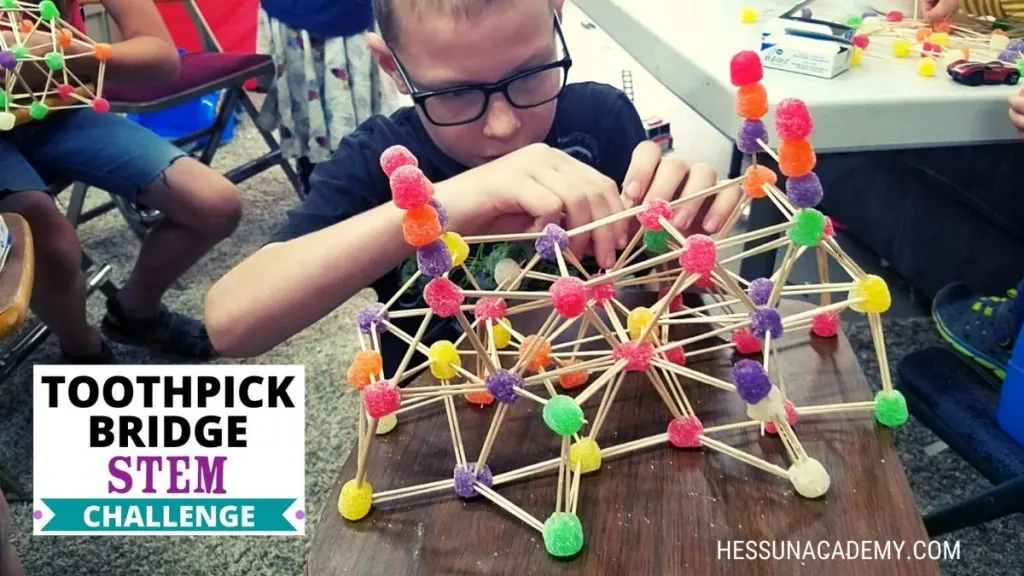
Have you ever considered including a toothpick bridge in your list of fun STEM activities for kids? A toothpick bridge makes a great STEM challenge idea.


Looking for at-home summer camp activities? Look no further than the toothpick bridge! You can enjoy this activity in your summertime adventures or it makes a great edible STEM activity for any time of the year.
Have you ever built a toothpick bridge before? This activity is something that’s been floating around in public school settings, typically middle school and high school physics class projects for a long time. But we’ve never seen anybody adapt this bridge-building idea for homeschoolers of multiple ages. We figured now was as good a time as any, so we bought materials and put this STEM challenge on the calendar.
Easy Navigation
How to Build a Toothpick Bridge: Free STEM Challenge Printable Instructions
Do you want to use these printable instructions again and again? Or maybe you want to quickly reference the science behind the activity and the taking it further ideas and suggestions?
Now you can download and print out the 8-page instructions so you can enjoy them anytime, anywhere! All you have to do is tell me where to send them.



Objective of this Project
The objective of this project is for kids to take a collection of seemingly random materials and put them together to build a structurally sound bridge, capable of supporting a large amount of weight. Throughout this STEM challenge, students will utilize physics, engineering, and math skills to design and build said bridge.
Bridge Project Materials
For our toothpick bridges, I bought each child 2 boxes of round toothpicks and a package of spice drops, but don’t feel limited to these materials. Feel free to use any material you want, including but not limited to:
- Toothpicks (Feel free to test out round toothpicks vs square toothpicks)
- Gumdrops/Spice drops
- Marshmallows
- Popsicle sticks
- School glue/Elmer’s glue
- Wood glue
- Something to test weight limit (we used cans of olives)
- Optional – Graph paper (for pre-planning)
- Optional – Wax paper to use as a bridge-building surface
- Optional – Cars to drive under the bridges


Toothpick Bridge Competition
I was feeling very frazzled the day of our toothpick bridge building competition so instead of spending the morning going over successful bridges and the different designs they use, we skipped over the planning phase and I just handed my kids their materials, told them the objective, and told them to get to work.
I was pleasantly surprised to see that my kids were content to get straight to work and, with the exception of picture-taking, the whole group of them worked independently without bothering me for more than three hours! (For this reason, this activity has probably been my favorite out of all of our STEM summer camp activities.)
I told the kids that at the end of the competition, they would need to test the weight limit of their bridges, and whoever built the strongest bridge would be declared the winner. This added a little motivation to the deal and the kids enjoyed building and testing different designs and tweaking their designs to strengthen weak points as they went along.




Toothpick Bridge Designs
Some bridge designs you could research and duplicate at home include:
- Suspension bridge
- Arch bridge
- Tied arch bridge
- Beam bridge
- Truss bridge
- Cantilever bridge
- Cable-stayed bridge
The rules I imposed on my kids were:

A: Their bridges must be built using only the materials I provided them with. No deviating from the materials at hand.
B: I had to be able to push a Hotwheels-style car under the entire length of the bridge.
In the future (maybe next year’s summer camp?), I will up the ante a little by providing them with two surfaces (two tables for example) and telling them their bridge must span across the open area.
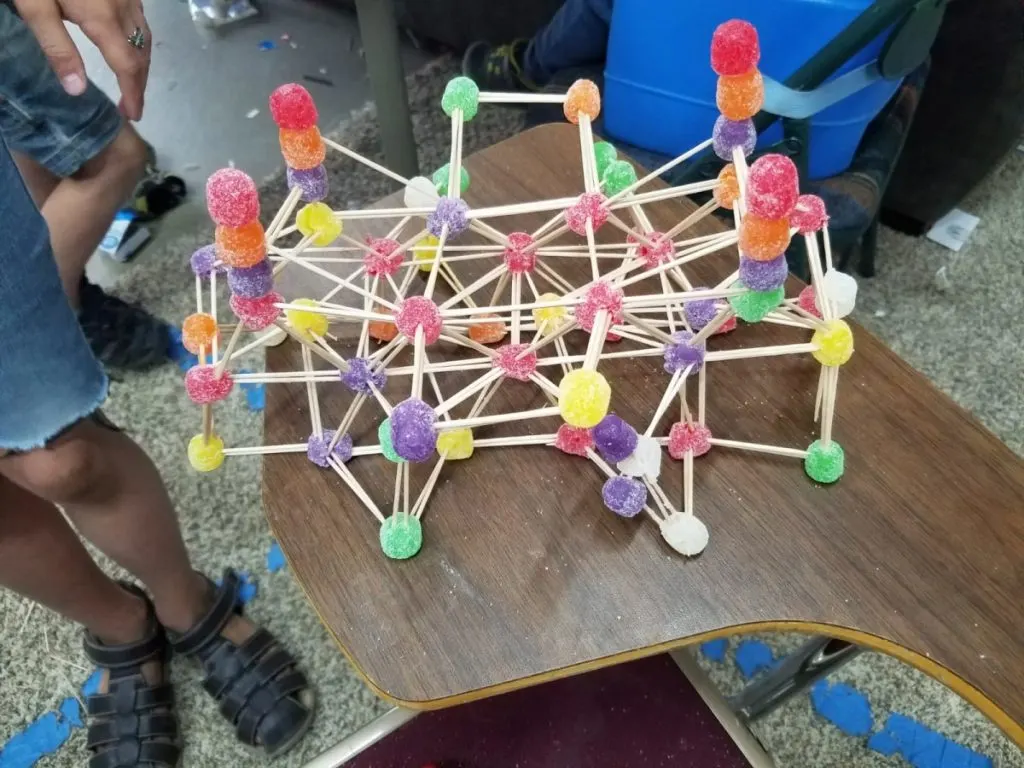
Here are some of the toothpick bridge designs my kids came up with.




The Strongest Toothpick Bridge Design
All of my junior civil engineers built some pretty impressive bridges, but the strongest toothpick bridge was built by my son Spencer. He was able to get a whopping 6 cans of olives on his bridge before it started to collapse. The next strongest bridge was able to support 3 cans of olives.


All in all, this was definitely a successful school project and I hope your students enjoy this simple STEM activity as much as mine did.
Follow up Questions
After you’ve completed this project, discuss the following questions with your students. This will help concepts they are learning sink in even more.
- Which bridge design held up the best? Which was the worst? Why?
- What design concept or shape did the most and least successful bridges follow?
- What are some real-world bridges that follow these design principles? (Find some examples on the internet and discuss them with your students.)
- What are some examples of real-world bridges that did not follow these design concepts and thus were not structurally sound? (Find some examples on the internet.)
Tips and Tricks
- Some of our kids found the bridges were stronger if they used two side-by-side toothpicks instead of just one single toothpick.
- This activity can get surprisingly sticky! Make sure you work in a place that is easy to sweep and wash up
- Plan on plenty of toothpicks breaking and make sure you have 2-3 times the number of toothpicks you think you will need.
Bridges and Resonance
Let’s learn about resonance. Resonance involves vibrations and the
frequencies at which things vibrate as well as the outside factors that
manipulate these vibrations. After looking up videos about resonance
online, perform the following basic experiment.
- Put a marshmallow onto the end of a piece of pasta (ex: a long spaghetti noodle).
- Now put a marshmallow on a shorter piece of pasta (a spaghetti noodle you broke to be about ⅔ the length it was originally).
- Practice making each noodle vibrate by either pulling the marshmallow back and letting it go or by shaking the noodle.
How violently can you make each noodle vibrate before it breaks? Which noodle seems more structurally sound and why? What does this have to do with resonance?
How does resonance affect bridges and other structures? (look up the Tacoma Narrows Bridge)
Now using all that you have learned about bridge design and resonance,
design another bridge that will be able to withstand even more weight.
What was different from your first design to your second?
Taking the Learning Further
After you’ve completed the resonance experiment, take the learning even further with some of the following ideas:
- Have the students pick a real-life bridge and see if they can duplicate it. First make it out of the materials you already used, then try making it out of new materials. What else can you use to make a sturdy bridge?
- Complete a research paper about the bridge you chose. Who designed it? What problem were they trying to solve? What could have gone better?
Benefits of Doing the Toothpick Bridge STEM Project with Your Students
So we’ve discussed just about everything you could possible need to organize the toothpick bridge project, but now lets focus on the why. Why do the toothpick bridge challenge?
Well, it offers participants a hands-on experience that encourages the development of various skills and understanding of fundamental concepts. Through engaging in this activity, young learners can expect to achieve the following learning outcomes:
- Problem-solving skills: Building a structurally sound toothpick bridge requires participants to analyze the given materials, plan their design, and overcome challenges along the way. This process fosters critical thinking and problem-solving abilities as they identify weak points, make adjustments, and optimize their bridge’s strength.
- Engineering principles: Participants will gain a basic understanding of engineering principles through the hands-on construction of their toothpick bridges. They will explore concepts such as load distribution, stability, and forces acting on structures, which are essential in engineering disciplines.
- Mathematical thinking: The toothpick bridge challenge incorporates elements of mathematics as participants calculate and estimate various measurements. They will apply mathematical concepts such as geometry, measurement, and spatial reasoning to create a balanced and well-designed bridge.
- Collaboration and teamwork: If done in a group setting, the toothpick bridge challenge promotes collaboration and teamwork. Participants will learn to communicate ideas effectively, listen to others’ perspectives, and work together towards a common goal. They will experience the benefits of cooperative problem-solving and the importance of sharing responsibilities.
- Creative thinking and innovation: Designing a toothpick bridge offers participants an opportunity to unleash their creativity and explore innovative solutions. They will think critically about different bridge designs, experiment with various techniques, and adapt their strategies to achieve the desired outcomes. This process fosters creativity and encourages participants to think outside the box.
- Understanding structural integrity: Participants will develop an understanding of structural integrity as they test and observe the load-bearing capacity of their toothpick bridges. By exploring the limits of their designs and analyzing bridge failures, they will gain insights into the importance of stable foundations, balance, and distributed weight in creating robust structures.
- Application of scientific concepts: The toothpick bridge challenge involves the application of scientific concepts, particularly in the fields of physics and material science. Participants will explore principles such as equilibrium, tension, compression, and material properties, which contribute to the stability and strength of their bridges.
There are plenty of reasons to do the project. So go ahead and click here to get our free printable and get started!
STEM Resources Delivered to Your Inbox Every Month


If you liked this edible STEM activity, you are going to love the STEM Made Easy Digital Subscription. Each month, you’ll receive 5 fully-planned STEM project guides along with worksheets and instructions for how to make them fun and engaging for kids ages 3-19. Check it out now!
Related Posts:
- Tin Can Ice Cream STEM Activity
- Blasting Soda Mentos Rockets
- More STEAM Activities For Homeschoolers
- Fun STEM Activities for Kindergarteners
- Free Printable Valentine Multiplication Worksheets - June 4, 2025
- Free Printable Martin Luther King, Jr. Word Scramble - June 4, 2025
- Digital Math Curriculum | Pros, Cons, and Options - June 4, 2025