


Here at Hess UnAcademy, we believe that learning should be FUN! That’s why today I’m sharing these fun and easy water cycle lesson plan ideas with you.
While the idea might seem simple enough, diving into lessons regarding the water cycle can quickly become a complicated topic if you’re not careful.


However, it’s very important that everybody learn about the water cycle.

That’s why we’re here to help with fun and easy water cycle lesson plan ideas and activities for younger kids.
If your kids are ready to learn about the water cycle and you don’t know where to start, you’re in luck because we’ve got some great ideas for you! We’ll show you how to prepare an easy lesson plan that will keep them engaged from start to finish.
These activities are perfect for preschoolers and kindergartners. They’re hands on, fun, and teach the big picture of the water cycle in a way that’s easy enough for even the youngest of kids to understand.

This article may contain affiliate links. Please see our disclosure policy for more details.
Easy Navigation
What Is The Water Cycle?
Before we can teach the kiddos about the water cycle, we must first go over what exactly that water cycle is.
So what is the water cycle?
In short, the water cycle is the term we give to describe the different states of water and how water enters and leaves each of these states.
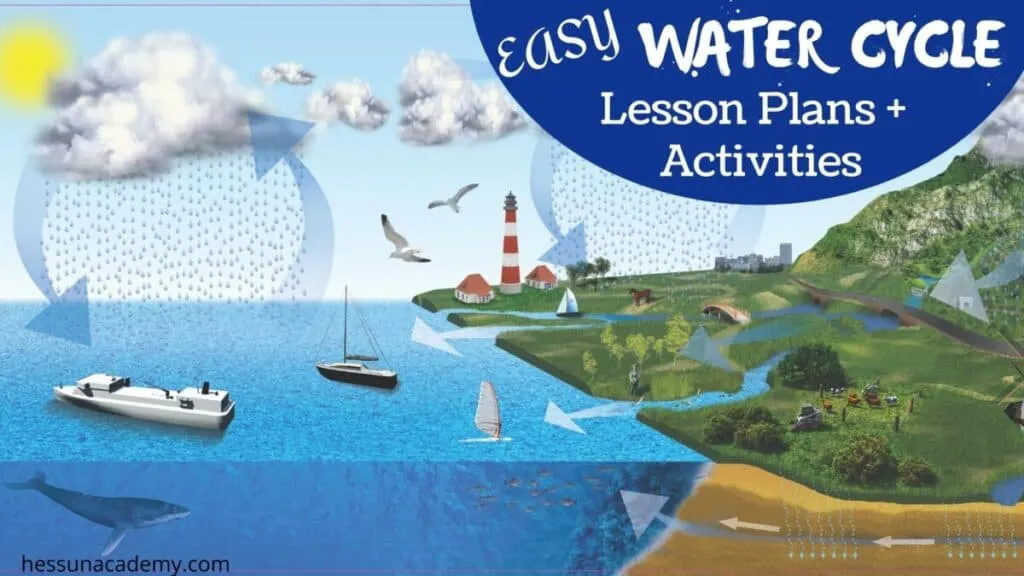
The basic water cycle takes droplets of water from collection (both freshwater rivers, lakes, and groundwater as well as saltwater oceans) to evaporation, to condensation (clouds), to precipitation (rain, snow, etc), and around and around again.


You can see the different parts of the water cycle represented in the picture below.


What Do You Teach Kids About The Water Cycle?
Now that you know what exactly the water cycle is, let’s cover what to teach kids about the water cycle. There are different topics within the water cycle to focus on. You have subtopics like evaporation, condensation, and precipitation. Then you have water as a solid, liquid, and gas – which are the three states of water.

In order to understand the water cycle, it’s important that your kids realize that there is water everywhere. It exists as a solid, as a liquid, and as a gas (and sometimes all three states at once).
Depending on the exact ages and abilities of your kids, you might work with one or two hands-on activities or experiments, or you might dive more into worksheets and flash card activities. (On that note, I’ve got some free water cycle flash cards you can download at the bottom of this article.)
It’s definitely possible, but it’s more fun and less complicated if we teach the kiddos about the water cycle as a whole, and not as separate parts. This way they can easily understand what is happening without getting too bogged down in details until they’re old enough to start really learning about the complexities of our planet’s atmospheric processes. After all, the water cycle is a complex Earth Science topic and you must be careful to keep things age appropriate.
Easy Water Cycle Lesson Plan Ideas and Activities
Now that you’re familiar with what exactly the water cycle is, we can go over some hands-on activities and experiments you can do with your kids to teach them all about the water cycle.
Use these fun activities as stand alone lesson plans or in conjunction with another unit study or collection of books. (There are a ton of great ones on Amazon or Preschool Powol Packs has a super cute new children’s book that talks about the water cycle.


Water Cycle Lesson Plan Idea #1: Bubble Solution
Here is an easy way for younger kids to get familiar with the three different states of water that exist in our world. You’ll need three plastic cups, some soap or shampoo, and some water.
Fill each cup with a different amount of water – about ¾ full for the solid one, half-full for the liquid, and nearly empty for the gaseous one. Then mix in some soap or shampoo to bubble up the first two cups (the liquid and gas states).
Finally, let the kids blow bubbles in all three cups. They will see the water turn from a solid to a gas as it rises up and out of the cup, go from a liquid to a gas as it leaves the cup through the bubbles, and then become a solid once more as it falls back down into the bottom of each cup again. It’s a really cool experiment to see in action!
Ask your kids what they think will happen if you take the bubbles out of the cup.
Water Cycle Lesson Plan Idea #2: Foggy Window
This activity is perfect because it not only demonstrates how liquids turn to gases, but also the fact that water exists in all three states. First, go over with your kids what happens when you breathe on a cold window. They should be able to tell you that the water in your breath turns to gas and then creates condensation, leaving little droplets of liquid on the window.
Next, have the kids breathe on a window that is NOT cold. They’ll realize that there are no droplets of liquid left on the window after they exhale. Instead, the water in their breath has turned to gas right away and formed into little clouds of fog.
Now you can demonstrate how water changes from one state to another by
Before you go through all the work of breathing on your windows, this experiment works best if you first clean off any existing condensation using a towel or cloth. Then give another demonstration with a warmer surface – the inside of your car on a warm afternoon is perfect for this activity. Show them how when you breathe on the interior of your car, there are no visible droplets left behind!
Water Cycle Lesson Plan Idea #3: Cloud in a Cup
Clouds are created when water changes between states – that is, they’re formed through condensation and then precipitation. To show your kids this, fill up two clear plastic cups with hot water (this one’s best if you do it outdoors, where you can safely leave them out for a bit.)
Put one cup outside in the cold. Once you’ve done that, fill up the other cup with hot water and put it outside as well. Cover each cup with a little bit of plastic wrap. Make sure to label which is which!
The first cup will cool down faster due to the lack of heat from the surrounding air, and it will form a cloud as water changes from a gas to a liquid state.
The cup with the hotter water might take a bit longer, but eventually, you’ll see tiny droplets of water on the inside surface of your second cup as well! Remember how we said earlier that clouds are formed through condensation? Well, here’s where the clouds are forming, in this cup.
It might take a bit of time before you see your cloud form – it can turn out to be more like fog. But either way, it’s still pretty cool!
Water Cycle Lesson Plan Idea #4: Water Bottle Rain Cloud
This one is really easy to set up and it’s a lot of fun. All you need is a plastic water bottle, a little bit of rubbing alcohol mixed with dish soap, and some food coloring!
Put the food coloring in the bottom half of your bottle, then fill up the rest with the soap mixture. Shake well. Finally, put an open top on your bottle and watch it form a cloud!
As you shake the bottle and watch the cloud form, tell your kids how the soap and alcohol are changing the water into gas. The food coloring makes it even cooler looking! And everybody loves having their own little rain clouds inside an empty bottle.
You can also do this with two plastic cups if you don’t have a water bottle.
As you can see, there are plenty of fun ways to teach and demonstrate the Earth’s water cycle. Just because this is a common science topic doesn’t mean it has to be difficult and boring. When you’re willing to get a little creative, there is plenty of fun to be had!
Free Water Cycle Worksheets and Water Cycle Flash Cards
Want to take the learning even further? I’ve got a free water cycle activity packet for you to download here. This packet is best suited for kids between the ages of 3 and 10.


Inside this packet, you will find a beautiful illustration of the Earth’s water cycle (water cycle diagram), complete with blank spots for your kids to fill in labels for different stages of the water cycle such as condensation, precipitation, collection, and evaporation. You’ll also get a few pages of brightly colored flash cards that allow your kids to name the correct stage of the water cycle as water moves through the images are portraying.


This is a fun supplement to any water cycle lesson plans or activities you may be working on in your homeschool. Or feel free to use it as a stand alone lesson plan instead! The choice is yours. And either way, the water cycle activity pack is free and will go a long way in helping your children’s understanding of the water cycle.
Grab your free water cycle activity pack now!
More Fun Water Cycle Resources for Kids
Still looking for more water cycle lesson plan ideas? Here are a few more ideas just for you.
And be sure to check out Preschool Powol Pack’s collection of 10 amazing water cycle activities for kids! (And check out her cute new children’s book too!)
Related Posts:
Why and How to Homeschool Preschool
Dinosaur STEM Activities
Fun and Educational BEE Activities
- Free Printable Valentine Multiplication Worksheets - June 4, 2025
- Free Printable Martin Luther King, Jr. Word Scramble - June 4, 2025
- Digital Math Curriculum | Pros, Cons, and Options - June 4, 2025