


If your kids are into dragons, odds are good you have spent your fair share searching for dragon STEM activities and experiments for your kiddos to enjoy. While there are a few popular dragon experiments on the internet, I ask you, my friend, if you have ever enjoyed a dragon fire science experiment?
I’m not talking about just making a toy dragon breathe smoke with dry ice or a fog machine (although we’ve done that too and it’s a lot of fun). I’m talking about experimenting with fire and making multi-colored flames.


This experiment is a ton of fun and highly educational. However, it can also be very dangerous (read – fire) so be sure there is plenty of adult supervision for this activity.
Easy Navigation
An Overview of the Dragon Fire Science Experiment
In this project, you will be lighting a number of different chemicals on fire in order to see what color they burn.
CAUTION: This project will be using real fire so plan accordingly with adult supervision. A well-ventilated but not windy location is recommended.


Many people have seen a camp/wood fire before and/or a propane stove fire. They may have even noticed that there are many colors of fire. In those types of fires, the color is because of the heat levels. But many students may not realize that you can have a different colored fire just by changing the fuel the fire is burning.


As all dragon lovers know, not all dragons breathe out the same thing. Dragons of various species have a variety of different breath-based weapons at their disposal. Some have acids, some have lightning, some have plasmablasts, but most have a type of fire.
In many cases, this fire is not always your traditional orange and yellow flames. There are blue flames, red flames, green flames, yellow flames, orange flames, purple flames, white flames, and orangey-yellow flames, all of which one species or another of Dragon produces.
In this project, we will be trying to replicate each of these colors of flames.
Materials and Tools Needed for a Dragon Fire Experiment


- Lithium – We got ours from cutting open a AA lithium battery. (be careful with this as it can be very dangerous – wear protective gear and make sure kids are standing back)
- Calcium Chloride – We found this in some snowmelt.
- Isopropyl Alcohol – We had ours in Iso-HEET for cars (the red bottle).
- Sodium – We used just straight table salt.
- Boric Acid – We got a roach killer that was nearly pure boric acid.
- Copper Sulfate – We found this in a root killer chemical.
- Potassium Chloride – We sourced ours from No Salt Salt.
- Magnesium – This we got as a Magnesium fire starter block. However, be sure you’re getting a quality one because the first one we bought must have been a knock-off and didn’t light at all. In the future, I would recommend using something simple like Epsom Salt.
- Methyl Alcohol – An easy source is HEET for cars (yellow bottle).
- Containers to hold solutions in – We used tea light candles with the candle removed.


- Fire maker – We used a propane torch.
- Fire Safe Surface – We used Fire Bricks and Cinder Block combination.
- Fire Extinguisher – At least one plus a secondary fire control method.
- PPE – Personal Protection Equipment, this will include gloves (fire and chemical), eye protection, as well as appropriate clothing (nothing loose or dangling or easily caught on fire).
Initial Prep


- Source all ingredients and turn them into powders if in large pellet forms.
- If you have to build a safe burn space, do so before starting.
- Set up a separate solution making area if the burn area is not large enough to handle both safely
- Remember to pull the Lithium out of your AA battery.
WARNING Lithium can spontaneously combust when hit with oxygen. YOU MUST be in a fire-safe location when disassembling your battery. We actually had a larger lithium battery spontaneously combust during this prep time, which is partially why we recommend a nice small AA.


EXTRA WARNING batteries hold electricity so use proper equipment and precautions to not get zapped! Also a good reason to go with a small AA battery.


EXTRA EXTRA WARNING Lithium can spontaneously combust up to 72 hours after exposure to oxygen so if you do not burn it all then make sure you dispose of properly!
- Make sure everyone is aware of the dangers and safety precautions.
Making Your Multi-Colored Dragon Fire
- Read all instructions before starting:
- Create burn solutions. Add one ingredient to one burn pot aka tea candle cups.


- Each burn pot should have a single burning ingredient in them.
- Add Methyl Alcohol aka Yellow HEET to each pot to create a liquid burn solution. The exception will be the magnesium as it will not dissolve.


- One at a time, light each burn pot on fire on a safe burn location such as a welding table or fire bricks.
- Please note that some of these need time to dissolve in the alcohol before lighting and may take several minutes to do so. The Lithium will most likely need the most time.
- Observe the colors the fire burns.

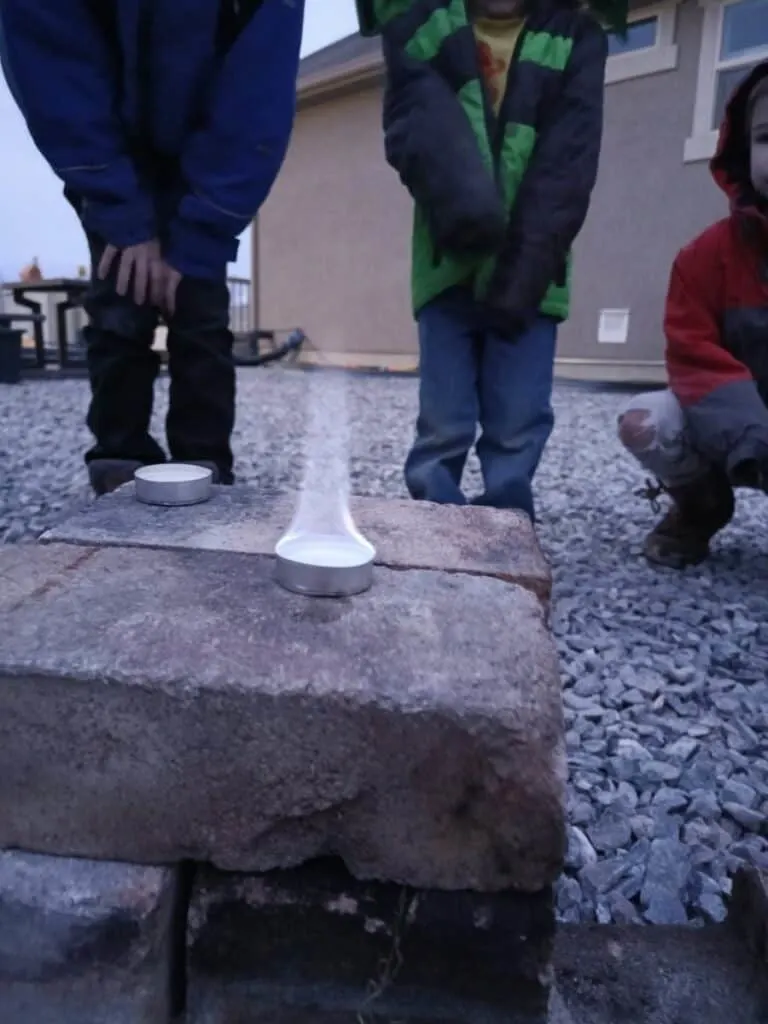
- Note: using Methyl Alcohol as your liquid makes the colors not get as tainted as other alcohols which is why we used it.
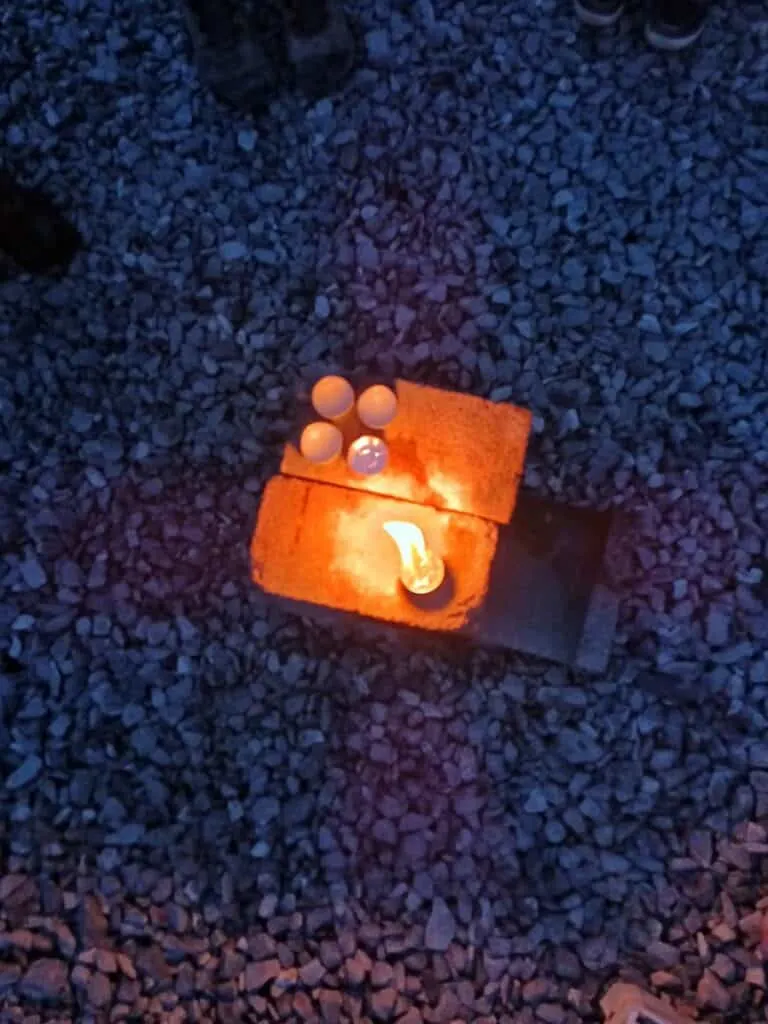
- You can also make a full rainbow of fire if you line them all up.
- If you have smaller children it may be beneficial to have more than one adult on duty.

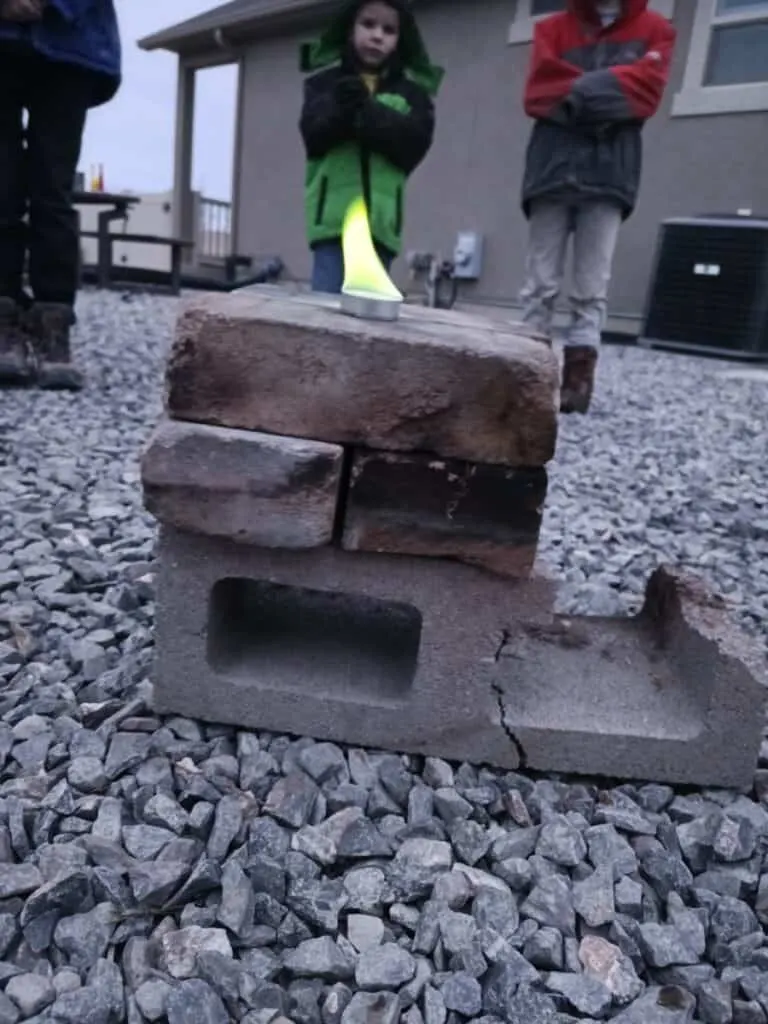
WARNING the magnesium will be burning so hot your burn pot will melt. Only use a few shavings.

ALSO WARNING it will be ultra-bright and should not be looked at directly without a welding mask on. Please skip this one if you are worried about hurting your eyes as it can happen if you look at it while burning.
- Note that all other fires will not be burning at a very high temperature (for fire).
- Ensure clean-up is safe and proper as your local area dictates.

The Science Behind Multi-Colored Dragon Fire
When making multi-colored fire, or any fire really, the color of flames you see depends on the energy level of the photos that are being emitted.
When you have lower energy levels, you will see flame colors that are towards the red end of the light spectrum, so red, orange, yellow, and so on. On the other hand, higher energy levels produce colors that are more on the blue end of the light spectrum. These will be blue, green, purple, etc.
Incidentally, the closer to the blue end of the spectrum your flame colors, the hotter the flames will be. The very hottest flames will appear to be white.
In the case of this experiment, the chemical elements in the flame will also manipulate the colors of the flame.


While there are many chemicals you can burn that will put off different colored flames, these are the chemicals we used:
Red : Lithium burning
Orange : Calcium Chloride burning
Yellow : Isopropyl Alcohol burning
Yellow Orange : Sodium burning
Green : Boric Acid burning
Blue : Copper Sulfate or Methyl Alcohol burning
Violet/Purple : Potassium Chloride burning
White : Magnesium burning
Or feel free to find some of your own things to burn! There are so many options. Just be sure to research the safety behind burning each ingredient as some things can be very dangerous when burned.


Follow Up Questions
After completing the dragon fire experiment, ask your kids the following questions and discuss the answers as a group.
- Do you think there are other things that will burn these unique colors?
- What do you think would happen if you mixed ingredients? New color?
- How does knowing this information help you in real life? What situations would this knowledge be good for?
Tips and Tricks
Learn from our mistakes!
- If you choose to not use Methyl Alcohol as your base then try and find something that has a low color amount of burn. The paler, the better.
- Remember that only the magnesium burns super hot in our list, so if you skip this one you will not need an extra fireproof surface, just standard bricks would do fine.
- Safety is a big one with this, do not go skimpy as you do not want to lose body parts or get burned.
- Keep at least one fire extinguishing source close by and make sure you have enough adults on hand for the number of small children.
Ideas for Taking the Learning Further
You can find different materials to burn and keep a more color-precise record. (like different shades of red or brightness levels of white.) If you get metals you will likely not need to create solutions like the magnesium.
More STEM Resources for Kids (Including A Free Printable)
If you liked this activity, you are going to love the STEM Made Easy Digital Subscription. Each month, you receive a project pack that includes 5 fully planned STEM project guides along with worksheets and instructions for how to make them fun and engaging for kids ages 3-19.


Want a free project sample? Sign up to get a complete 39-page project guide sent to you so you can see exactly what’s inside each of the STEM Made Easy Digital Subscription project pack.
I’ve also got this ultimate list of STEAM and STEM activities for kids of all ages if you want to take a look.
More Related STEM Posts
STEM Activities for High Schoolers
STEAM Activities for Middle Schoolers
The Ultimate Collection of STEM Activities
- Free Printable Valentine Multiplication Worksheets - June 4, 2025
- Free Printable Martin Luther King, Jr. Word Scramble - June 4, 2025
- Digital Math Curriculum | Pros, Cons, and Options - June 4, 2025