


Today we are going to dive into the science behind homemade bath bombs with a DIY bath bomb science experiment. This is an example of an exploding STEM experiment that kids love.
Bath bombs are an easy way to make bath time extra fun no matter how old you are, but did you know there is much to be learned from a bath bomb?


Feel free to use these ideas to spur on your own science fair project or as a fun science lesson in your homeschool. This science activity can also be enjoyed as a screen-free activity for kids who are taking a break from screen time.
However you choose to enjoy this activity, your kids are sure to have a blast while also learning a lot about catalysts, acids, bases, and more.
Add this to your list of fun STEM activities to enjoy with your kids.
Easy Navigation
How to Make Homemade Bath Bombs
Making homemade bath bombs is not as difficult as it may sound. It’s merely a matter of collecting your ingredients and mixing everything together. The hardest part is actually getting the bomb out of your mold but that challenge too can be overcome with the right amount if patience, diligence, and preparation.


Scientific Method Worksheets – Free Download
Before you move on, we’ve got some free scientific method worksheets for you to download and enjoy. These printable worksheets are useful for any science experiment, science project, STEM challenge, or STEM projects your students might be engaging in.
Turn every science project and STEAM activity into a thought-provoking STEM challenge. Plus give left brain and right brain kiddos alike a chance to utilize their strengths and improve their weaknesses. Get yours now!


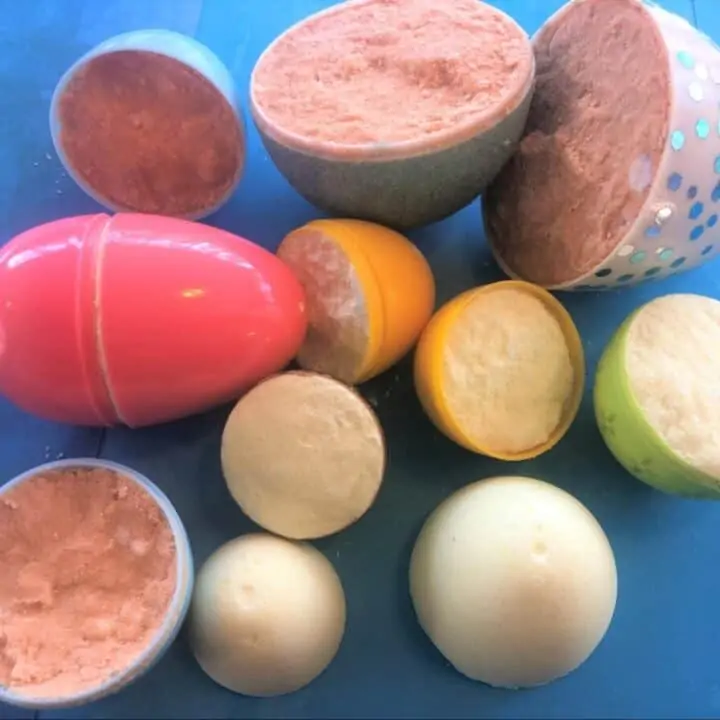
Homemade Bath Bombs Tutorial
Follow this easy homemade bath bomb tutorial and soon you'll be well on your way to enjoying a bath bomb science experiment with your kids.
Materials
- Citric acid
- Baking soda
- Coconut oil
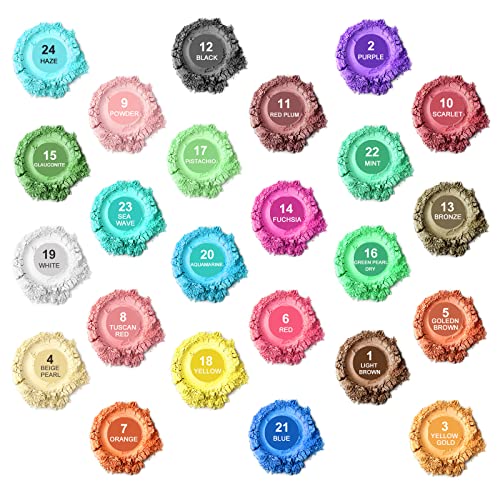
- Mica Powder (optional)
- Essential oil (optional)
- Measuring cups
- Bowl
- Molds (plastic Easter eggs work if you don’t have ball-shaped molds. Silicone muffin cups would also work in a pinch.)
Instructions
Measure 1 ½ cups of baking soda and put in a mixing bowl.
Add 1 cup of citric acid to the mixing bowl.


Mix thoroughly.
If using mica powder for coloring add 1 teaspoon and stir into your mixture.

Melt and measure ½ cup coconut oil.
If using an essential oil, add 20 drops to the coconut oil and stir the oils together.
Slowly add the oil into the powder mixture, stirring well.
You may want to get your hands into the mixture to finish stirring.
Press the mixture into your molds, pack it down.


Leave it in the molds for 24 hours.
Drop it in water and enjoy the fizzy reaction!
Notes
- You don’t need the mica powder or essential oil, so don’t worry if you don’t have them, they just make the bath bomb a little more fun in the tub. (Mica powder makes your bombs colorful and can be found on Amazon for about $10.
- You can purchase citric acid at supermarkets, cleaning supply stores, and hardware stores, as well as online. It tends to be in a different aisle every time so you might consider asking an associate for help finding your citric acid. Oftentimes it is in the canning section near the pectin or in the spices section under the name ‘sour salt’.
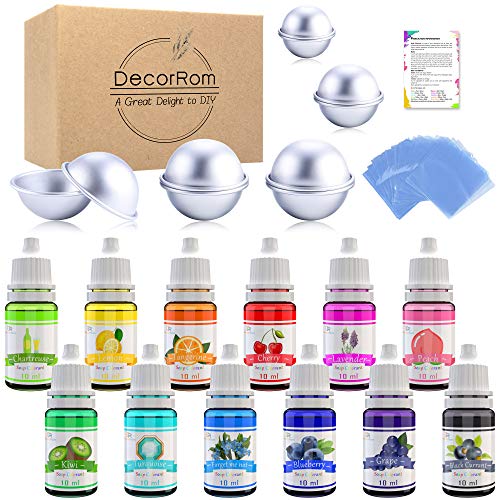
Recommended Products
As an Amazon Associate and member of other affiliate programs, I earn from qualifying purchases.



The Science Behind Homemade Bath Bombs
The acid we are using in our bath bombs is citric acid. This is a powdered form of acid often used for cleaning and food preservation. It is even one of the ingredients used in sour candy to increase the sour taste.
The chemical formula of citric acid is C₆H₈O₇


The base we are using in our bath bombs is baking soda. Baking soda is used in baked goods. It reacts with acids in the recipe (such as lemon juice or vinegar). The food bakes as the reaction takes place, baking in the air bubbles created. Next time you eat a piece of cake look at all the air that is baked in, this is what makes cakes light and fluffy.
The chemical formula of baking soda is NaHCO₃
When baking soda and citric acid react they create sodium citrate, carbon dioxide gas, and water. Here is the formula of the reaction.
3NaHCO3 + C6H8O7 → C6H5Na3O7 + 3CO2 + 3H2O
The carbon dioxide creates the bubbles you see when you put the bath bomb into water.
What is a catalyst?
When you stir baking soda and citric acid together to make your bath bomb, nothing happens. You may be wondering why. Baking soda and citric acid are both powders. They need a little help before they can react. These powders need a catalyst to get started.
A catalyst is any substance that increases the rate of a chemical reaction but does not get consumed. In other words, it helps the chemical reaction move along faster, but it is not actually a part of the chemical reaction.
You can think of catalysts like a cheering crowd at a sporting event or show. The audience’s energy helps spur on the athletes and performers to do their best, but the crowd is not part of the game.


Baking soda and citric acid need the catalyst of water to get the reaction moving along, this is why a bath bomb can be saved on the counter or in a cupboard until you are ready to use it. However, they may still be reacting to water in the air, it is just at such a slow rate that we will not notice.
It is best to use a bath bomb within six months, and you will get the most fizz if you use them sooner rather than later.
Ideas for Taking the Learning Further with Bath Bomb Science
Want to take the learning even further? Use these ideas with your older students. There is more to this experiment than meets the eye.
- Research where citric acid comes from and how we use it.
- Bake a vinegar & baking soda cake.
- Learn the math behind the chemical formula.
- Research the difference between homogenous and heterogeneous catalysts
- Once older students have perfected their bath bomb recipe, they can consider starting a small business of their own and selling bath bombs to friends, neighbors, and their community. Research and go through the planning, execution, and selling portions of starting a small business. See if you can make back everything you invested in materials. Then take it even further and see if you can save up for a big-ticket item you have been wanting. (car, college, etc)
Bath Bomb Science Tips and Tricks
Follow these tips and tricks to get the best possible outcome from your experiment. These tips will make this fun activity even better.
- You don’t need the mica powder or essential oil, so don’t worry if you don’t have them, they just make the bath bomb a little more fun in the tub. (Mica powder makes your bombs colorful and can be found on Amazon for about $10.
- You can purchase citric acid at supermarkets, cleaning supply stores, and hardware stores, as well as online. It tends to be in a different aisle every time so you might consider asking an associate for help finding your citric acid. Oftentimes it is in the canning section near the pectin or in the spices section under the name ‘sour salt’.
- Toddlers may have a lot of fun playing with the mica powder, which floats to the top of the water, don’t worry, it will rinse right off their hands and does not stain.


- Don’t close your plastic eggs too tight, we had trouble opening the ones that we closed all the way.
- Try gently twisting the egg mold to remove the egg-shaped bomb from the mold.
- The bombs may break apart while you are trying to remove them from the molds, you may also have trouble getting the bomb out of the egg. But it’s okay, you can just throw the open, broken egg bath bomb into water and you will still get a great reaction, your mold will be nice and clean when the reaction is over.
- Tip, if you are observing the reaction in a sink or bucket, make sure you use warm water, we found the reaction was disappointing in cold water.


Follow-Up Questions
Use these follow up questions with your kids to enhance the learning adventure. Feel free to conduct some research or have some fun discussions as a family.
- What are the similarities and differences between this activity and a baking soda & vinegar volcano?
- Why do bases and acids react?
- What is a catalyst?
Free Printable Exploding STEM Project


Want a free project sample? Sign up to have one of the projects sent to you so you can get an idea of the type of experiment guides you’ll get in our STEM Made Easy Digital Subscription!
More Related Activities
Summertime STEM Activities
STEAM-Based Homeschooling
Edible Science Experiments
- Free Printable Valentine Multiplication Worksheets - June 4, 2025
- Free Printable Martin Luther King, Jr. Word Scramble - June 4, 2025
- Digital Math Curriculum | Pros, Cons, and Options - June 4, 2025