



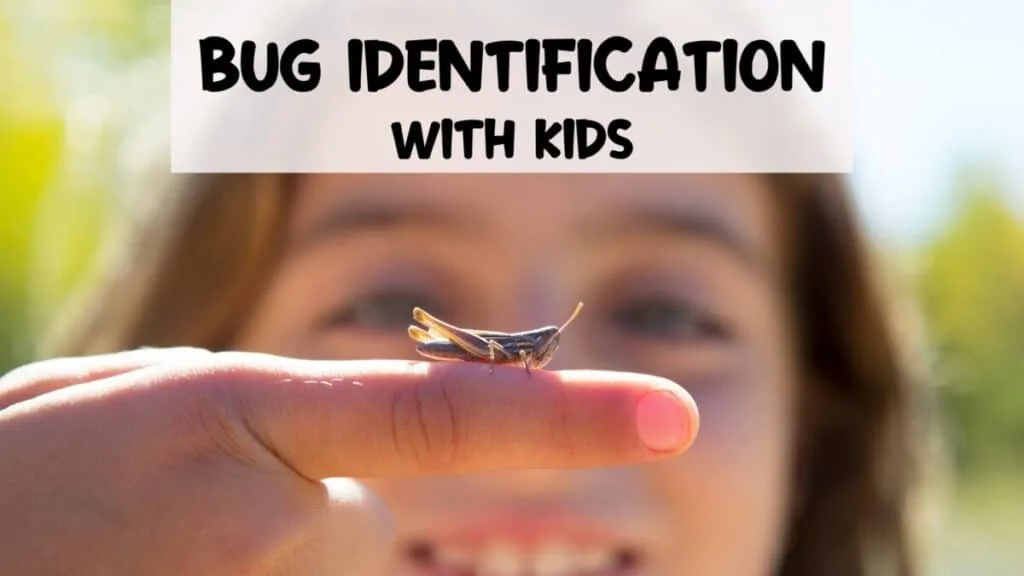
Are your kids interested in bugs? Maybe it’s time you considered a backyard bug identification with kids activity.
Oh, those creepy-crawlies! Some people love bugs and some are totally creeped out by them! No matter which category you or your kids fall into you can find the fun and benefits of learning to identify your backyard six- and eight-legged beauties.


Insects comprise an estimated 80% of all animal species! That’s a lot! There are over 1 million identified species of insects and spiders in the world, with many more still to be discovered.
The science of Entomology, the branch of zoology that deals with insects, is a vast field. Entomology is a useful science, not only for the scientific community, agriculture, or pest control, but for all of us because we all live near or with insects.
Knowing which bugs are hanging out with you in your yard or home is useful for knowing which creepy-crawlies are helpful, which are neutral, and which may be harmful.
Add to that the many benefits of spending time outdoors, specifically in nature, and you have a win-win!


And working bugs is one of the best educational summer activities to enjoy with your kids! It’s great for any warm weather period, really, regardless of season.
Did you know that the term “bug”, which is often used by people to mean “insect” or even broader meaning to include arachnids as well, actually has an entomological meaning all its own? “Bugs” are a large order of insects that have mouthparts made for piercing and sucking.
Many kids who are interested in bugs enjoy making their own bug jars. Use this guide for your own DIY bug jar to learn simple tips on catching and caring for bugs. Or that page also has a free paper bug jar printable if you want to pretend you have a bug jar without actually having to catch any bugs.
Easy Navigation
Free Bug Identification Journal
Before you begin you buggy adventures, be sure you have a way to keep track of what you find. This could be a notebook, a field guide, or a bug identification journal.
Do you want to turn backyard bug identification into a whole educational adventure for your kids? Then grab my FREE bug identification journal now!




When used in conjunction with apps such as Google Lens, this bug journal makes learning and identifying backyard bugs tons of fun for kids of all ages. There are spaces to read, write, draw, and more. Go grab your free bug identification journal today.
While you’re at it, craftskidslove.com has some fun ladybug coloring pages that are free. Go grab them now!

Common Insects You Might Find in Your Backyard
Two common types of true bugs found in North America are Assassin Bugs and Box Elder Bugs.


Assassin Bug ID
Assassin bugs are considered beneficial insects because they eat other insects, including many that are considered garden pests. There are about 160 species of assassin bugs in North America. The most identifiable part of the assassin bug is its three-segmented mouthpart, called a rostrum.
They range from ½ to 1 ¼ inch in length and are usually brown, grey, or black. They can have bright red, green, or orange coloration on parts of their bodies. They have protruding round eyes and a long tubular head. Although they have wings and can fly they tend to be poor flyers. Many assassin bugs will bite if handled, so proceed with caution.
Box Elder Bug ID


Box Elder Bugs are very common anywhere there are Box Elder trees, Maple Trees, Ash Trees, and Cherry trees — their preferred food source.
Box Elder Bug adults are usually about ½ inch in length and black with red-rimmed wings and red eyes. The juveniles are smaller, rounder (or fatter looking), and mostly or entirely red in color.


More common bugs you are likely to come across, at least if you live in the Northern Hemisphere, include:
- Grasshoppers
- Ladybugs
- Dragonfly
- Praying Mantis
- Butterfly
- Caterpillar
- Ants
- Termites
- Bees
- Wasps
- Mosquitos
- Spiders
Bees! Or Not Bees?
Do you know how to tell the difference between a beneficial bee and a wasp (or yellow jacket)?
Western Honey Bees, just one of several important pollinators, are easy to identify. They are golden brown with black abdominal stripes. A close look at their legs will show a bundle of pollen if they’ve been visiting flowers.
Yellow Jackets, a carnivorous wasp the same size as the Western Honey Bee, have yellow and white markings and are not covered in golden brown or tan hairs, nor do they have pollen baskets on their legs.
Fun Facts about Bugs
The world of insects (and bugs in general) is a fascinating place! These little critters are known as invertebrates and they have exoskeletons that help protect them from danger. Both insects and spiders belong to the family of arthropods.
Insects have 3 body parts and bugs such as spiders have 2 body parts. Insects have 6 legs attached to their thorax and spiders have 8 legs. Insects also have antennae attached to their heads.
Continuing Your “Buggy” Journey
There are many resources online and likely at your local library to help you identify the insects you see in your backyard. Treehugger.com has a great article on identifying bees and wasps.
I’ve got a super fun Wildlife in the Gardens unit study that teaches kids about harmful and beneficial insects. is a guide for kids to a few of the beneficial insects for gardening.
Insectidentification.org is another great resource. And of course, remember to use Google Lens whenever you come across something you’re not familiar with.
To go along with our Women in STEM studies check out these awesome women entomologists:
- Anna Botsford Comstock
- May Berenbaum
- Annette Frances Braun
Related Posts:
Gardening STEM Projects
Bird Watching with Kids
Summertime STEM Activities
- Free Printable Valentine Multiplication Worksheets - June 4, 2025
- Free Printable Martin Luther King, Jr. Word Scramble - June 4, 2025
- Digital Math Curriculum | Pros, Cons, and Options - June 4, 2025