


Have you ever tried to teach a lesson on density for kids? Teaching kids about density might seem simple but in fact, this topic can get really complicated really quickly. That’s why when we were ready to teach our kids about density in our homeschool, we used a fun marbled eggs STEM activity to help solidify the lesson.
Incorporating STEM into your child’s lessons, such as this fun dragon STEM activity, is a great way to help reinforce all kinds of topics and ideas. And one of the best parts about STEM activities is they tend to be hands-on, making them even easier for kids with all kinds of learning styles to understand.


In addition to being a fun addition to your homeschool or after school learning adventures, this marbled egg activity can also double as a fun Easter Egg dyeing method. While the materials specifically used in this STEM activity are not edible, marbled Easter eggs would still make beautiful Easter decorations.
Or you can substitute a few of the ingredients so that everything is edible. (I’ll make note of how to do that in the tutorial section.)
But enough introduction nonsense. Let’s dive right into the marbled egg STEM activity now!
This article may contain affiliate links. Please see our disclosure policy for more details.


Easy Navigation
A Brief Overview of the Marbled Eggs STEM Project
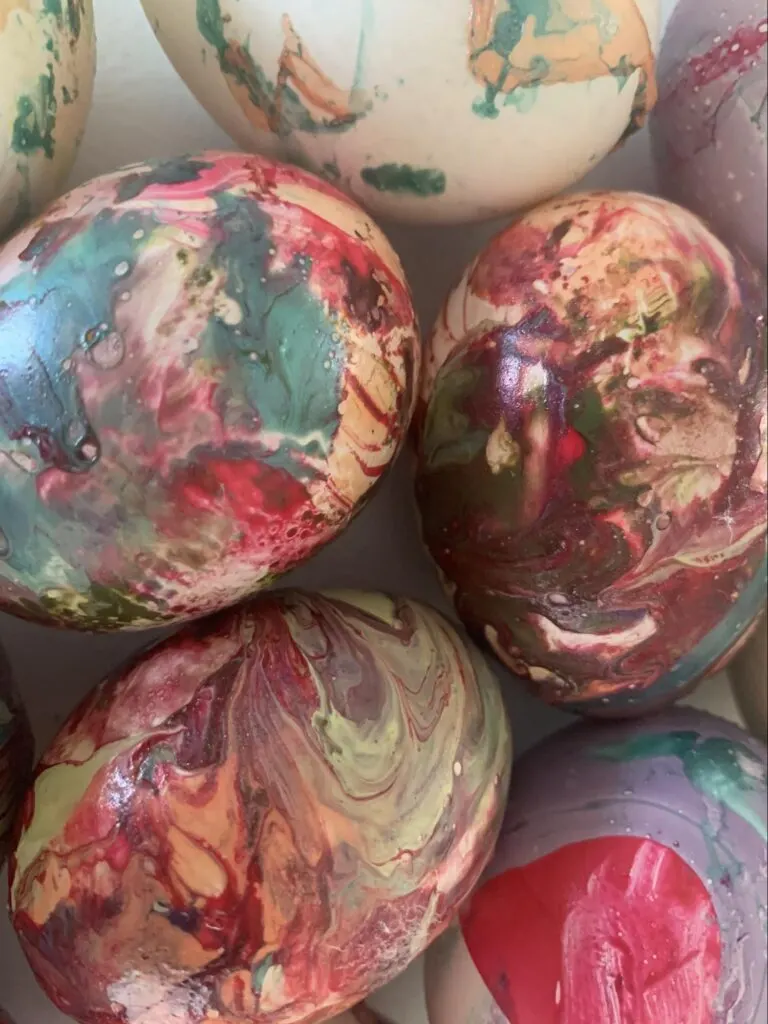
For this STEAM activity, we will be hydrodipping eggshells to create “dragon eggs.”
What is hydrodipping? Hydrodipping is a method used by artists and hobbyists all over the world to add a beautiful, decorative design to various surfaces.
When I was growing up, my mom would hydrodip all kinds of things for us so they would be personalized and labled without looking lame. I remember having hydrodipped water bottles, hydrodipped hair accessories, and even hydrodipped shoes.
She was quite the decorator.
You can grab an easy hydrodipping kit for beginners on Amazon if you want to dive into this hobby yourself. It can be quite rewarding.


Or keep reading to see how to make your own hydrodipped eggs using supplies you probably already have at home!
For this activity, you will take a bowl of water and pour various colors of nail polish into the water. Since the nail polish is less dense than the water, it will float.

Then you will place the hard boiled or fake egg into the water to hydro dip.
When it touches the nail polish, the polish will stick to the egg creating an amazing marbleized pattern looking like a “dragon egg.”
Materials Required For Your Marbled Eggs STEM Activity
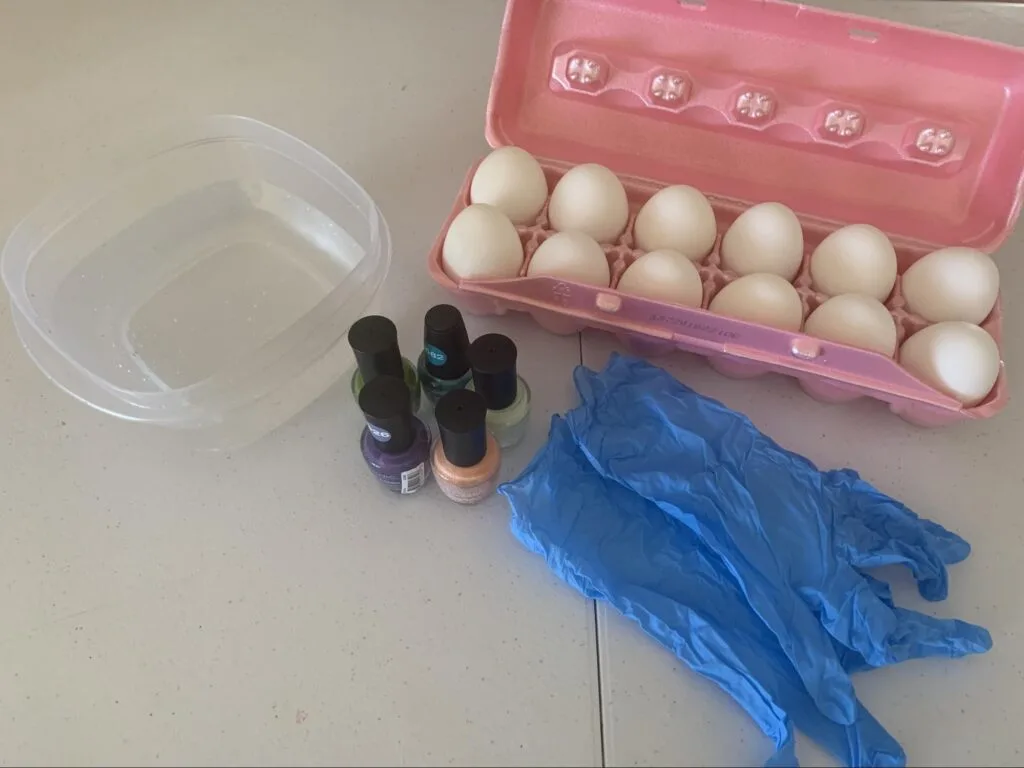
- Hard boiled eggs or fake dyeable eggs
- Water
- Small bowl (you could also use plastic cups but bowls are easier)
- Nail polish (various colors)
- Gloves
- Plastic bowl large enough for a few eggs (that you don’t mind getting ruined)
- Pencils or chopsticks (that you don’t mind getting ruined)
- Paper towels
Note – If you decide to go the edible route, just swap out nail polish for drops of food coloring and the water with either vinegar or cool whip. The hydrodipping will work better with water and nail polish (or paint) but if you want to eat these eggs (like boiled Easter eggs) you’re not going to want to use nail polish. In the past, I’ve also used shaving cream but that’s not edible either so if you’re going for edible, choose cool whip. Cool whip and food coloring is one of our favorite ways to dye Easter eggs that we’re going to store in the fridge and eat.

Making Your Beautiful Marbled Eggs – A Simple Tutorial
Follow this marbled egg tutorial and learn how to easily make your own marbled eggs!
Initial Prep:
- Hard boil eggs or purchase fake dyeable eggs. If you are hard boiling eggs, they will not be edible after this project.
- Make sure the eggs are at room temperature before making them into dragon eggs.
Project Steps:
- Fill the plastic container about halfway with water.
- Shake your nail polish.
- Put on gloves.
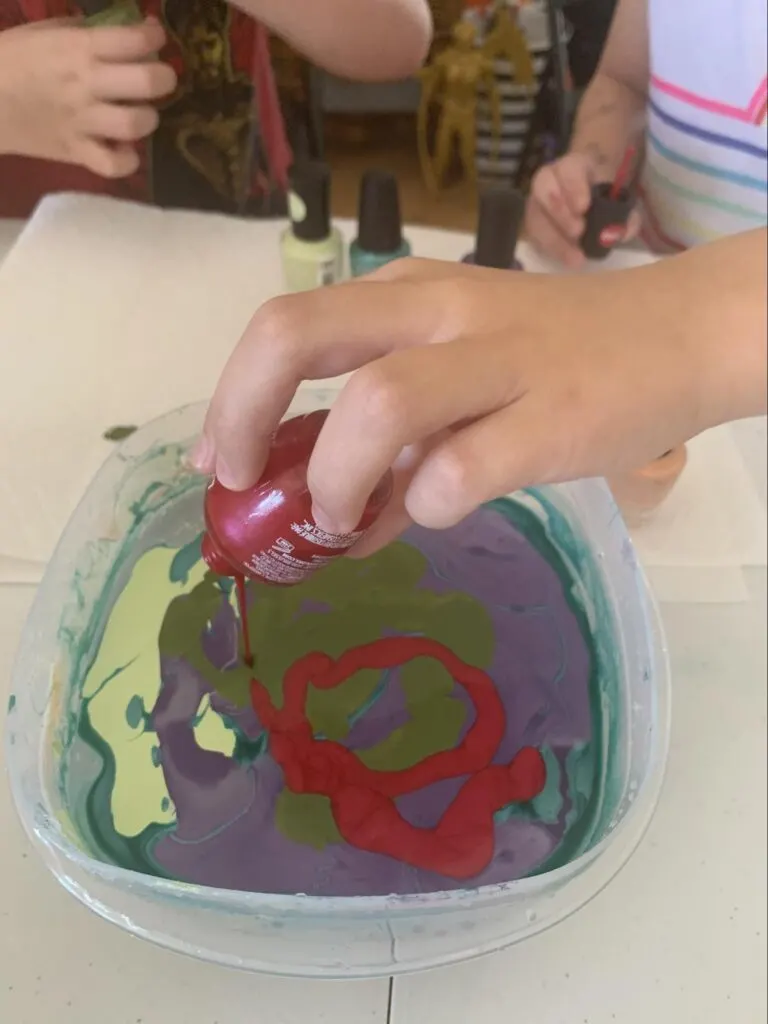
- Pour a few nail polish colors into the water. Some nail polish will float better than others. We started with 3-4 nail polish colors. (Experiment and find which colors float the best.)

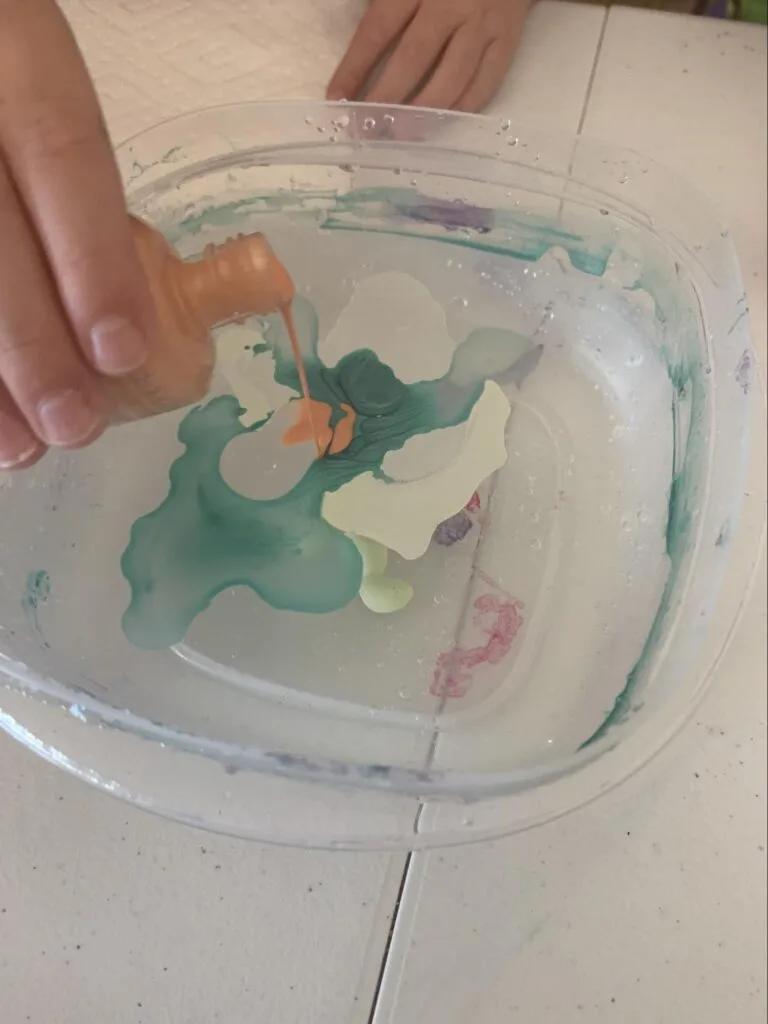
- Gently submerge an egg in the bowl. Do not “drop” the egg into the bowl as this will create a splash that could send nail polish to places you do not want it.
- Use a pencil or chopstick to move the egg around to coat it with the nail polish better.

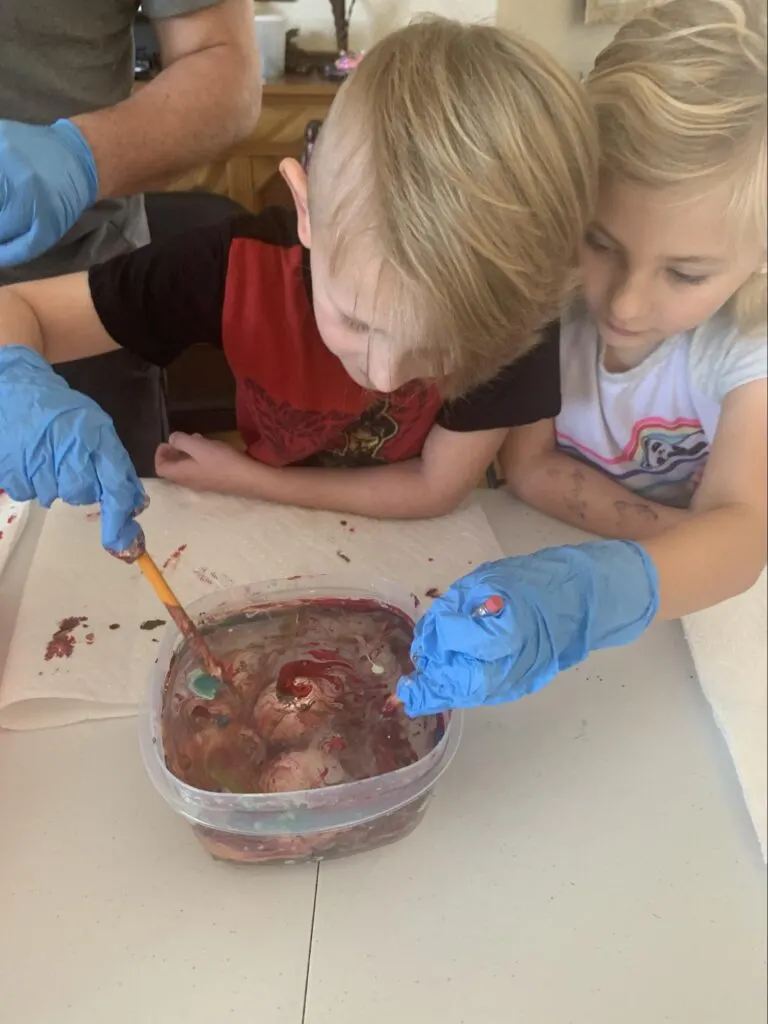
- When the egg has the design you like remove it and place it on a paper towel or area to dry.
- Dump out water, rinse the bowl, and repeat with different color combinations. See what different kids of marbled effects you can create!
Follow Up Questions and Activities – Ideas For Taking This STEM Project Further!
Ask your students the following questions to keep the learning going.


- Why do some nail polishes float better and others sink?
- What other objects could be dipped?
- Why does the nail polish and water not mix? If we stirred the bowl quickly, would the nail polish and water ever mix together?

Consider completing some of the following activities so you can keep learning and having fun. These ideas are particularly great for older kids.
- Add other liquids to the bowl to show liquid density.
- Consider hydrodipping other objects to sell. Encourage older kids to start their own side businesses and sell unique, decorated items to their friends and family. Or have them join a local kids business fair!
- For older kids, introduce the formula for calculating density. Have them calculate the density of various objects and determine using only the math whether specific items will sink or float. Have them test their math and see if they were right! Density= Mass/Volume.

The Science (And STEM) Behind Marbled Dragon Eggs
The science behind dragon eggs comes down to density. Nail polish is less dense than water, therefore it floats at the top.
There will be some nail polish that will sink. This is said to be because there is a thin film on the polish or the water which changes the density of the nail polish making it more dense than the water.
What Is Density?
Density is how much mass is in an object. It can help you to find out if something will sink or float. This is because some objects are more dense than others, which means that they have a greater amount of matter in one given unit volume, as opposed to another object with less matter per unit volume. For example, iron is more dense than wood, so an object made of iron will sink in water, whereas an object with the same volume made of wood would float.
To explain what density is you need to know how to calculate it. Density is calculated by dividing mass (the amount of matter within an object) by volume (how much space that mass takes up).
Density= Mass/Volume
In short, Density is how much mass an object has and how much space it takes up.
So for example, if you have a brick that weighs 2 kg and it has a volume of 0.05 m, the density would be:
Density= 2 kg / 0.05 m = 40 kg/m^3 (or 40 g/cm^3)
Another way to calculate density is by using the SI unit kg/m^3. You would just use this if you know that the unit in which the mass or volume is given in is kg, for example it could be 10 kg/m^3. Density = Mass / Volume
Density= 10kg / 0.5 m = 20 kg/m^3
How Does Density Affect Whether an Object Will Sink or Float?
If tIf two objects have the same volume, but one has a higher mass than the other, then this means that it has more matter within it and so it will be denser.
If you place these two objects in the same liquid (for example, let’s say both are placed within water) then the object with more mass will sink to the bottom if it has a higher density than the liquid. The other object with less mass will float because it is less dense than the liquid.
Tips and Tricks to Make Your Marbled Egg STEM Activity Go As Smoothly As Possible
- Nail polish is very strong smelling so make sure you are in a well ventilated area and take breaks if that affects you or your family. Wear a respirator mask if necessary.
- Hydrodipping can quickly become fun and addicting. It’s very easy for kids of all ages to enjoy. We grabbed a few packages of plastic animals and dipped them and now we have rainbow animals and the kids love them.
- The more nail polish you add to the bowl, the thicker it will coat the item you are dipping. Keeping it to 3-5 colors in a thin layer is best. Otherwise it gets clumpy and it takes quite a while to dry.
More STEM Resources for Kids (Including A Free Printable)
If you liked this activity, you are going to love the STEM Made Easy Digital Subscription. Each month, you receive a project pack that includes 5 fully planned STEM project guides along with worksheets and instructions for how to make them fun and engaging for kids ages 3-19.


Want a free project sample? Sign up to get a complete 39-page project guide sent to you so you can see exactly what’s inside each of the STEM Made Easy Digital Subscription project pack.
I’ve also got this ultimate list of STEAM and STEM activities for kids of all ages if you want to take a look.
More Post Related to Dragons and Marbled Eggs
Easter Egg Dying Science Experiment
Dragon STEM Activities
The Ultimate Collection of STEM Activities
- Free Printable Valentine Multiplication Worksheets - June 4, 2025
- Free Printable Martin Luther King, Jr. Word Scramble - June 4, 2025
- Digital Math Curriculum | Pros, Cons, and Options - June 4, 2025