


If you’re looking for fun gardening projects or garden-themed STEM activities for kids, then you have got to take a look at this next activity. Today I am going to show you how to regrow food from kitchen scraps with your kids!
My kids always joke that I have got a black thumb. I am no garden whiz by any means and every time I try to start a traditional garden, without fail everything I try to grow dies. But for some reason, unconventional gardening methods always turn out well for me. Go figure!


This Spring, our homeschool STEM curriculum is focusing on nature, the great outdoors, and all things gardening. It’s been a ton of fun and we have all learned a lot about gardening. This regrowing kitchen scraps activity is certainly no exception.

This article may contain affiliate links. Please see our disclosure policy for more details.
Easy Navigation
How Does Regrowing Food from Kitchen Scraps Count as a STEM Activity?
The purpose of this project is to show students how to create renewable food sources from things they already have access to, such as leftover vegetables and kitchen scraps.
In this project, we will be regrowing vegetables from plants that we already harvested food from. Most people know that a fruit can be harvested from a plant every harvest season and every year, year in and year out.


When it comes to vegetables where you are eating the plant itself, does that mean you have to start from seed every time? The answer is it depends.
There are many vegetables that can actually grow back over and over and over and like a fruit plant gives you good stuff to eat multiple times instead of just once.
This project definitely counts as a science experiment due to the lessons regarding vegetation, asexual reproduction, plant life, and botany in general. However, if you are willing to look beyond the obvious, you could also enjoy some mathematics (counting, measuring, predicting) and engineering (building a safe place for your food to grow).
Let’s get started, shall we?


Preparing and Regrowing Your Food Items
Lettuce
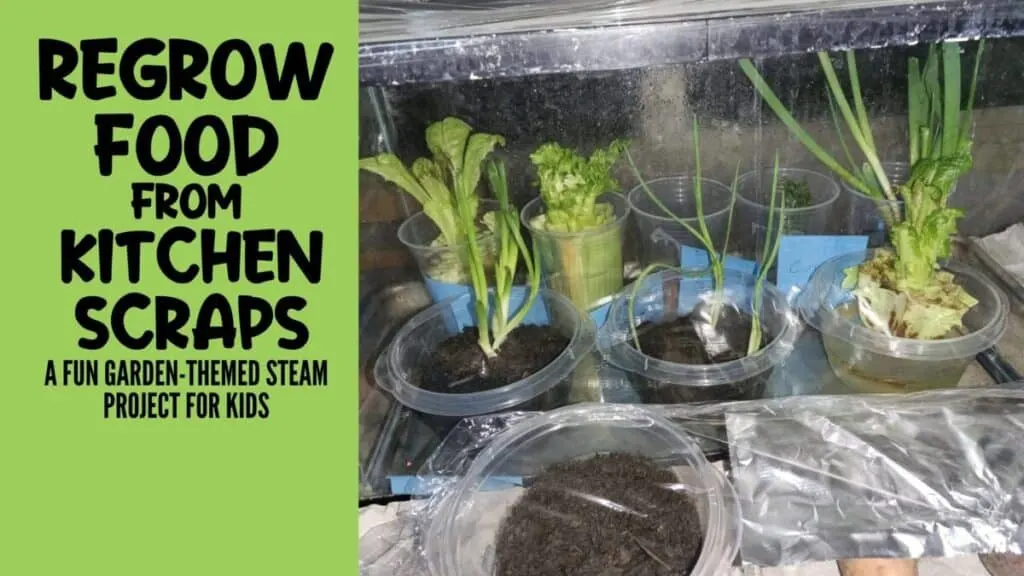
Cut your lettuce about 3 inches from the base. Place in a cup or bowl of water. Be sure to only put in an inch or so of water so the lettuce doesn’t rot.


Green Onions
Cut green onions about 1.5 inches from the bottom. Place in a cup or bowl of water.
Onions
Take a big slice out of your big onion right where the roots used to be. Place the root part down in a few inches of potting soil. Water gently.

Potatoes
Place your potatoes in a darker area. We made a cave for ours out of tinfoil. Once the potatoes begin growing ‘eyes’ you can cut the potato into several chunks and plant each chunk in soil individually.
Alternatively, you can just plant the whole potato in soil from the very beginning.
Celery
Cut celery about 2-3 inches from the base, similar to lettuce, and place in water.
Garlic
Take one clove of garlic and place it in soil. Water gently.
Ginger Root
Cut off a section of the ginger root and plant in soil. Water gently.


For All Food Items
No matter what vegetables or herbs you are regrowing, you must allow time to grow and you must water as needed. Make sure your cups and bowls of water never dry out and keep your soil moist but not too wet.
Once roots form on your cuttings, you can transplant them into a more permanent location, should you desire.
Each of these plants will have specific needs so if you want to grow them for longer than a week or two, be sure to research what each plant needs so you can have a bigger harvest. Or in the case of green onions, celery, and lettuce, just keep the bowls close to your dinner prep area and harvest daily as needed.
Follow Up Questions
Enhance your child’s learning experience by asking the following questions. Feel free to engage in discussions or further research with your kids.
- Why did these plants grow?
- What is the difference between fruits and vegetables?
- Why is it important to have or know how to have a garden?
- When in history has gardening been absolutely necessary for survival?
- Have you ever seen a food shortage in your lifetime? Did having a garden help?
Ideas for Taking the Learning Even Further
If you liked this project, feel free to take the learning even further! Older students in particular will benefit from some of these other learning ideas.
- Continue this project for a long period of time. How many times can you eat off of your regrown plant before it isn’t able to regrow anymore?
- Research other plants that can be regrown.
- Select some plants that you did not already grow with this project. Grow those plants. Compare and contrast how this project worked vs how that project worked.
- Now that you have experienced vegetative propagation, come up with another plant that follows a different method of reproduction. Grow a plant using that method. Compare and contrast each experiment. See if you can grow something successfully using all four methods of asexual reproduction in addition to sexual reproduction (using seeds).
- Research Heirloom vs GMO plants and how each has their place in the world and in our lives. (Note – this one can get really political really quickly so if that is something you want to avoid, don’t research this one.) Both Heirloom and GMO plants are useful for certain situations.
More STEM Resources for Kids
If you liked this activity, you are going to love the STEM Made Easy Books. Each book includes 10 STEM projects along with instructions for how to make them fun and engaging for kids ages 3-19. Take a look at the third edition, the Gardening Edition. Or read more about the books in this article on homeschool STEM curriculum.


Want a free chapter sample? Sign up to get a complete project chapter sent to you so you can see exactly what’s inside each of the STEM Made Easy books.
I’ve also got this ultimate list of STEAM and STEM activities for kids of all ages if you want to take a look.
as an Amazon Associate, I earn from qualified purchases



More Gardening Posts for Kids
STEM Made Easy Gardening Book
Classroom Aquaponics
DIY Seed Bombs
- Free Printable Valentine Multiplication Worksheets - June 4, 2025
- Free Printable Martin Luther King, Jr. Word Scramble - June 4, 2025
- Digital Math Curriculum | Pros, Cons, and Options - June 4, 2025
BonnieJ
Thursday 21st of April 2022
This is absolutely fascinating! Thank you for posting. I’ve only tried green onions once and they re-grew for about three months!
Clark Ju
Sunday 12th of September 2021
Great pictures of regrown kitchen scraps. Thanks!