




Have you ever asked yourself what the ideal homeschooling schedule looks like?
Maybe you don’t want the perfect homeschool schedule and instead you are just looking for a bunch of homeschool scheduling ideas that you can use to creat your own ideal schedule?


While it’s true that no two homeschooling families are exactly alike, it is also true that many homeschooling families look very similar and subscribe to similar philosophies in regards to styles and methods, as well as schedules.
In this blog post, we’ll dive into different homeschooling schedule ideas that will help you find the right rhythm for your family.
Whether you prefer a structured block schedule, a flexible loop schedule, a simple checklist approach, or something entirely different, we’ve got you covered. Let’s explore these options and find the one that fits your unique homeschooling needs. Get ready to reclaim your sanity and create a routine that works for you!
This article may contain affiliate links. Please see our disclosure policy for more details.


Easy Navigation
How Much Time Should I Spend Homeschooling My Child?
So tell me – what does your ideal homeschooling schedule look like? Perhaps we should begin by answering the question, “How much time should I spend homeschooling my child?”
I recently came across a great blog, Raising Royalty. Sarah has a great article about the amount of time each child should spend working on schoolwork.
In her article, Sarah has a beautiful infographic that illustrates exactly how long you should be ‘schooling’ each of your children, based on age. For example:

PreK students only need 20 or so minutes of school time a day. Fourth graders need two hours, and tenth graders need four hours. (This may seem drastically different from the public school schedules you are used to, but keep in mind that homeschooled kids have customized, one-on-one educations and therefore learn things much faster than they would in a traditional schooling setting.
This infographic is a great example of how quickly a child will learn when they’re in a homeschool environment. Link to that article here. It’s a great read if you’re at all worried about not spending enough time schooling your child, and a perfect blueprint for getting started with your own homeschool scheduling system.


Homeschool Schedule Options
There are many options when it comes to a daily homeschool schedule. Just a few of those include:
- Block Scheduling
- Loop Scheduling
- Checklist Scheduling
- Term Scheduling
- Calendar Scheduling
- Year-Round Scheduling
- Traditional Schooling Scheduling
Each of these homeschool schedules work well for some families, but not all of them is right for everybody. It’s up to you to determine which scheduling method is right for you and your homeschool. And remember – don’t be afraid to switch things up if something’s not working!



What is Block Scheduling?
Block scheduling is probably one of the most popular methods used when it comes to homeschool planning and schedules. A block schedule is similar to a term schedule (see below) except you might work on a handful of subjects (think three or so) in a given ‘block.’
Block schedules are very similar to college schedules. Students might plan on taking certain subjects for a certain period of time (six weeks, three months, etc) and those are the subjects they focus on every day throughout that period of time.
With this homeschool scheduling method, you are focusing on fewer subjects, which means you have more time in a day to spend on each activity (think two or three hours of writing instead of just 30 or 45 minutes). At the end of your block period, you move on to another handful of subjects and start again.
What is Loop Scheduling?
Loop scheduling is one of the most popular homeschool schedules there is, right after block scheduling. With a loop schedule, you make a list of things your homeschool needs to study.
For example, your schedule might include math, reading, science, geography, history, typing, etc. You then proceed to spend your day moving through that schedule. Wake up and get started on math. Finish your math and move on to reading.


When you’re moving through your day’s lesson plans, expect to get interrupted. Younger children might need your attention or older kids might need to get to an extracurricular activity, or maybe you all just need a break. With a loop schedule, you are free to stop your homeschool day wherever you are and just move on to something else for as long as you need.
When you’re ready to get back to work, whether that’s later that evening, the next day, or even a few days later, you just pick up right where you left off in your loop schedule. Finished reading the last time you worked? Great. Now it’s time for science, and then geography (as an example).
With a loop schedule, homeschooling families are free to allow plenty of flexibility into their days without feeling like they neglected something important.
What is Checklist Scheduling?
Checklist scheduling is one of my personal favorite scheduling methods and is one that we go back to regularly.
With a checklist schedule, you make a list of subjects or activities you want to accomplish in any given day. Each item on your list should include a specific goal.
For example, your checklist of goals might include reading for 30 minutes, completing two math lessons, and getting through your study of topographical maps (or something). You might have an individual checklist for each of your kids, or you might have one big checklist that everybody follows together.
Regardless, with a checklist scheduling system, your kids are in charge. They get to determine which item on the checklist they start with and what order they go in. This gives your kids a sense of control over their homeschool routine, without surrounding all of your goals for a successful homeschool.
BONUS – families that follow a checklist scheduling method find it easy to include kids’ chore charts into their daily checklist with no extra stress or effort.
Checklist scheduling is actually a method of homeschool planning that can work well independently or in conjunction with one of the other scheduling methods. Are you following a term scheduling method? Perfect! If you’re studying history this term, you can still determine which order you work on which book or which assignment on a daily basis.
If you are interested in trying out the checklist method of scheduling your homeschool, I’ve got a free digital checklist to get you started. Feel free to download this checklist and edit it however you see fit.
What is Term Scheduling?
Term scheduling is a method of homeschool scheduling that is especially popular amongst unit study homeschoolers or project-based homeschoolers. If you struggle with the idea of having to fit too many things into your homeschool day and you find there’s just never enough time in the day to get everything done, then you might benefit from adding term scheduling to your homeschool.
So what is term scheduling? With term scheduling, instead of trying to fit 5+ subjects and activities into a certain day, or even a certain week, you instead pick one or two subjects that you want to focus on for the next few weeks (usually five or six but that’s flexible too).
For example, you may decide you want to focus on STEAM activities for a few weeks. In a term based homeschooling schedule, you’ll gather a bunch of STEAM activities you want to try and you’ll do nothing but STEAM projects for a month or two. When you’re done with your STEAM term, you’ll take a week or so off and then start a new term, this time surrounding a new subject such as history or geography.
Families that follow a term homeschool schedule find they have plenty of time to really dive into a particular subject or activity without feeling the pressure to move on before they are ready. And because terms switch so regularly, in an overarching school year, there is plenty of time to study all of the required subjects.
What is Calendar Scheduling?
Calendar scheduling is a very popular homeschooling schedule method amongst families who live in Australia, but families in other parts of the world also find this type of schedule easy to follow.
With calendar schooling, your yearly homeschool schedule starts in January right after the Christmas holidays. This is when your kids will move up a grade (should you follow traditional grade systems) and you will continue with that year’s homeschool schedule until you end for the year, typically around the holidays (think October or November).
Calendar-based homeschool schedules work well in conjunction with methods such as loop scheduling, block scheduling, or checklist scheduling. But don’t feel trapped in a box. This is your homeschool and you are free to change things up as you see fit.
What is Year-Round Scheduling?
Year-round scheduling is a very popular thing amongst seasoned homeschoolers. You’ll find that many homeschoolers prefer to take their time off from school when the local school districts are in school as this makes for less crowded roads and venues.
Additionally, some kids don’t do well with months and months off of school every summer, and other times families don’t do well with any kind of structured schooling during the holidays. Year-round scheduling is perfect for these families.
Note: if that sounds like your family, check out our article on summer homeschool scheduling.
In our homeschool, we practice year-round scheduling. We typically start school in July or August, depending on when our big extended family vacation is. We’ll work through the rest of the summer and fall and then we’ll take off the week or so before Thanksgiving all the way until the week or so after Christmas. (Christmas is HUGE at our house and I’d much rather focus on holiday fun than schedules and routines.) Then we tend to work again until May or June, depending on how ambitious we’re feeling by that time.
This simple homeschool schedule allows us the flexibility to take random days off throughout the year without feeling like we’re not getting enough school time in. So far we’ve lived in states that are very lax in their homeschooling requirements, but should we ever move someplace that requires a certain number of hours or days of homeschooling in a year, we won’t have to adjust too much in order to meet those requirements.
What is Traditional Schooling Scheduling?
Traditional schooling is just what it sounds like. The traditional school scheduling method follows the local public school schedules. This can be of benefit if you want to make sure your kids are ‘off from school’ when their neighborhood friends (or cousins) are.
This is also the schedule that most new homeschooling families start with because it’s what they are familiar with. And honestly? Following the traditional schooling schedule works for a lot of homeschooling families.
With this homeschooling schedule, your new school year starts up on the same day as the local school kids. You plan the same days off, the same holidays and vacations, and you plan to end for the summer at the same time as your local school district.
Families choosing to follow this method for homeschool scheduling can choose to have flexible days or days filled with structure and routine. Feel free to utilize this method of scheduling in conjunction with other methods such as checklist scheduling, calendar scheduling, or loop scheduling.
Making Your Printable Daily Schedule
Once you’ve decided on the overarching homeschool schedule(s) you want to follow, now it’s time for you to set up your detailed, daily homeschool schedule.
To start with, grab yourself a calendar. Depending on the method you choose, you might want a monthly calendar that allows you to write daily details in each day’s space, or perhaps a quick year-at-a-glance calendar will work better for you.

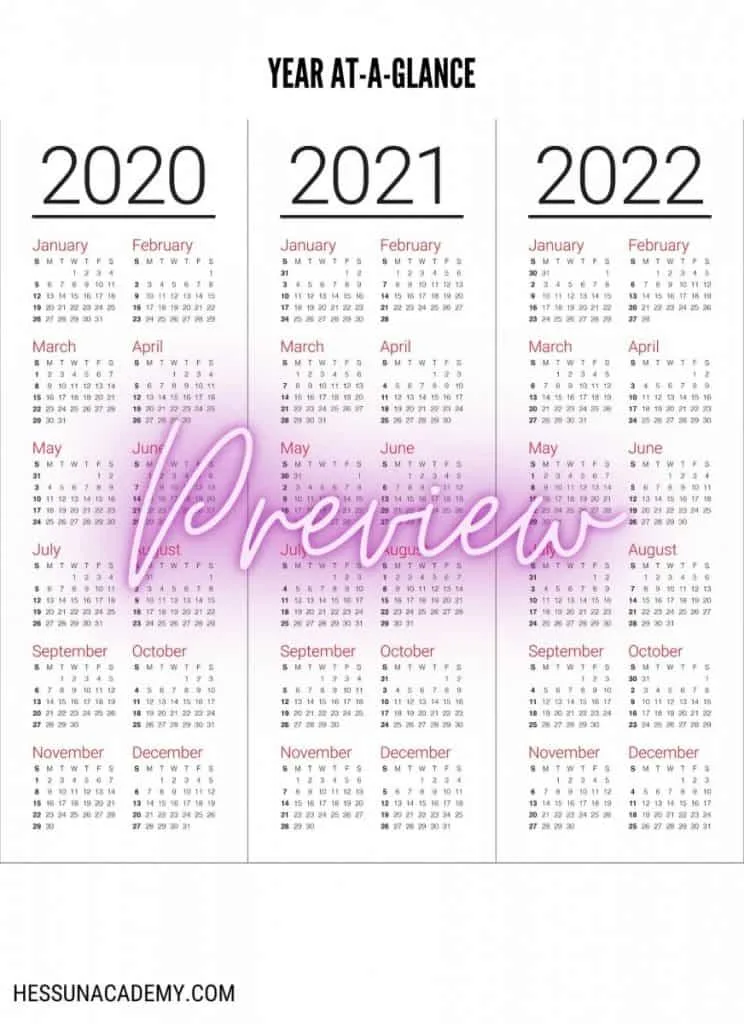
You can make these easily yourself using Microsoft Word or Canva online (free), or feel free to use another program. Use these calendars to cross out or circle days you will or will not be schooling, or to write in what you plan on focusing on that day.
Alternatively, if you don’t want to spend the time or energy creating your own calendar, my friend Christine from This Bit Of Life has a beautiful homeschool planner complete with a printable calendar you will just love. Her planner is very thorough and I could never do it justice – believe me, I’ve tried.
Or if simple is more your style, I do have a fun homeschool calendar printable available.
It is colorful and beautiful and filled with 30 pages of simplicity – basically, it’s a variety of calendar pages in multiple orientation options so you can put it in a binder or on a wall, or whatever else. It also includes some weekly goal-setting pages, some note-taking pages, and a payments calendar for tracking subscriptions your kids are participating in.
At just $7, it’s a steal! Buy yours today.


Free Homeschool Scheduling Fortune Teller
If you want to somehow combine a fun and random homeschool with the perks of an organized schedule, give this free homeschool scheduling fortune teller a try.

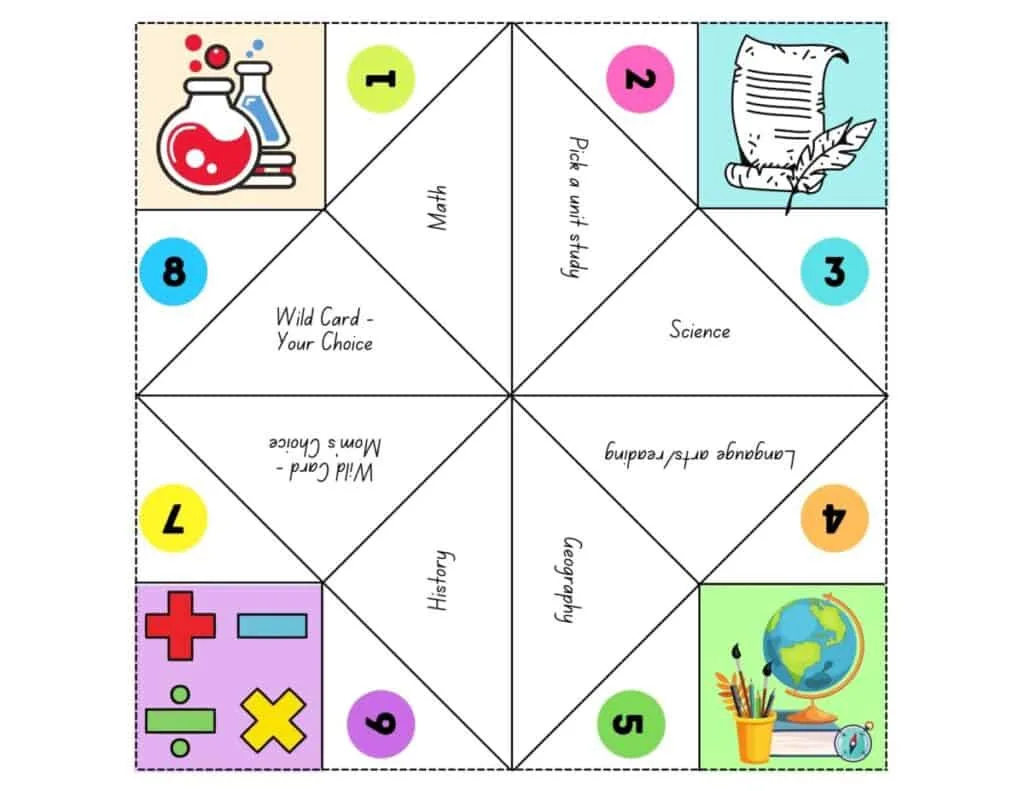
Grab your free Which Subject Homeschool Scheduling Fortune Teller now!
Reminiscent of the old school cootie catchers, this Which Subject Fortune Teller allows your kids to randomly select the subject you guys work on next. Just fold, play, and pick! This resource is perfect for the indecisive homeschooling family who wants fun and unpredictability without losing all sense of structure.
What Does Our Homeschool Schedule Look Like?
I have seven kids so I’m juggling a lot of grade levels and subjects. However, I naturally balk at structure and rigidity so our schedule is a bit more relaxed than most. Our schedule also seems to change and adapt regularly to our family’s current needs But for the time being, this is what our large family homeschool schedule looks like.
NOTE – This is what our schedule looked like as of early 2020, at the time of writing this post. Nowadays (2022) our schedule looks very different. And that’s okay! Flexibility is one of the beauties of homeschooling.
7:30am – Morning Chores
Every morning, the kids wake up and do their chores. Each kid has a chore list that they must accomplish by noon. If they finish their chores before noon then they have free playtime until I call them together.
During this time, I am free to do my own work or get that day’s meal prepped. (I find if I don’t have a meal planned and prepped by noon, then by evening time I have no interest in cooking so I try to plan ahead.)
12:00 Noon – Family Devotional
At noon, we gather for family devotional, or family scripture study. And because each kid takes a turn reading the scriptures aloud, this doubles as reading practice for everybody over the age of three.
1:00 – P.E.
We don’t do formal lessons every single day, but on the days we do, they are right after the family devotional. We begin with an online P.E. class where we follow along to a YouTube video and get our bodies moving for a few minutes. This typically lasts about 30 minutes. If we don’t do a YouTube video for our homeschool p.e., we tend to follow one of these other fun physical education ideas.
1:30 – History
Following our homeschool p.e. I pull up our Family School lesson and we watch a Power Hour video. These videos feature engaging teachers going through our day’s curriculum lesson with us, so instead of me having to prep and present, the video does all the work for me but the kids are still getting a quality education.
We are following a term schedule so we are currently in the middle of an early American history unit. This should take us through October, at which point we’ll probably move onto a science or geography unit, depending on the kids’ interests.
2:30 – Math
Following our video lesson, we move onto math. The older kids are each required to do 3-4 lessons of CTCMath per day, and the younger kids enjoy some Math Seeds. This usually takes between 20 and 30 minutes, depending on the age and focus of the child in question.
3:00 – Reading
Now normally by 3:00, I am tired of school and ready to set the kids free, but on days I’m not worn out, we either listen to a read-aloud together as a family (courtesy of audible) or I assign each kid a book to read for a few minutes. During this time, the younger kids either play on Reading Eggs or HOMER Reading.
After reading, we’re done for the day! It’s a simple schedule with a lot of room for flexibility, but it works for us.
Large Family Homeschooling Schedules
While large homeschooling families might benefit from any of the popular scheduling methods listed above, having homeschooled a large family myself for many years, my personal favorite homeschool schedules for large families include the checklist method of scheduling and the loop method of scheduling.
These two scheduling options offer the most flexibility when it comes to having both old and young children in the home. These methods also allow for a lot of field trips, which our family is really into.
Field trips are great because younger children and high school kids can learn something and enjoy exploring fun and exciting places without the need for everything to be catered to their own specific age range. In fact, as a homeschool mom of 7 kids, I’ve got a lot of tips for large homeschooling families.
Raising Successful Human Beings, Not Good Test-Takers
Our goal as a homeschooling family is NOT to teach our kids how to be good at book work. At this young age, book work is how we are teaching them the basics of reading and math. And that is important.
But our goal as a homeschooling family is to raise children who are proficient in life. So if we go days or even weeks without opening a book, and instead they learned how to build a treehouse, or write a short story, or bake bread, then that’s great!
Related Post – The Hess UnAcademy Homeschool Method
That’s the best part about homeschooling.
Being a homeschool family is a beautiful thing because homeschooling allows you to raise your children YOUR way with YOUR values. Homeschooling is not supposed to be stressful. If something is not working, make some changes! These are your kids – raise them your way.
Of course, these are just a few examples of homeschooling schedule ideas. The beauty of homeschooling lies in its flexibility, and you have the freedom to create a schedule that works best for your family’s unique dynamics and learning styles. Some families may find a combination of different scheduling methods or even a completely customized approach to be the most effective.
The key is to experiment, observe what works best for you and your children, and be willing to adapt as needed.
Remember, homeschooling is a journey, and finding the right schedule is a process of trial and error.
Embrace the flexibility and enjoy the opportunity to tailor your child’s education to their individual needs and interests.
Remember – Homeschooling is not supposed to be stressful.
Related Posts
- Why Homeschooling Doesn’t Have To Be Scary
- 7 Reasons Why We Choose To Homeschool
- Large Homeschool Family Tips
- How to Make a Homeschool Morning Basket
- Free Printable Valentine Multiplication Worksheets - June 4, 2025
- Free Printable Martin Luther King, Jr. Word Scramble - June 4, 2025
- Digital Math Curriculum | Pros, Cons, and Options - June 4, 2025
Sarah
Wednesday 7th of August 2019
Thank you so much for kind words about my blog and my post!! Since every homeschooling family is different, your schedule is going to look different than mine, and that's totally OK. Homeschooling really is a lifestyle, not just an educational alternative.