

Easy Navigation
What is Lifeschooling?
There are many different ways to homeschool. In fact, there are probably about as many ways to homeschool as there are homeschooling families!
From Charlotte Mason to Waldorf, from Unit Studies to a more traditional school such as Online K-12 – homeschooling methods and styles can quite literally span the board. In fact, there are nearly as many homeschooling methods as there are homeschoolers.


This article may contain affiliate links. Please see our disclosure policy for more details.
You can read more about just a few of the popular homeschooling methods here.
But First – What is lifeschooling?

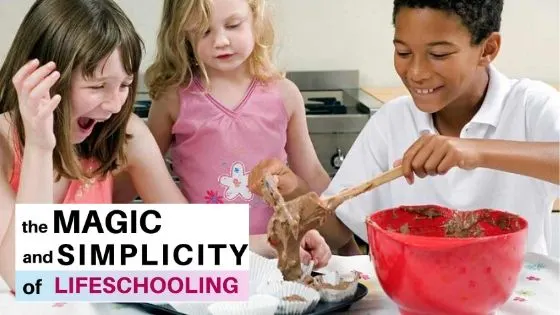
Lifeschooling is a term used to describe that happy little space that falls between unschooling and relaxed homeschooling.
Families who practice ‘lifeschooling’ are families who believe there is learning all around them. These are the families who are more than happy to forgo the workbooks and curriculums and instead spend the day in the kitchen or out in the shop.
Real-life experiences we all enjoy as part of our real-world everyday life are the main curriculum for lifeschoolers.
Kids are free to follow their own individualized process, but still have a strong hand of guidance from their parents and from that child’s God. These are lifeschoolers.
Lifeschooling is not so much schooling as it is learning through real life.
When I (Charlene) first started homeschooling my kids, I didn’t really know what style I fit into. I didn’t really have a homeschooling ‘tribe’ or homeschooling mom friends who I really connected with.


I didn’t care too much. I knew what worked best for my family, and I wasn’t afraid to do what I knew was best for us.
Our family bounces around from worksheets to bookwork regularly. But just as regularly, we forgo all ‘traditional schooling’ and instead spend weeks at a time doing nothing but field trips and family projects.

Every day presents its own unique situation and that mystery gives us a happy little thrill.
For example – we just began using the online strategy game Age of Empires as our homeschool history curriculum.
We are also in the middle of building a classroom aquaponics system. This has been a fun family STEM project!
I still don’t know if our family life exactly fits into the ‘lifeschooling’ category. I don’t know if we really fit into any particular category at all. And that’s okay!
As long as you’re teaching your children in the best way you know how, then you are doing great!


And finding the method that fits your own personal family life will help you avoid homeschool burnout and heartache surrounding your child’s home education.
Homeschooling and Learning the Lifeschool Way
Have you ever spent your entire summer researching, planning, and buying curriculum that you thought would be perfect for your family, only to have all your plans fall apart just three weeks into the new school year?
Let me tell you, this was the story of my life for the first four years of our homeschool career.
You would think I would catch on a little sooner, but I didn’t.

How Our Lifeschooling Journey Began
Public School Created A Fearful Child
We began homeschooling almost immediately after immigrating to Canada from Germany.
Our eldest son spent six months in a German elementary school and that was enough to turn an inquisitive little boy into a fearful child, whom we basically had to drag to school.
You see, homeschooling is illegal in Germany and that was made quite clear on our son’s first day of school. The children were threatened by their teacher to always come to school and stay on the school ground until dismissed, otherwise they would be police escorted (back) to school.
Making The Decision To Homeschool
I spent the first few weeks in Canada finding out the laws surrounding homeschooling.
I looked into registering my child with a school board, bought a bunch of books and crossed my fingers that I would be a good teacher and that my kid wouldn’t hate me.
I thought that if I replicated school at home and that if I didn’t diverge too far from the road well-traveled, my son would get an “okay” education. After all, I wasn’t a teacher and I truly thought that I would fail my child because I wasn’t qualified.
Traditional Homeschooling Was Miserable For All Of Us
We struggled along and in the following year, his sister joined him at the kitchen table.
To make a long story short, the children were miserable.
They hated the books I chose. They hated diagramming sentences and thought that the math book would kill them because it was so repetitive. In the meantime, their little brother was destroying the house.
I wanted to quit. I was no good at homeschooling. My children were miserable and I was a mess.

Accidental Lifeschooling
Fast forward a few years.
There was a new baby who was very sick and needed mommy 24/7.
We were forced to do life and not school, at least not in the traditional sense.
Their brother needed a lot of attention, so the older children learned how to prepare simple meals out of sheer necessity. They liked helping mom in the kitchen, but now they were learning how to fry eggs and bake muffins almost by themselves.
We still read and went to the creek for walks and visited a nearby open-air museum. I realized that the children were doing okay, actually, they were thriving and so was I.
God Called Us To Lifeschooling
It was sometime around then that our homeschool philosophy changed.
God had called us to something.
I could feel it.
Our life was flipped upside down so many times in those early years.
During the first five years homeschooling, we experienced two miscarriages, had two babies, two of us were diagnosed with celiac disease, my husband changed jobs twice and we bought our first home.
Our life seemed crazy and messy and that’s when lifeschooling became our saving grace.
I realized that our children learned better when we finished all formal lessons by noon.
Formal lessons consisted of math, reading and language arts and a rotation of history, science, art, music, and unit studies.
The afternoons were spent exploring our interests.
We went on nature walks, went to the playground, visited friends or neighbors, watched movies or documentaries, gardened, played games and lived. We also built things, went on field trips and even went camping for the first time.
What Lifeschooling Taught Me
What I learned…
The more I let God lead our children’s education, the more relaxed I became.
We started choosing to study subjects based on the children’s talents and interests instead of what the scope and sequence dictated.
One day, one of my children asked me if he could watch a YouTube video about submarines. I found a video about the submarine that sunk the Lusitania.
I had never heard of the Lusitania, but the video had good reviews and looked interesting.
The Lusitania’s fate was a torpedo launched from a German submarine during WWI.
This single video inspired a different child to do an in-depth study of WWI. I helped him choose books to read and he then immersed himself into some amazing “living” books.
This inspired him to study WWII and take an online class that used Socratic discussion to talk about John Keegan’s book “The Second World War.”
This prompted yet a different child to study the History of England.
One simple question changed the course of our study plans immensely.
Why You Should Try Lifeschooling
This lifeschooling thing might look scary at first.
It might look disorganized and not structured enough for your taste.
I admit, at first glance, lifeschooling can appear unstructured. Especially if you are coming from the perspective of a strict homeschool philosophy like Charlotte Mason or Classical. It might even come across as unschooling.
However, our version of lifeschool includes rhythm, routine, structure and lots of freedom. So can yours.
Lifeschooling Can Be Structured
We have a daily and weekly rhythm that includes meal times, chore time, morning time, independent study time (math and language arts and other subjects for the upper grades), and plenty of free time.
Plan your day to include life.
Life happens, children’s interest change, your family situation may change.
Find your rhythm, discover your talents, your children’s gifts and start from there.
You might consider some ideas for alternative homeschool days.
Our afternoons are spent pursuing hobbies, exploring outdoors and watching documentaries and playing games.
These also cycle depending on the time of year.
Our winters are long and very cold. We spend a lot more time indoors reading, crafting, computer coding and watching shows.
Weather permitting, we are outside gardening, building things, doing car maintenance, going on hikes, going on field trips, taking online courses or playing.
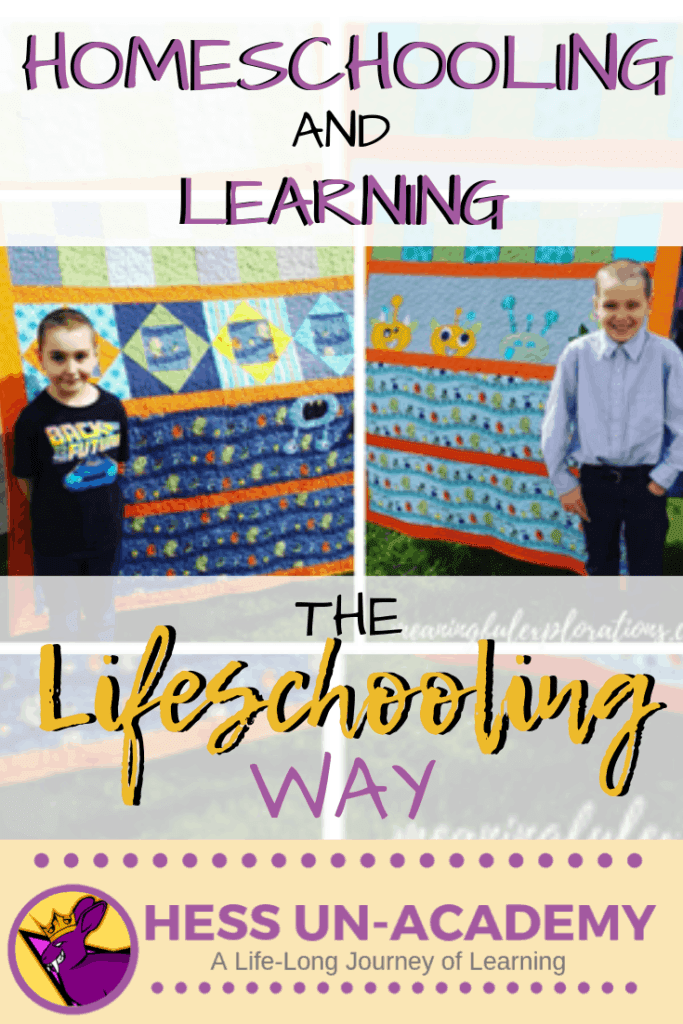
The children and I find things that interest us and learn all that we can. This past winter, four of the children made quilts for their beds.
This coming summer, we are expecting a baby and in the fall our oldest is heading off to college. Our life is about to change again.
Life doesn’t stop because homeschooling starts again in the fall. I will plan the core subjects, we will try to develop a new routine and we will continue to learn.
My Top 5 Tips for Homeschool Moms…
- Develop a rhythm or routine that feels organic to your family
- Account for life (potty training of a younger sibling, sickness, a move, holidays etc.)
- Deepen the relationship with each child and help them discover their talents
- Try new things
- Find your passions and learn new things
No two families are going to be the same.
Stop comparing your situation or family to others and stop trying to live up to unrealistic expectations.
Sometimes life just happens. Use these opportunities to grow.
Find out what your family charism is. What is each family member good at?
If you don’t know, try out new things.
And mom, don’t stop pursuing your own interests and hobbies. You never know what your children might learn from you. Your passion might inspire them!
Related Posts:
The Ultimate Collection of STEM Activities
Homeschool Curriculum Tips
11 Delicious Edible Science Experiments
Best Books on Homeschooling
What is Lifeschooling?

- Free Printable Valentine Multiplication Worksheets - June 4, 2025
- Free Printable Martin Luther King, Jr. Word Scramble - June 4, 2025
- Digital Math Curriculum | Pros, Cons, and Options - June 4, 2025
Rose
Sunday 14th of August 2022
Thank you for this article. I too am a lifestyle homeschooler. My two children have learned more in doing life skills that most graduated high schoolers will ever know. Learning sticks with them and it prepares them for the future of their grown-up lives. I have stuck to teaching what they will need to know for their future. I do not teach how to do math where it takes a page of math to do one problem. Now and then they will ask if we can do something like we did in the past, no big deal we go back to that. They love to do schoolwork or reading assignments in the vehicle while we are on the road. When we get to our destination, they are free to shop, investigate or have fun. We sit and study nature and marvel at how God created animals. We may do some internet research to find out more information. I like learning different sites where I can go to or the kids can turn, to learn in a different way like playing games that teach something. This year my just 16 year wanted to try a little bit of online school. We will see how that goes for us.