


This article may contain affiliate links. Please see our disclosure policy for more details.
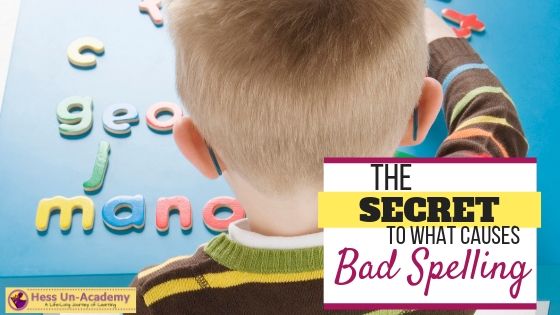
Is your child a poor speller? Let’s discuss what might make a bad speller, as well as some helpful tips and tricks.


Are you raising a child who struggles with poor spelling?
I have a few kids who are naturally bad spellers and regularly struggle with spelling difficulties. Seriously. These kids love to write stories and lists and love notes to family members, but everything they write is just riddled with so many spelling mistakes, it can be difficult to understand what they are even trying to communicate!
I was this way too. I have gotten a lot better at spelling over the years but as a child, I tested in the bottom 2% of my grade level for spelling proficiency.
Is your child naturally bad at spelling? What are you doing about it?
For some people, spelling comes naturally. All they have to do is read more books and practice their weekly spelling test and voila! Fantastic spellers.
But what happens if these spelling tricks don’t work? What happens if, no matter how many times you practice your weekly spelling test, your spelling never improves?
How do you deal with a bad speller?
Easy Navigation
Overcome Spelling Difficulties Without Spelling Tests
Learning how to spell is something everybody must go through. Learning to spell is a necessary component of being literate.
Unfortunately, the English language is not always intuitive when it comes to spelling.


Don’t believe me? Just check out some of these funny memes about spelling and the English language. Some of these English words are hilarious, and not very intuitive.
What good is knowing how to read and write if no one can read what you wrote? (say that 10 times fast!)


Why Some People Are Bad Spellers Has To Do With Learning Style
Did you know that a person’s learning style can affect their natural spelling ability?
Analytical Learning Style vs Global Learning Style
–Thelearningcommunity.us
A learning style is the way in which an individual concentrates, processes, and retains difficult information. Most children learn in one of the two ways—analytically or globally.
Analytical learners process information in a step-by-step method.
Here a little and there a little, they take information, like pieces of a puzzle, and put them together until they see and understand the whole picture.
These children are natural spellers because what is spelling but puzzle pieces coming together?


This learning style tends to be what the public school system is built around. Most people learn in part or wholly in this area.
Global, or holistic learners are quite the opposite.
A note on this: in my experience, I have found a good majority of dyslexic people to fall into the global learning category. Knowing this has made teaching my own dyslexic children a lot easier.
Global Learners (Sometimes Associated with Dyslexia)
A global learner has a hard time spelling because a global learner learns by taking the whole picture and working backwards.
When I was in school, I would sit through a lecture bored out of my mind and not understanding a thing. Until finally, at the very end, the teacher would tie all these little pieces together into one big picture.
And then it would click for me.
I was always thinking to myself, “Well, why didn’t you just say that from the beginning?”
Thinking Backwards Results In Bad Spelling
Poor spelling is caused by thinking backward – or rather, thinking backward from the point of view of the global learner.
An analytical learner, or a step-by-step learner, goes from letters of the alphabet to the sounds these letters make. Then onto phonetics and building words.
These words are then put together to form sentences and paragraphs and books. It’s all a very simple step-by-step process!
How An Analytical Thinker Learns About Reading
- Learn the letters of the alphabet and their sounds
- Learn phonics and stringing sounds together
- Learn sentences by stringing words together
- Learn paragraphs by stringing sentences together
- Learn books by stringing paragraphs together
If a step-by-step person goes from the beginning to the end, then a big-picture person goes from the end to the beginning.
How A Global Learner Thinks About Reading:
- Looks at a book and realizes it is filled with paragraphs
- Looks at these paragraphs and realizes they are filled with sentences
- Looks at the sentences and sees they are built up of many words
- Notices these words are comprised of many many letters
- Remembers that these letters all make individual sounds
An analytical learner and a global learner think so differently that sometimes it is hard to translate from one to the other what is going on in their brains. So as a global learner myself, let me put this in step by step and tell you where it all gets lost.
Step 1: letters F, O, U, R. Sorry that was too large. Step one: Letter F, letter F looks like this ‘F’ and sounds like this ‘FFFF’.
Step 2: Letter O, it looks like this ‘O’ and sounds like this ‘OOOO’.
You get the idea I hope for Step 3-4.
But now you teach a whole picture person the word four and you’ve completely lost them.
WHY?
Because you just handed them 4 individual complete pictures.
You thought you were handing them 4 puzzle pieces to hook together and make a picture, but you didn’t. You handed them 4 different completed pictures just last week and told them that was it.
In their minds, the letter F is not a detail of a larger picture unless it has been pulled out of a larger picture to begin with.


How To Help Children With Spelling Difficulties
Translate this into spelling.
You give me a list of spelling words on a page and, with some practice, I could duplicate the list in the order of them being written.
But as soon as you put that word in a sentence, it will not be spelled correctly.
Why?
Because before it was a list and now you changed the picture to a sentence. Now the entire picture is a complete do-over!
If you want to help a bad speller learn to spell, then you must put the word inside the same end picture that you will find that word in later.
That means if you want them to spell it right in a sentence later, they must see it in a sentence when they are first learning to spell!
Help Problem Spelling by Playing Fun Games
Sometimes, one of the best ways to learn how to spell is by playing a fun game.
A good educational board game might introduce your child to spelling in a whole new way.
Or investing in a fun and educational video game might also be the way to go.
These methods are particularly helpful for analytical learners, but some global learners can benefit from these methods as well.
When a kid doesn’t even realize he’s learning and thinks he’s just having fun, the learning happens all the faster! In fact, many homeschooling families learn exclusively through games instead of traditional boxed curriculums. This method of schooling is called gameschooling.
Help Problem Spelling by Typing with a Spell Checker
Another great way to help a bad speller (who by the way are sometimes identified by being sight-readers instead of phonetic readers) is to have them WRITE.
Not writing the word a hundred times. We’re not talking about boring copy work here. We’re talking about regular, everyday writing.
Have your child write a story or a research paper. Write a note to a sibling or a letter to a family member who lives far away.Or just random sentences that have nothing to do with each other.
Then put this writing into the computer exactly as you have it on paper (including spacing issues and everything).
Using spell check, one sentence at a time, have your child correct every word. Soon they will start making connections on common mistakes they make without having to rely on spell checker.
Phonic miss-matching and all kinds of other things will start filling in the details to their picture.
Typing Practice
In our homeschool, we learn and practice touch typing through various free typing games.
My kids are still learning and are very very slow, but their accuracy is improving. And that’s great!
But you don’t have to be good at touch typing to practice spelling.
You can use the hunt-and-peck method too. (and there’s no shame in that)
The hunt-and-peck method is thought to be slower. But I’ve seen some incredibly fast typists using this method. Just as I’ve seen some incredibly fast touch typists.
Regardless of the way you choose to practice typing, just get out there and type!
(While you can help your poor speller’s spelling improve with handwriting, we prefer typing because, with typing, the student can notice and fix mistakes independently.
Get Better At Spelling With Typing Practice
Like I said before, we use (and LOVE) Typesy.com in our homeschool.
But there are several sites that claim to teach kids to type for free. I have never tried any of these, but a simple google search pulls up dozens of options.
However, for a child to get better at spelling with this method, you really need to use Microsoft Word. Even if you must use the hunt-and-peck method.
Why Microsoft Word (or some equivalent)? Because of the little red squiggly lines that pop up under an incorrectly spelled word. Spell check is your best friend (and your child’s best friend).
These lines, and the corresponding suggested replacement words, will catch spelling errors and are what will teach your child to get better at spelling.
You type a sentence. A word comes up wrong. You keep typing. The same word comes up wrong You right-click on that word and choose the correct replacement.
Now you go through and replace all the words with this replacement.
You repeatedly see the correct spelling of this word in multiple sentence formations. And you memorize the spelling. It’s not easy. But it is simple.
Once your child has practiced sentences and words on a computer with autocorrect or a good spell checker, you can take those newly learned words and reinforce good spelling habits by learning and practicing cursive.
Cursive is good for reinforcing good spelling skills because of the neural connections that are made in the long-term memory part of the brain.)
17 Free Writing Prompts for Typing and Spelling Practice

I’ve created a printable list of writing prompts for kids of all ages. From little kids who are just learning to spell, to older kids who need some real spelling practice.
Click here to get your free writing prompts.
The free writing prompts are available to VIP subscribers.
Please note that global learning kids will probably never be national spelling bee champions. But by using this approach you can at least get a bad speller to write a paper and be able to understand what they are trying to say without having them there to translate all the misspelled words.
Related Posts:
Writing Short Stories For Language Arts
Homeschool Language Arts – A Bookbildr Tutorial
What Books Does Our Homeschool Read
- Free Printable Valentine Multiplication Worksheets - June 4, 2025
- Free Printable Martin Luther King, Jr. Word Scramble - June 4, 2025
- Digital Math Curriculum | Pros, Cons, and Options - June 4, 2025
Alice
Monday 5th of October 2020
You talk about 17 free writing prompts in this article but I searched and it wasn't found.
Charlene Hess
Monday 5th of October 2020
I'm sorry about that. I have fixed the post so hopefully they are easier to find. Or you can click here https://sowl.co/nJT1p and fill out the form to tell me where to send them
Rachel
Tuesday 18th of February 2020
I'm really lost. I'f I'm following this correctly, I should be a terrible speller -- or at least should have struggled in school. I have to have the outline first before I can make sense of any of the information you give me; otherwise I just get lost in the weeds. That would be a global learner, right? But I'm not a lousy speller; I'm a near-perfect speller.
I've always assumed an affinity for spelling was a matter of how visual a learner someone is. If you're very visual, the word either looks right, or it just doesn't. If you're not very visual, your brain is less concerned with trying to compare the word to a mental template.
I don't know; I feel like I must be missing a piece of information here.
Nikki
Friday 27th of December 2024
@Charlene Hess, Great explanation!You've taught me more about myself, than any teacher or school I went to. Thank you.
Charlene Hess
Tuesday 18th of February 2020
I apologize for that confusion! I will try to explain.
Global and analytical learners are examples of how people's brains work. People tend to look at and interact with the world on from one of these two points of view. Now there are exceptions to this rule and a select lucky few are able to balance and translate both styles of thinking. You may be one of these lucky people.
But a common misconception, and it sounds like this is where the confusion lies in this instance, is that there is a difference between how we think and how we learn. You see, there are learning styles (visual, kinesthetic, auditory, etc) and these learning styles are how people learn best. Visual learners succeed when they are taught with visual methods. Kinesthetic learners succeed when they get up and move around or have the opportunity to otherwise physically interact with their learning environment. And so on.
But people with each of these learning styles still tend to also have brains that either work better analytically (step-by-step) or globally (big-picture).
So let's take an example. Let's say you are a visual learner. You are being shown pictures and visual aids of a concept you are trying to learn. Spelling, perhaps. As an analytical learner, you can see the letters coming together and forming words. You spell best phonetically and by visualizing the word you are trying to spell. A global learner with the visual learning style will still struggle with visualizing one letter at a time, or even one word at a time, because he cannot visualize how that word connects to other words. He has to work backwards and visualize the whole picture or story of the word and then break it down in order to spell it. An analytical learner with the kinesthetic learning style learns to spell with manipulatives such as magnetic letters or blocks or even a fun crossword puzzle. He is moving and playing while building the words in a step-by-step format. But a global learner with the kinesthetic learning style still struggles with activities such as crossword puzzles because he needs to work backwards. This child would have better success with those fun word and sentence magnetic packs where you are given a whole bunch of already built words and you put them together to form sentences. This child can manipulate the words to form sentences and the more he works with the words, the more familiar he gets with the spelling of that word. He just did it from a backwards direction.
Does that make sense?
Benjamin
Friday 26th of April 2019
I was searching for how to deal with a poor speller and this site came up. What great tips!
SioC
Tuesday 9th of April 2019
Some great insights on helping a poor speller here! Thank you!
Charlene
Tuesday 9th of April 2019
You're welcome! Thanks for the comment! I hope these tips help other families with a child who is a bad speller. They've certainly made a difference in our kids' spelling abilities.