



Easy Navigation
Learning About Other Religions In Our Homeschool
As a homeschooling mother, I want my kids to be exposed to all kinds of rich, educational experiences.
I was raised a Christian and I grew up in predominantly Christian areas. As a result, I don’t know as much as I would like to about other religions and cultures.


I do have some very fond memories of my 4th-grade teacher teaching us a little about Chanukah. I remember we all got to make and play with our own dreidels. I can still remember singing the dreidel song as a child!
Unfortunately, that is about the extent of my childhood cultural studies. I have made more of an effort as an adult to learn more about other religions and cultures myself, as well as to expose my own children to these different ways of life.
Because no matter what you believe, we are all humans, neighbors, and friends!
This article may contain affiliate links. Please see our disclosure policy for more details.


So on that note, I made an open invitation for homeschooling bloggers of other religions to come and share a little about their wintry holiday traditions with you guys!
Yvie from Homeschool On The Range was very happy to oblige. (On an unrelated note – how cool is that blog name?? I dream of the day we will also be ‘homeschooling on the range.’)
Yvie is here to share her love of Chanukah with us. I hope you enjoy learning about these cultural traditions as much as I did!
So without further adieu – here’s Yvie!
Jewish Holiday Unit Studies – All About Chanukah
For the next year, we’ll be sharing literature-based
unit studies for the Jewish holidays at Homeschool On the Range. Each
study will feature history, cooking, hands-on projects and more, and will
center around a book.


What is Chanukah?
Chanukah – also spelled Hanukka, Hanukkah, and Chanukkah –
has several names.
It is commonly known as the Festival of Lights.

In the New Testament, it is referred to as the Feast of Dedication, and historians reference it as the Feast of the Maccabees.
The dates of Chanukah vary in America, but it generally
falls within the month of December. On the Jewish calendar, Chanukah begins on the eve of Kislev 25. It runs for eight days.
In 2019, Chanukah runs from December 22-30.


History of Chanukah
During the second century BC, the Holy Land was ruled by
Syrian-Greeks, or Seleucids, who tried to force the Israelites to accept
Hellenistic beliefs and culture.
After a time, this culture became enviable and fashionable amongst the wealthier classes, and the Jewish people split into two factions.

The Seleucids were ruled by Antiochus IV, a king who had
invaded Judea, led the revolution toward Hellenistic culture, and desecrated the Holy Temple.
In an act of courage, a small band of faithful Jews, led by Judah the Maccabee, stood up for their beliefs, defeated one of the mightiest armies on earth, drove the Greeks from the land, and reclaimed the Holy Temple in Jerusalem.
Judah was a priest, and the son of Mattathias the priest.
He was a natural-born leader who
earned the nickname, ‘The Hammer.’
The Maccabean revolt lasted three long years. Upon their victory, the Jews lit the temple menorah, only to find that there was just a tiny bit of oil left – enough for one day.
It would take several days to prepare more oil to the standards of ritual purity.
The Miracle of the Oil
Miraculously, the oil lasted for eight days, until more oil was prepared!
Judah restored the Holy Temple, now called the Second Temple, in 164 BC, removing statues of Greek gods and goddesses.
At this time, a new altar was dedicated – on Kislev 25 – and Judah proclaimed the dedication date should always be celebrated for eight days, beginning on this date, to celebrate the miracle of the oil that lasted eight days!
Chanukah Symbols and Rituals
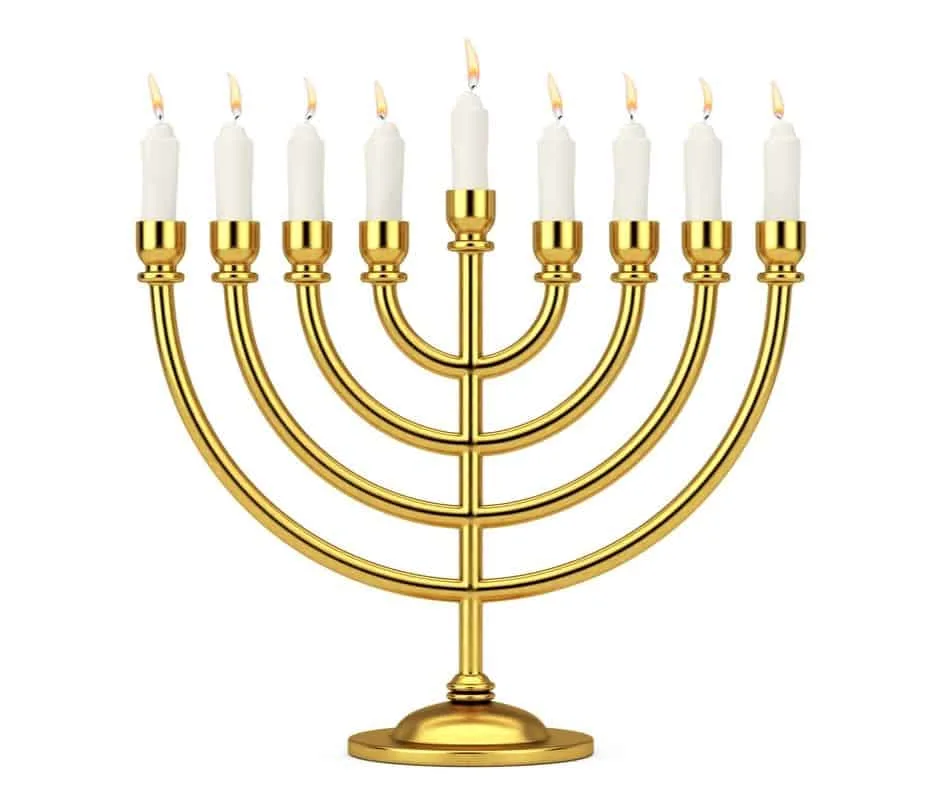
The most iconic symbol of Chanukah is the menorah, and each
household has one.
The menorah is traditionally placed in a window, spreading light into the darkness outside.
The world’s largest menorah is 32 feet high, gold-colored, and in the middle of Central Park in New York City!

Lighting the Menorah
In commemoration of the temple oil lasting eight days, we
light the menorah each night for eight nights. The shamash, center candle, is used to light the other candles.
Each night we light one more flame. (One the first night; two the second; etc)
During the candle lighting, special blessings are recited and songs are sung.
Gelt
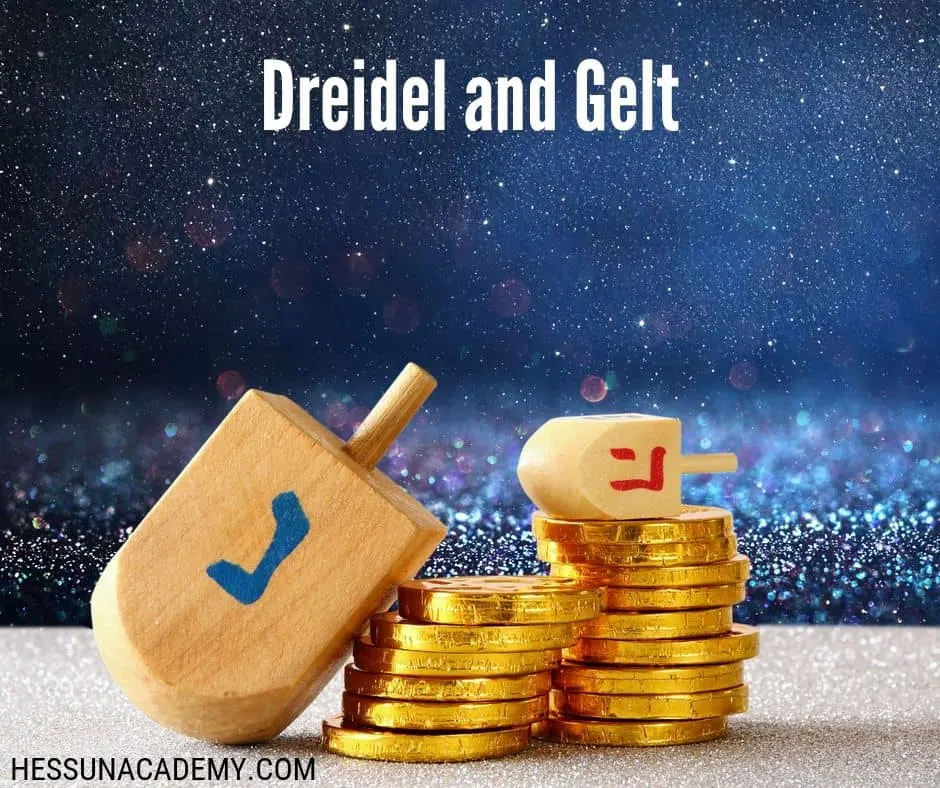
One favorite way to celebrate the holiday is with gelt – the small, gold-foiled, chocolate coins you’ll see in stores this time of year.
Gelt (the Yiddish word for money) was originally given to children to encourage tzedakah (charity, or giving). It has since evolved into a tasty ante for dreidel games.

The Dreidel
The dreidel is a four-sided top with letters nun, gimel, hay, and shin.
Collectively, the letters stand for ‘nes gadol hayah sham,’ meaning ‘a great miracle happened there.’
You spin the dreidel, and when you land on a letter, you have to complete the corresponding action.
Everyone wants to land on gimel because then you get all of the chocolate!
Fun Fact About Chanukah
Did you know that the story of Chanukah doesn’t appear in the Torah?
These historic events didn’t occur until after the Torah was written. However, in the New Testament, when Jesus attends the ‘Feast of Dedication,’ they are talking about Chanukah.
Pick up a FREE Chanukah unit study, with recommended readings, videos, vocabulary, history, cooking projects, and hands-on fun!
Related Posts:
What is the Secret to Raising Kids of Character?
A Surprising Homeschool History Curriculum Hack
What Is Lifeschooling?
Learning About Chanukah In Our Homeschool
- Free Printable Valentine Multiplication Worksheets - June 4, 2025
- Free Printable Martin Luther King, Jr. Word Scramble - June 4, 2025
- Digital Math Curriculum | Pros, Cons, and Options - June 4, 2025