


Easy Navigation
Learning With Games with Game-Based Learning Activities
In the eighteen years we spent homeschooling our four kids, we utilized several different modes of curriculum. Out of all of the variety of materials, there are a few tried and true methods that stuck with the children and really grew their knowledge in ways that were fun. One of those resources was learning by games, or game-based learning.
What child generally doesn’t like to play games? And what better way to encourage a child in their learning than by feeling like they are taking a break from “school” to play a game! What’s more, playing games is a great way to engae kids with different learning styles, especially kinesthetic learners.


Just take a walk down any department store aisle, and you will find educational board games, video games, and computer games galore. There are apps for almost anything you can use with a tablet or smartphone, and now children are interacting with these learning tools as early as they are old enough to hold a phone! My two-year-old grandchildren can swipe and click like nobody’s business! This makes it easy to use games as learning tools.
Many digital games and board games focus on academics, while others help children learn real-world skills including problem-solving skills, strategy, creativity, and how to think out of the box.
This article may contain affiliate links. Please see our disclosure policy for more details.

Free Printable Games
Did you know that in addition to the list of amazing games below, I’ve got a collection of free printable games?
If you like including games in your child’s studies, you need to grab this free printable collection of games.
This collection includes 11 printable games (50 pages) for your kid to enjoy, no matter where you are! Enjoy in the car, at the desk, or on the living room floor.
And the best part is these printable games are educational too!
Grab your collection of free printable games now!
Perfect for ages 3-13.


Learning Through Card Games
One of the things we used to do is take classic card games and incorporate them with something we were learning about.
For example, classic card games such as “Go Fish” can be substituted with matching cards that can relate to a topic of study. What an easy way to learn by games!

For the very young, you could use two identical images, such as letters, animals, or vehicles. As the children started early elementary, we would use matching images of famous people, such as George Washington, Betsy Ross, or Ben Franklin. You could even add some fun dress-up activities into the mix to make learning even more enjoyable!
As the kids grew into the older years, the matches would be two cards relating to each other, such as an artist with a work they had done or an author with a title or classic line or paragraph from their book. Other pairs could consist of inventors and their inventions or famous people with their accomplishments.
Another classic card game we would use was “Old Maid.” When we studied World War II, we would change out the cards to be pairs of military leaders, such as MacArthur, Patton, and Rommel, to name a few. We used Hitler as the “Old Fool.”
If you give the military leaders a number, you can actually play “War” with the pairs, as well! In fact, that would work with military or key people from any war. This could also include non-military figures, such as Abraham Lincoln, Clara Barton, Belle Boyd, or Frederick Douglass if learning about the Civil War era. In fact, there are a variety of games you can use in a learning environment, whether that is a home or your classroom. The only limit to your educational gameplay is your imagination.
Learning Through Educational Board Games
You can easily develop a game board with a simple file folder. By decorating with a pathway of your choice, you can create a great way to drill spelling, answer history or science questions, learn about artists, a country, presidents, an ancient civilization, or practically any topic you wish.


I have had the best success with the children retaining information when using question cards on a topic we had studied. And here’s a bonus! Have the children research the material they studied to make the question cards themselves. Not only will this give them the “leg up” they need to play the game (they will, of course, know the answers to their own questions), but it will force them to really study the materials and resources in order to extract facts for questions.
If you have several children, divide them into groups and send them off to collect questions. By having the children divide and conquer the materials they’ve been taught, you won’t even have to make the question cards at all! The more they can participate in, the better!
Another form of a board game is “Bingo.” You can do this with math facts or vocabulary words, or even words of another language. You can create cards to draw from with the words in English, but the child’s Bingo card will have the words in the language of choice. Games and learning activities such as this reinforce learning objectives and enhance the learning process, all while developing critical thinking skills. With this method, you can turn any game into an educational game.


Taking the Games and Learning Activities Outdoors
Getting children outdoors while still doing school is a win-win in my book. We’ve often turned common games into educational learning games by introducing lessons and learning tools.
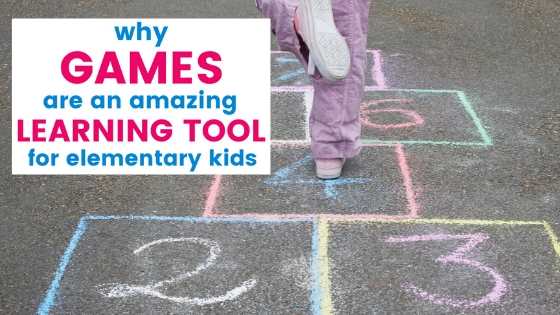
When learning about early American history, we drew a chalk map on the driveway of the thirteen colonies. We then proceeded to play “Hopscotch” on it. Needless to say, the children got very familiar with not only the colonies themselves, but their placement relative to each other.
We also would play what we called “Baseball Drill” with various topics. We set up a baseball diamond, and each child started at home base. I would ask a question, and if the child answered it correctly, he would advance to the first base. Taking turns, this would continue, and they would advance to the next base with each correct answer, but if they missed, they had to stay where they were. The winner was the child with the most runs.
Another type of “game” you can do outside is a scavenger hunt. In fact, a scavenger hunt is one of the best and most versatile learning games.
For younger ones, this might be finding items that begin with each letter of the alphabet, or a certain number of items. For older children, this is a great way to incorporate mapping skills.
You can bury a “cache” of items, such as a shoebox with baggies of snacks, stickers, or a small token “treasure” in it. Either draw a map for them to follow or provide clues ending at the final destination. You can have the kids dig for the cache or you can hide it under something, in a bush, or up in a tree branch.
Another idea is to incorporate a “bean bag toss” or something similar. This could be buttons or stones tossed into small cups or bowls. Have children answer questions correctly to earn their items to toss. The person with the most items tossed in the holes or cups wins.
As you can see, there are all kinds of ways to enjoy learning by games. Combine learning with playing and those are the lessons that seem to sink in the best. So, next time you hear groans because you have to drill those vocabulary words, math facts, or history dates one more time, try pulling out a game and see if they don’t change their tune!
Related Posts:
- Free Printable Valentine Multiplication Worksheets - June 4, 2025
- Free Printable Martin Luther King, Jr. Word Scramble - June 4, 2025
- Digital Math Curriculum | Pros, Cons, and Options - June 4, 2025